

251件中 21~30件目を表示中 (日付順)
テクニカルレポート
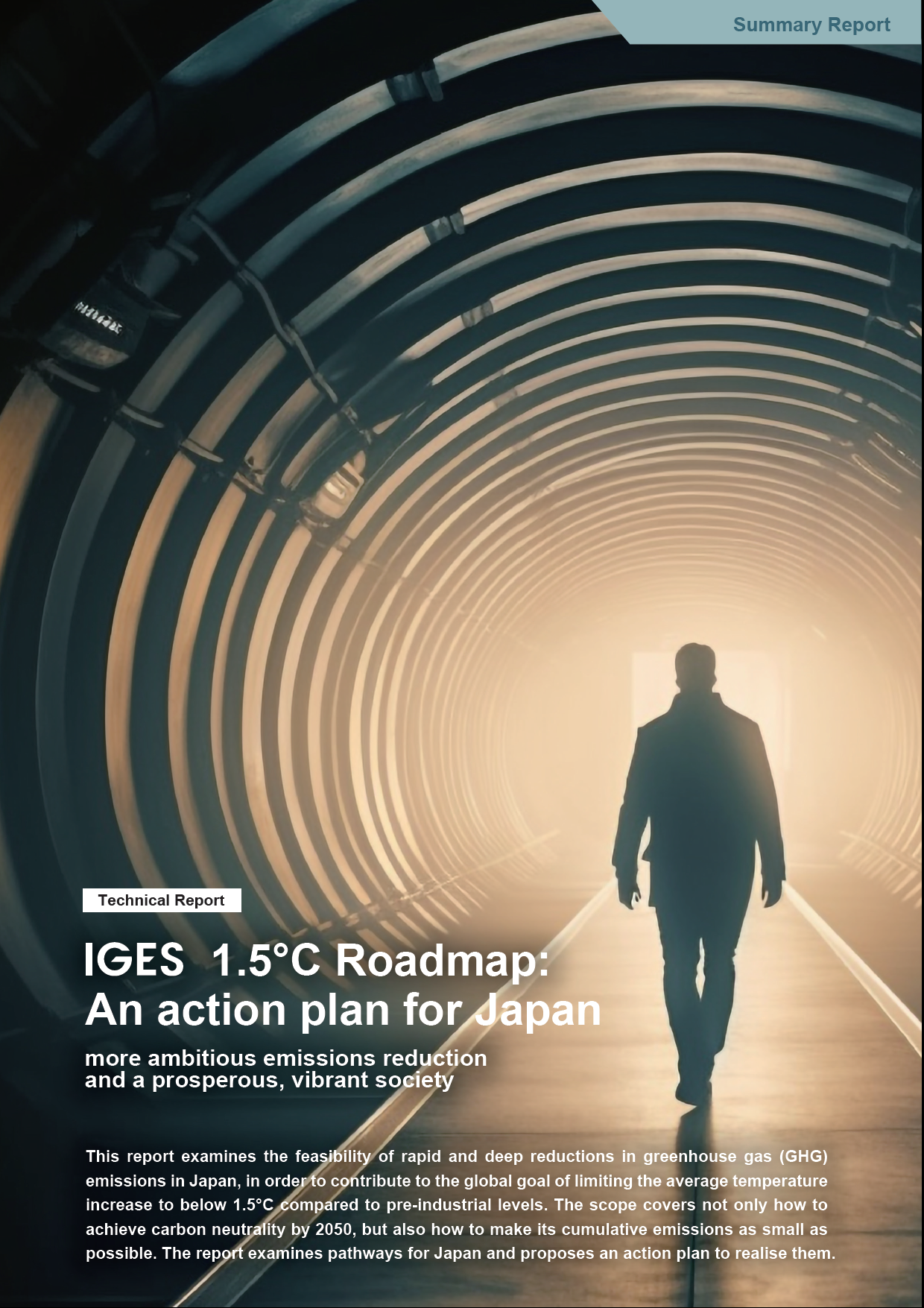
This report examines the feasibility of Japan not only achieving carbon neutrality by 2050, but also making significant reductions in greenhouse gas (GHG) emissions, so as to make its cumulative emissions as small as possible, thereby contributing to the global goal of limiting the average temperature increase to below 1.5°C compared to the pre...
テクニカルレポート

本レポートは、世界平均気温の上昇を産業革命前と比べて1.5℃以内に抑えるという目標の達成に向けて、2050年までにカーボンニュートラルを実現するだけではなく、累積排出量をできる限り小さくする観点から、日本国内で早期に大幅な温室効果ガス(GHG)排出量削減を果たす可能性を検討し、その実現のためのアクションプランをまとめたものである。 2024年4月2日更新 謝辞の追記、出典の追記、誤記の修正を行いました。 企業の方向けに使いやすく再構成した「 1.5℃ロードマップ - 脱炭素でチャンスをつかむ。未来をつくる。」もご活用ください。
査読付論文
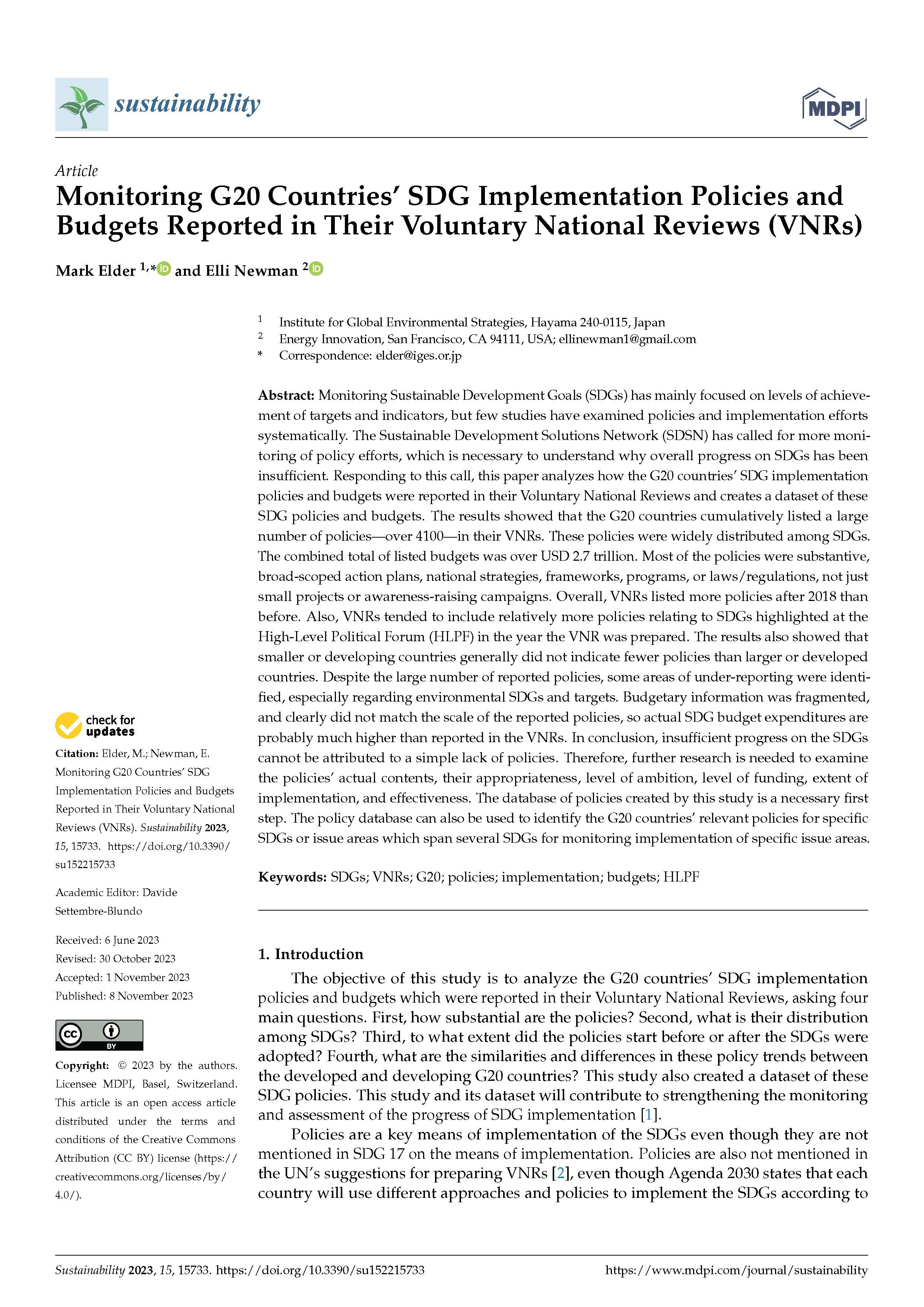
Sustainability所収
Monitoring Sustainable Development Goals (SDGs) has mainly focused on levels of achievement of targets and indicators, but few studies have examined policies and implementation efforts systematically. The Sustainable Development Solutions Network (SDSN) has called for more monitoring of policy efforts, which is necessary to understand why overall...
レポートチャプター
Sixth ASEAN State of the Environment Report所収
• By 2050, more than half the population of most ASEAN Member States (AMS) will live in cities, and by 2035 the ASEAN region will have at least five mega-cities. • Cities are a laboratory of local and global challenges and solutions, and ASEAN cities are frequently frontrunners in developing sustainable (model) cities, with multiple good practices...
レポートチャプター
Sixth ASEAN State of the Environment Report所収
▪ Remarkable progress has been made to improve access to safe and clean drinking water over the last 20 years; however, water degradation caused by poor sanitation and hygiene services, low water-use efficiency for agriculture, and lack of appropriate domestic wastewater treatment systems are still common challenges observed in many ASEAN Member...
ポリシーレポート
The ASEAN State of the Environment Report (SOER) is a regular flagship publication of the ASEAN Senior Officials on Environment (ASOEN) which is periodically published every 3-5 years. The SOERs present a comprehensive review of the state and trends of the environment, the pressures on it and the drivers of those pressures, and the national and...
レポートチャプター
Sixth ASEAN State of the Environment Report所収
• Except for land-linked Lao PDR, the remaining ASEAN Member States (AMS) are bordered by seas. Those seas, however, are under increasing direct and indirect pressure from human interference, including the preference for many forms of development in the region’s coastal zones and islands. • Aquaculture is rapidly replacing overexploited capture...
レポートチャプター
Sixth ASEAN State of the Environment Report所収
• The ASEAN region is one of the most biodiverse in the world on land, in freshwater and in the ocean. • Drivers that underlie pressures on biodiversity in AMS include economic incentives that promote consumption and, hence, land-use change. These drivers are challenges to achieving SDGs 14 and 15 on conserving marine and terrestrial biodiversity...
レポートチャプター
Sixth ASEAN State of the Environment Report所収
• As ASEAN increasingly transitions away from its agrarian traditions and becomes a core part of the global supply chain, improved environmental management of chemicals and waste is imperative. • Manufacturing is now a major contributor to AMS' gross domestic product (GDP) and exports but too many outdated factories in some developing ASEAN...
レポートチャプター
Sixth ASEAN State of the Environment Report所収
• Climate change is already causing serious negative impacts in the region. In the future, extreme weather and sea level rise will cause mounting economic costs in terms of damage to health, infrastructure, and food security. • ASEAN Member States (AMS) have a variety of policies and responses to climate change adaptation and disaster risk...
お探しのプロジェクトは見つかりませんでした。