This policy brief identifies approaches that could help achieve better synergies in implementing three major global frameworks dedicated to sustainable development (SD), disaster risk reduction (DRR) and climate change adaptation (CCA) on the ground via programmatic integration, collaboration, capacity, and innovation. The salient messages from...
10777件中 9541~9550件 (日付順)
ISAP2016
Raising Ambition towards the 1.5˚C/2˚C Goal: Ratcheting-up Mechanism under the Paris Agreement
ISAP2016 Discussion Paper - Sub-plenary Session 3
This is the paper for ISAP2016 sub-plenary session.
In ISAP2016 Discussion Paper - Parallel Session 1
This material was prepared for the International Forum for Sustainable Asia and the Pacific (ISAP) 2016 as an executive summary of the IGES Discussion Paper DP1601: Koakutsu, K., Amellina, A., Rocamora, A.R. & Umemiya, C. (2016): Operationalizing the Paris Agreement Article 6 through the Joint Crediting Mechanism (JCM) - Key Issues for Linking...
The focus of disaster risk reduction has changed from response-based approaches to pre-disaster preparedness, mitigation and risk reduction approaches over the course of the last 25 years. However, the progress of this transition in focus has been slowed by a narrow perspective on risk reduction, which is yet to be fully mainstreamed into climate...
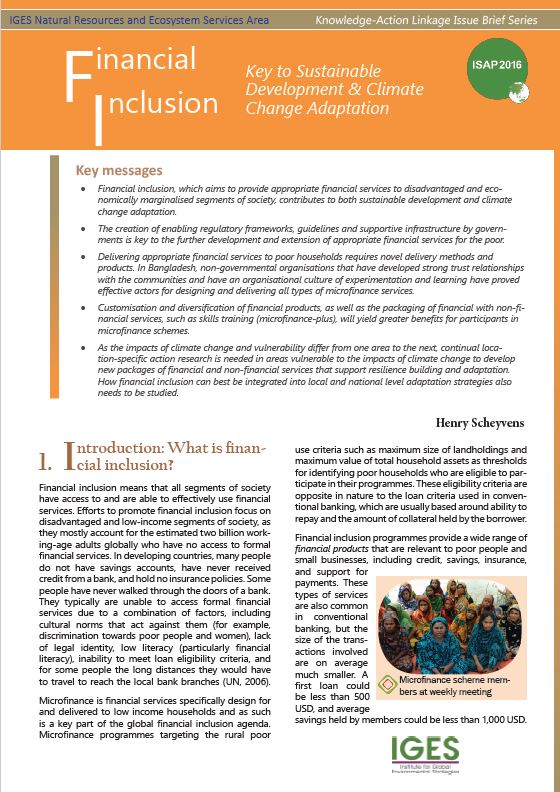
Financial inclusion, which aims to provide appropriate financial services to disadvantaged and economically marginalised segments of society, contributes to both sustainable development and climate change adaptation. The creation of enabling regulatory frameworks, guidelines and supportive infrastructure by governments is key to the further...
ISAP2016
Sustainable Consumption and Production: An overview of key sectors and stakeholder initiatives in Asia
This policy brief analyzes the position of air pollution in the SDGs, and makes recommendations for how air pollution could be better integrated into SDG implementation. The SDGs, with 17 goals, 169 targets, and even more indicators, were criticized by some for having too many goals and lacking a clear sense of priorities. However, this policy...
2016年2月、日本の温室効果ガス排出量の約4割を占める電力部門における排出削減の取り組みが明らかになりました。本ペーパーでは、これまでに至る経緯を概観した後、自主的枠組みと制度的仕組みを紹介し、電力部門の低炭素化に向けた中長期的な観点からの課題及び石炭火力・ガス火力発電新設に伴う様々なリスクについてまとめています。 Remarks: 7月15日改訂 ○石炭火力及びガス火力発電に対するポリシーミックスの在り方として、政府が講じる政策措置は電気事業低炭素社会協議会を中心とする自主的取り組みを促すものであることを明記致しました。 ○火力発電所の設備容量に関するデータの更新、発電所の年式別熱効率のデータを追加致しました。 ○2030年、2050年時点で想定されるCO2排出量及び各時点の原単位目標...
Starting Strong on the SDGs in Asia: A Framing Paper on National Readiness
Remarks: [Related Link] Readiness in South Korea: http://pub.iges.or.jp/modules/envirolib/view.php?docid=6682 Readiness in India: http://pub.iges.or.jp/modules/envirolib/view.php?docid=6683 Readiness in Bhutan: http://pub.iges.or.jp/modules/envirolib/view.php?docid=6684 Readiness in the Philippines: http://pub.iges.or.jp/modules/envirolib/view.php...