120件中 1~10件 (日付順)
ブリーフィングノート
著者:
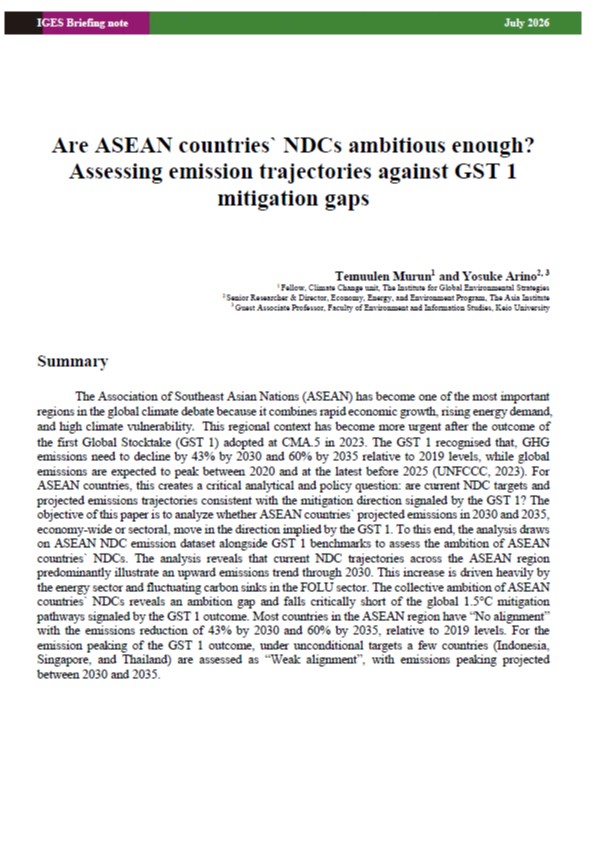
The Association of Southeast Asian Nations (ASEAN) has become one of the most important regions in the global climate debate because it combines rapid economic growth, rising energy demand, and high climate vulnerability. This regional context has become more urgent after the outcome of the first Global Stocktake (GST 1) adopted at CMA.5 in 2023...
プレゼンテーション
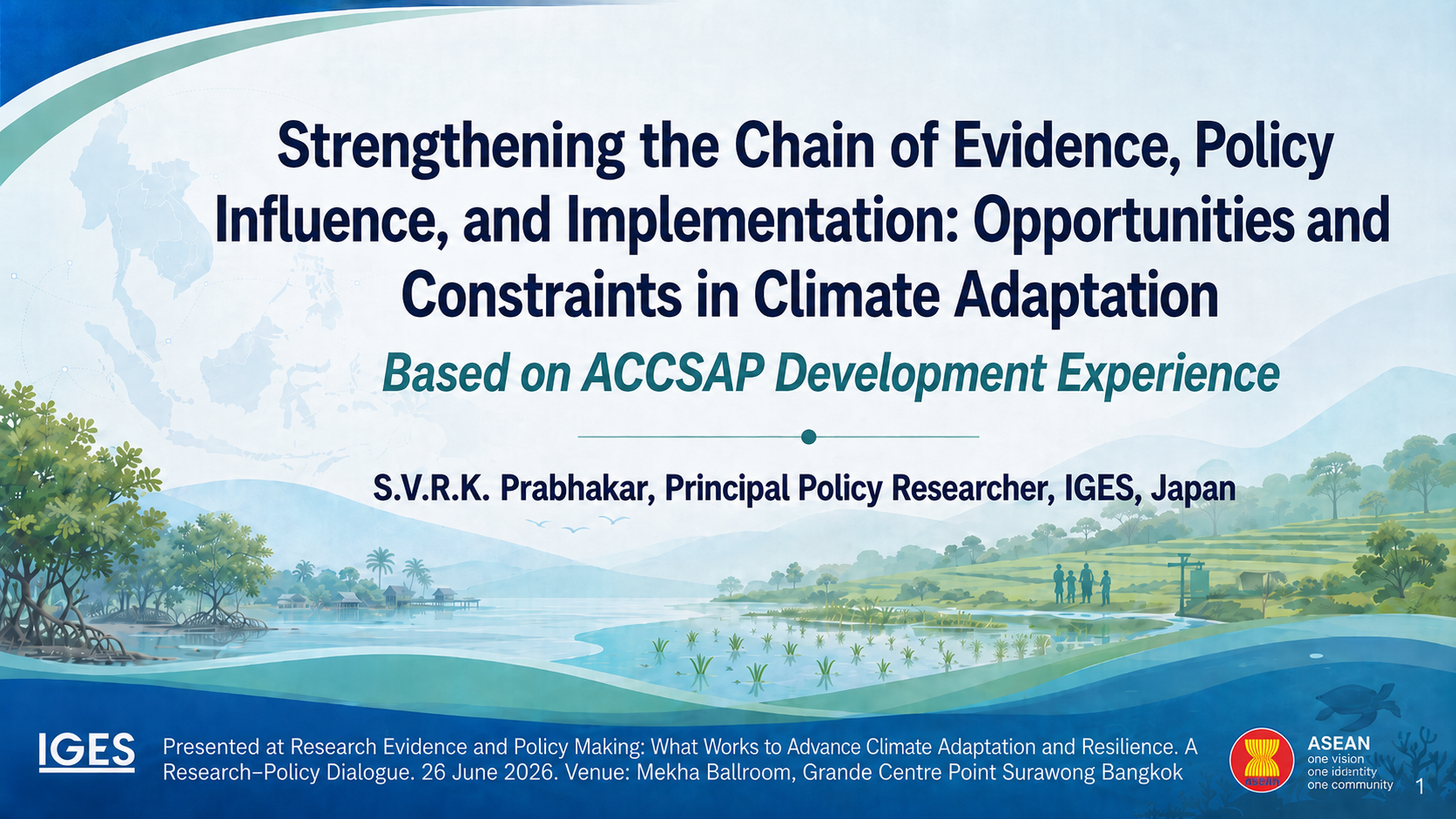
esearch Evidence and Policy Making: What Works to Advance Climate Adaptation and Resilience. A Research–Policy Dialogue
This presentation reflected on the experience of developing the ASEAN Climate Change Strategic Action Plan 2026–2030 (ACCSAP) to examine how evidence can move beyond assessment and analysis to influence policy and support implementation. The ACCSAP experience showed that evidence becomes policy-relevant not simply through technical quality, but...
ディスカッションペーパー
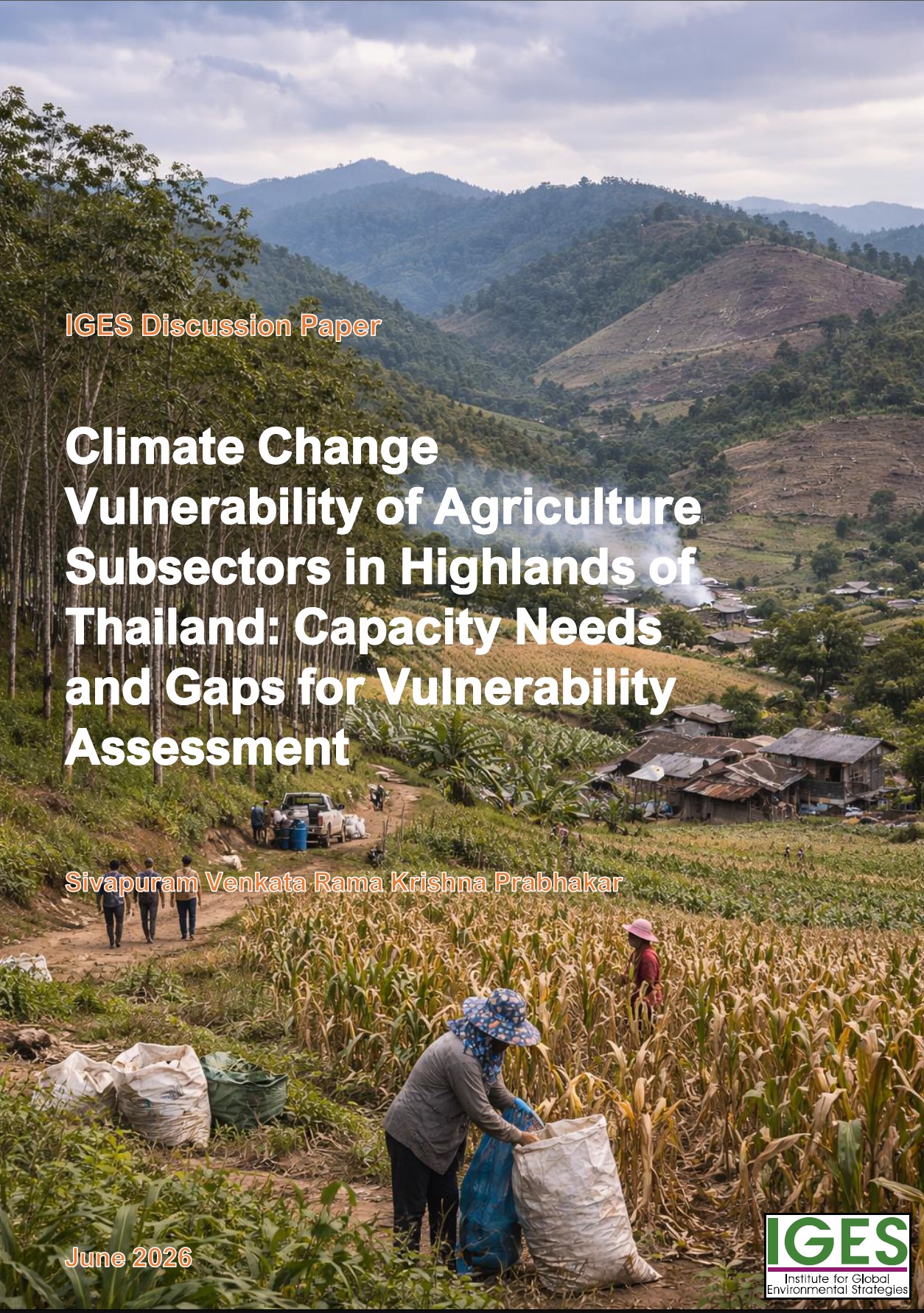
Highland regions in Thailand are increasingly vulnerable to climate change due to rapid land-use transitions, environmental degradation, and shifting socio-economic conditions. This Discussion Papaer examines the drivers and dimensions of vulnerability in the Thai highlands, with particular attention to the expansion of maize cultivation and...
プレゼンテーション
JICA Training Program on "Climate Change Measures for Paris Agreement Implementation"
Agriculture lies at the centre of the climate change challenge, simultaneously functioning as a highly climate-vulnerable sector and a significant contributor to greenhouse gas emissions through land use, crop production, livestock, and food systems. This presentation examines the climate change–agriculture nexus through a comparative analysis of...
データ/ツール
IGES's ASEAN NDC Database compiles the key elements of the Nationally Determined Contributions (NDCs), which are submitted by the ASEAN member states to the United Nations Framework Convention on Climate Change (UNFCCC). ASEAN member states are Brunei Darussalam, Cambodia, Indonesia, Lao DPR, Malaysia, Myanmar, Philippines, Singapore, Thailand and...
ブリーフィングノート
As of September 2025, only 54 NDCs with the target year of 2035 have been submitted to the United Nations Framework Convention on Climate Change (UNFCCC), showing the slow progress of climate commitments from both developed and developing countries. This means that the 30 th Conference of the Parties to the UNFCCC (COP30), to be held in November...
レポートチャプター
Climate-Smart Agriculture in Highlands – Insights from Asia所収
Highland communities are facing numerous challenges that heighten their susceptibility to climate change, particularly because of rapid alterations in land use and land cover, which in turn affect local ecosystems. In the absence of non-governmental organizations and other non-state entities, local governments assume a crucial role in enhancing...
リサーチレポート
著者:
Sangam Shrestha
Mohana Sundaram Shanmugam, Mukand Singh Babel, Suwas Ghimire, Pragya Pradhan
The knowledge product “Vulnerability of Highland Agriculture: Current and Future Climate Change Scenarios – Insights from Nan Province, Thailand” assesses how climate change is affecting smallholder highland farming systems in northern Thailand, with a detailed case study from Bua Yai subdistrict in Nan Province. Using climate projections, crop...
研修用教材
著者:
Sangam Shrestha, Mohana Sundaram Shanmugam, Mukand Babel, Suwas Ghimire, Pragya Pradhan
Climate Change Vulnerability Assessment in Highlands – A Guidance Manual (Knowledge Product 3 under ADB TA-9993 THA) provides a practical, step-by-step framework for designing and implementing climate change vulnerability assessments (VA) tailored specifically to highland contexts. Grounded in field testing in Thailand’s highlands, the manual...
ワーキングペーパー
著者:
While food security is conventionally defined by four pillars—availability, access, utilisation, and stability—this apolitical framing overlooks underlying economic and political processes shaping food insecurity and constraining the agency of food producers. In doing so, it also overlooks the structural threats to human security. Considering the...