- English


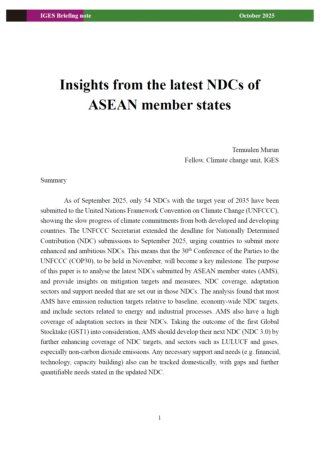
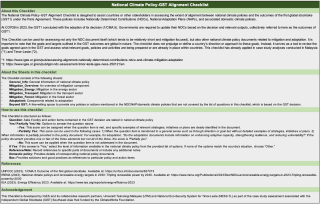
The Association of Southeast Asian Nations (ASEAN) has become one of the most important regions in the global climate debate because it combines rapid economic growth, rising energy demand, and high climate vulnerability. This regional context has become more urgent after the outcome of the first Global Stocktake (GST 1) adopted at CMA.5 in 2023. The GST 1 recognised that, GHG emissions need to decline by 43% by 2030 and 60% by 2035 relative to 2019 levels, while global emissions are expected to peak between 2020 and at the latest before 2025 (UNFCCC, 2023). For ASEAN countries, this creates a critical analytical and policy question: are current NDC targets and projected emissions trajectories consistent with the mitigation direction signaled by the GST 1? The objective of this paper is to analyze whether ASEAN countries` projected emissions in 2030 and 2035, economy-wide or sectoral, move in the direction implied by the GST 1. To this end, the analysis draws on ASEAN NDC emission dataset alongside GST 1 benchmarks to assess the ambition of ASEAN countries` NDCs.
- English