- English
Date: 9th February 2026
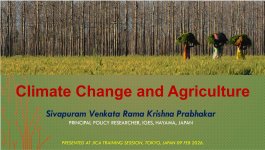


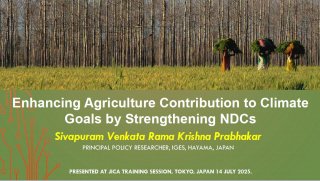
Agriculture lies at the centre of the climate change challenge, simultaneously functioning as a highly climate-vulnerable sector and a significant contributor to greenhouse gas emissions through land use, crop production, livestock, and food systems. This presentation examines the climate change–agriculture nexus through a comparative analysis of six participating countries, i.e. Angola, Egypt, Ghana, Jamaica, Malaysia, and Zimbabwe, representing diverse agro-ecological, socio-economic, and institutional contexts. The analysis aims to support mid-career policymakers in understanding how structural characteristics of agriculture shape vulnerability, adaptive capacity, mitigation potential, and policy choices.
The first part of the presentation assesses country-specific agricultural systems along a subsistence-to-commercial spectrum, highlighting differences in production systems, food import dependency, yield stability, water management, soil health, and institutional capacity. Most participating countries remain dominated by smallholder, rain-fed systems with low input use, resulting in high exposure to climate shocks but relatively low emissions intensity. Egypt and Malaysia emerge as exceptions, benefiting from stronger irrigation infrastructure, policy integration, and institutional capacity. Across countries, food security challenges are driven less by absolute production shortages and more by climate risk, market access constraints, and systemic capacity gaps.
The presentation further evaluates countries’ capacities for climate change adaptation and mitigation, identifying significant “latent adaptive capacity” rooted in farmer knowledge, land potential, and existing practices. However, this capacity remains underutilised due to limitations in finance, extension systems, climate data, research investment, and monitoring and reporting frameworks. Nationally Determined Contributions (NDCs) and National Adaptation Plans (NAPs) are reviewed to assess priority areas, vulnerable sub-sectors, and existing gaps. While agriculture is prominently featured in adaptation strategies, mitigation opportunities, particularly in soil carbon sequestration, input efficiency, and market-based instruments, remain underdeveloped in most countries.
The second part situates country experiences within the global climate and food systems context, introducing Climate-Smart Agriculture (CSA) as a systems approach that integrates productivity, adaptation, and mitigation objectives. The presentation reviews policy instruments such as subsidy reform, agricultural insurance, payment for ecosystem services, and certification and labelling as mechanisms to overcome perverse incentives, buffer climate shocks, rebuild ecosystem services, and influence consumer behaviour. A CSA maturity assessment demonstrates that scaling climate-smart outcomes depends less on individual technologies and more on policy coherence, institutional strength, finance, and data systems. The presentation concludes that accelerating climate action in agriculture requires moving from fragmented pilots toward coordinated, investment-backed, and measurable strategies aligned with NDCs, NAPs, and broader sustainable development goals.
- English
Date: 9th February 2026