

8930件中 3871~3880件 (日付順)
プレゼンテーション

ISAP2018, Yokohama
This document is a presentation given at one of the Thematic Tracks of ISAP2017. It introduced IGES-TERI efforts to promote environmentally sound technologies through a stakeholder’s matchmaking approach.
プレゼンテーション
The 5th Asian Energy Modelling Workshop on "Achieving a Sustainable 2050: Insights from energy system modelling"
This presentation introduced the Integrated Green Economy Modelling (IGEM) Framework and its application to modelling a carbon tax in Mexico. The presentation was based on the project of the development of an integrated green economy modelling framework led by the UN Environment, in collaboration with four modelling experts, namely Dr. Xin Zhou...
研修用教材
The video explain concrete example of how to use the Indicators of Resilience in the Socio-Ecological Production Landscapes and Seascapes. The video introduce the example from the forests near Ecuador’s coastline live the people of Agua Blanca.
コメンタリー

At the May 2017 session of UN Climate Change Conference (SB 46) and the Innovate4Climate, Parties and non-Party stakeholders explored Article 6 implementation, innovation, and the role of non-Party stakeholders. The inclusion of Article 6 to cater to market-based mechanisms in the celebrated Paris Agreement (PA) was a surprising turnout even for...
プレゼンテーション
The 9th biennial conference of the International Society for Industrial Ecology (ISIE) and the 25th annual conference of the International Symposium on Sustainable Systems and Technology (ISSST)
Policy intervention towards sustainable consumption is thus important in shifting the demand side/civil sector towards a sustainable socio-techno regime. i.e. altering provision systems and infrastructure. This is a shift from a technically oriented efficiency approach to a sufficiency approach. This shift in thinking is highlighted in the...
プレゼンテーション
The 9th biennial conference of the International Society for Industrial Ecology (ISIE) and the 25th annual conference of the International Symposium on Sustainable Systems and Technology (ISSST)
Sustainable Consumption and Production (SCP) has gained increasing importance to sustainability policy, featuring prominently in global policy frameworks, including the United Nations’ 10-year framework of programmes for SCP (10YFP) and as both Goal 12 and a cross-cuttting objective of the Sustainable Development Goals (SDGs). The question remains...
その他アーティクル
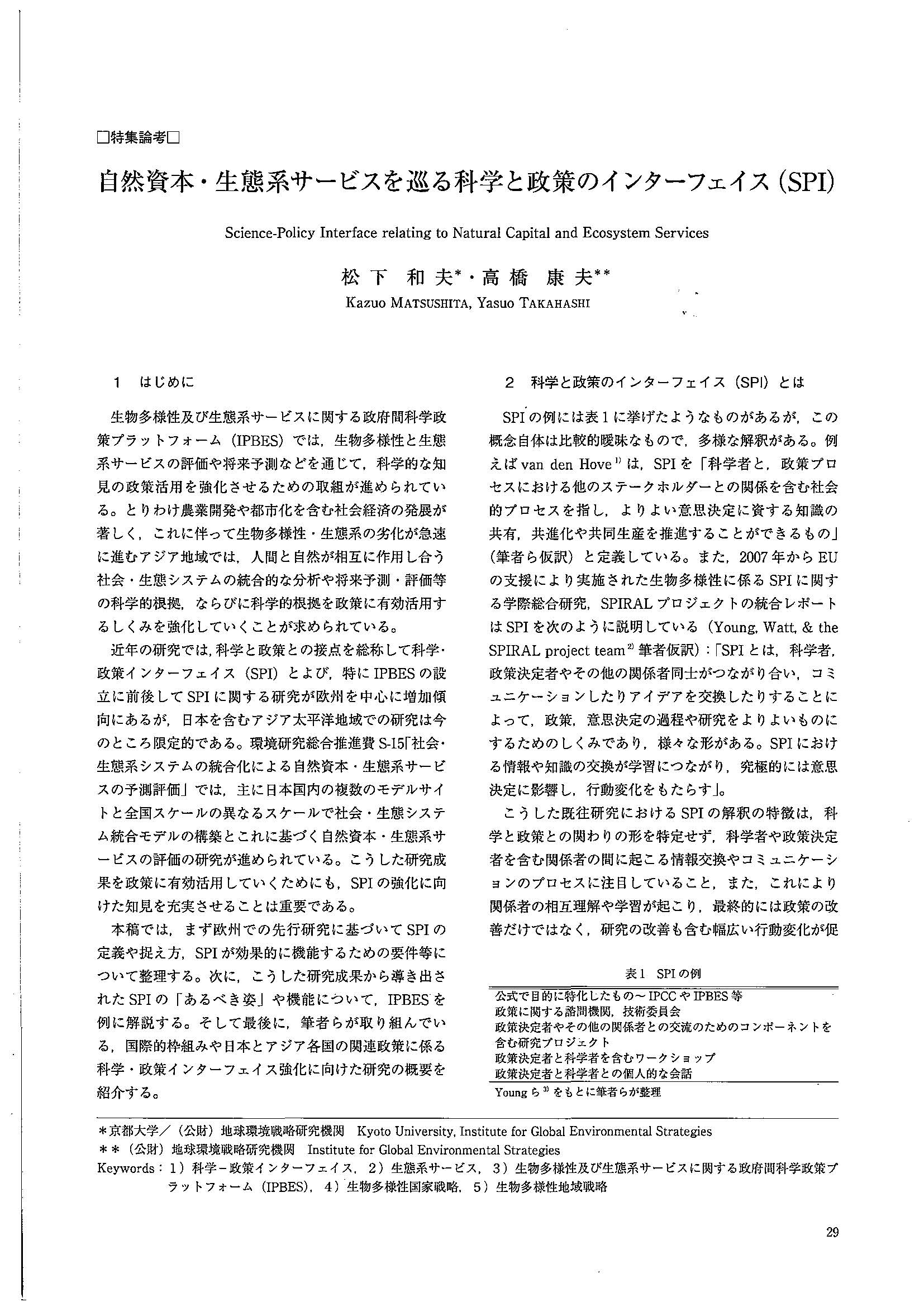
農村計画学会誌所収
生物多様性及び生態系サービスに関する政府間科学政策プラットフォーム(IPBES)では、生物多様性と生態系サービスの評価や将来予測などを通じて、科学的な知見の政策活用を強化するための取組が進められている。とりわけ農業開発や都市化を含む社会経済の発展が著しく、これに伴って生物多様性や生態系の劣化が急速に進むアジア地域では、人間と自然が相互に作用し合う社会・生態システムの統合的な分析や将来予測・評価などの科学的根拠、ならびに科学的根拠を政策に有効活用するしくみを強化していくことが求められている。近年の研究では、科学と政策との接点が科学・政策インターフェイス(SPI)と総称されているが、本稿ではまず、欧州での先行研究に基づいてSPIの定義や捉え方、SPIが効果的に機能するための要件等について整理する...
プレゼンテーション
ISIE/ISSST 2017 Joint Conference
We showed the difficulty to realise sustainable living in terms of reduction of ecological footprint of final demand (EF_FD). In Japan, a high rate carbon tax effectively reduces carbon footprint of production (50% reduction from the base year), but EF_FD reduces much less (24.7% reduction by upstream carbon tax and 27.0% by midstream carbon tax)...
ディスカッションペーパー
This discussion paper aims to identify critical factors to encourage the business and finance sectors to act on transitioning to investments for decarbonised and resilient society by recognising the climate risks and opportunities. Chapter 1 defines climate risks and opportunities for the business and finance sectors, referring mainly to...
プレゼンテーション
The 12th Policy Consultation Forum of Seoul Initiative Network on Green Growth
The presentation discussed importance of nexus approach for sustainable use of environmental resources. Taking the case of India, it presented how current sectoral approach approaches creates trade-off. It also suggested solutions to minimize trade-off and capture multiple benefits across the water energy and food nexus.