

164件中 101~110件目を表示中 (日付順)
コンファレンスペーパー

National Workshop on Business Models for Septage Collection and Treatment in the Urban Areas of Indonesia
This presentation explains about the process and results of developing commercially viable business models for septage management, including emptying, collection & transport, treatment/disposal and/or reuse, through a case study in Bandung and Denpasar city of Indonesia
ポリシーレポート
UNEP published the Air Pollution in Asia and the Pacific: Science-based Solutions, the first-ever comprehensive scientific assessment of air pollution outlook in the region. It outlines 25 clean air measures that could achieve safe air quality levels for 1 billion people by 2030 - with numerous benefits for public health, economic development and...
ブックチャプター
Environmental Degradation of the Tonle Sap Lake and Capacity Building to Recover Its Sustainability.
Environmental Sustainability in Asia Publication - Series on Cambodia所収
In this book chapter, the authors provide a comprehensive understanding on: (i) the current status of Tonle Sap Lake water environment, (ii) human-induced and global environmental change impacts on the livelihoods of local communities on and around TSL, and (iii) the expected contribution of the SATREPS project to address these challenges through...
プロシーディングス
17th World Lake Conference
The Tonle Sap Lake (TSL) is among the most productive freshwater ecosystems, and one of the most fish-abundant lakes in the world. It is connected with the Mekong River by the Tonle Sap River. The TSL absorbs a huge volume of water, which helps to reduce flooding in the Mekong River floodplains during the peak flooding season, then releases water...
研修用教材
This training material has been designed for water engineering students and water practitioners in Da Nang city under the 10YFP Project on "A new approach to reducing greenhouse gas (GHG) emission through changing lifestyle toward water and electricity saving in urban households in Danang, Vietnam" funded by UNEP. The presentation addressed some...
ポリシーレポート
UNEP published the Air Pollution in Asia and the Pacific: Science-based Solutions, the first-ever comprehensive scientific assessment of air pollution outlook in the region. It outlines 25 clean air measures that could achieve safe air quality levels for 1 billion people by 2030 - with numerous benefits for public health, economic development and...
コンファレンスペーパー
The 6th Workshop on Decentralized Domestic Wastewater Treatment in Asia
This presentation gives an overview on septage management situation in Asia, including its challenges and opportunities
プロシーディングス
The 11th Regional Conference on Environmental Engineering 2018 and the 3rd International Symposium on Conservation and Management of Tropical Lakes “Enhancing Sustainability and Resilience under Anthropogenic Pressure and Climate Change
The Tonle Sap Lake (TSL) is among the most productive freshwater ecosystems, and one of the most fish- abundant lakes in the world. It is connected with the Mekong River by Tonle Sap River. The TSL absorbs a huge volume of water, which helps to reduce flooding in the Mekong River floodplains during the peak flooding season, then releases water into...
イシューブリーフ
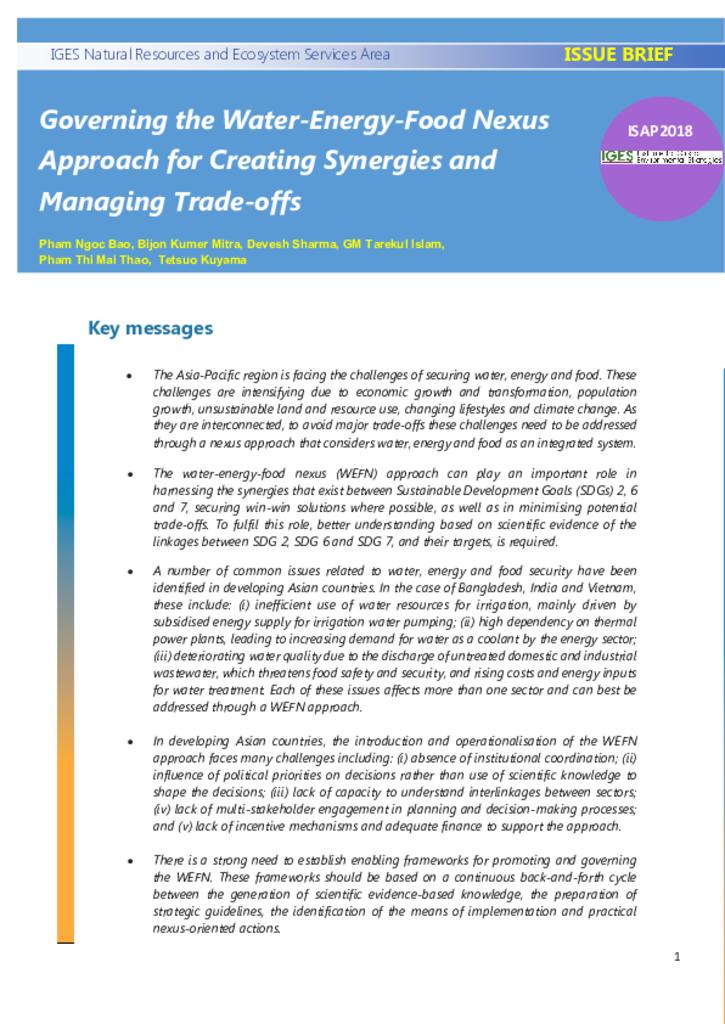
The Asia-Pacific region is facing the challenges of securing water, energy and food. These challenges are intensifying due to economic growth and transformation, population growth, unsustainable land and resource use, changing lifestyles and climate change. As they are interconnected, to avoid major trade-offs these challenges need to be addressed...
ブック
Many policymakers are responding to the Sustainable Development Goals (SDGs) by integrating multiple economic, social and environmental concerns into their development plans. Much of the recent research on SDGs has sought to help policymakers with this cross-sectoral integration by developing evidence-based models and analytical frameworks that can...
お探しのプロジェクトは見つかりませんでした。