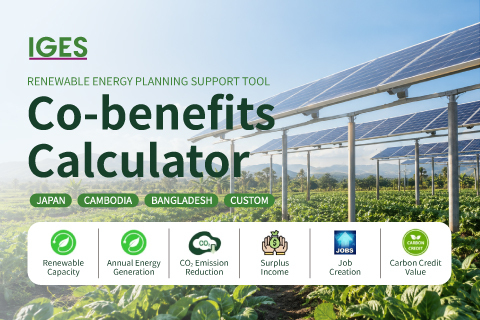
This tool supports renewable energy planning by estimating the environmental, economic, and social co-benefits of agrivoltaics deployment. The calculator can be applied across different cities, regions, and countries using customizable assumptions and conversion factors, enabling users to assess potential project impacts, including electricity...
- クリア
- プロジェクト: (-) Co-benefits Calculator
- プロジェクト: (-) The Satoyama Development Mechanism (SDM)
- プロジェクト: (-) 持続可能な開発に関するアジア太平洋フォーラム(APFSD)特集
11件中 1~10件 (日付順)
Land Degradation and Development所収
Place attachment and ecocentric attitude are the important determinants of conservation behaviour, especially for traditionally managed landscapes. In this paper, we explore the relationship between place attachment and the ecocentric attitude of farmers engaged in Jhum cultivation ( aka shifting /slash and burn cultivation) in the Zunheboto...
On Thursday 2 December 2021, United Nations University Institute for the Advanced Study of Sustainability (UNU-IAS) and Institute for Global Environmental Strategies (IGES) convened a session entitled “Landscape Approaches for Biodiversity, Climate Change and Sustainable Development Co-benefits” at the 13th International Forum for Sustainable Asia...
Implementing the Satoyama Initiative for the benefit of biodiversity and human well-being所収
Primary production, including agriculture, aquaculture, forestry and fisheries is the strongest driver of biodiversity loss globally. It can, however, contribute to biodiversity conservation if wisely managed such as in ‘Satoyama’ and ‘Satoumi’, or socio-ecological production landscapes and seascapes (SEPLS), where production activities support...
On Thursday 12 November 2020, United Nations University Institute for the Advanced Study of Sustainability (UNU-IAS) and Institute for Global Environmental Strategies (IGES) convened a session entitled “The Satoyama Initiative, transformative change, and societies in harmony with nature” at the 12th International Forum for Sustainable Asia and the...
High Level Political Forum on Sustainable Development 2020 Side Event "Satoyama Initiative – Societies in Harmony with Nature: An inclusive approach for communities, landscapes and seascapes"
This presentation is about the critical role of socio-ecological production landscapes and seascapes (SEPLS) for the achievement of Sustainable Development Goals (SDGs) and the Post-2020 Global Biodiversity Framework. It overviews the Satoyama Initiative, including the Satoyama Development Mechanism, and discusses resilience in the face of COVID-19...
This report demonstrates that changes in consumption patterns and dominant lifestyles are a critical and integral part of the solutions package to addressing climate change. The report fills a gap in the existing research by establishing global targets for lifestyle carbon footprints, examining current consumption patterns and their impacts on...
Global Policy所収
This article argues that the environment was extensively incorporated into the Sustainable Development Goals (SDGs), with broad and ambitious targets, reflecting environmental concerns throughout the SDGs. Many environment‐related targets – including some of the most important ones – were placed under ‘non‐environmental’ goals. The SDGs also...
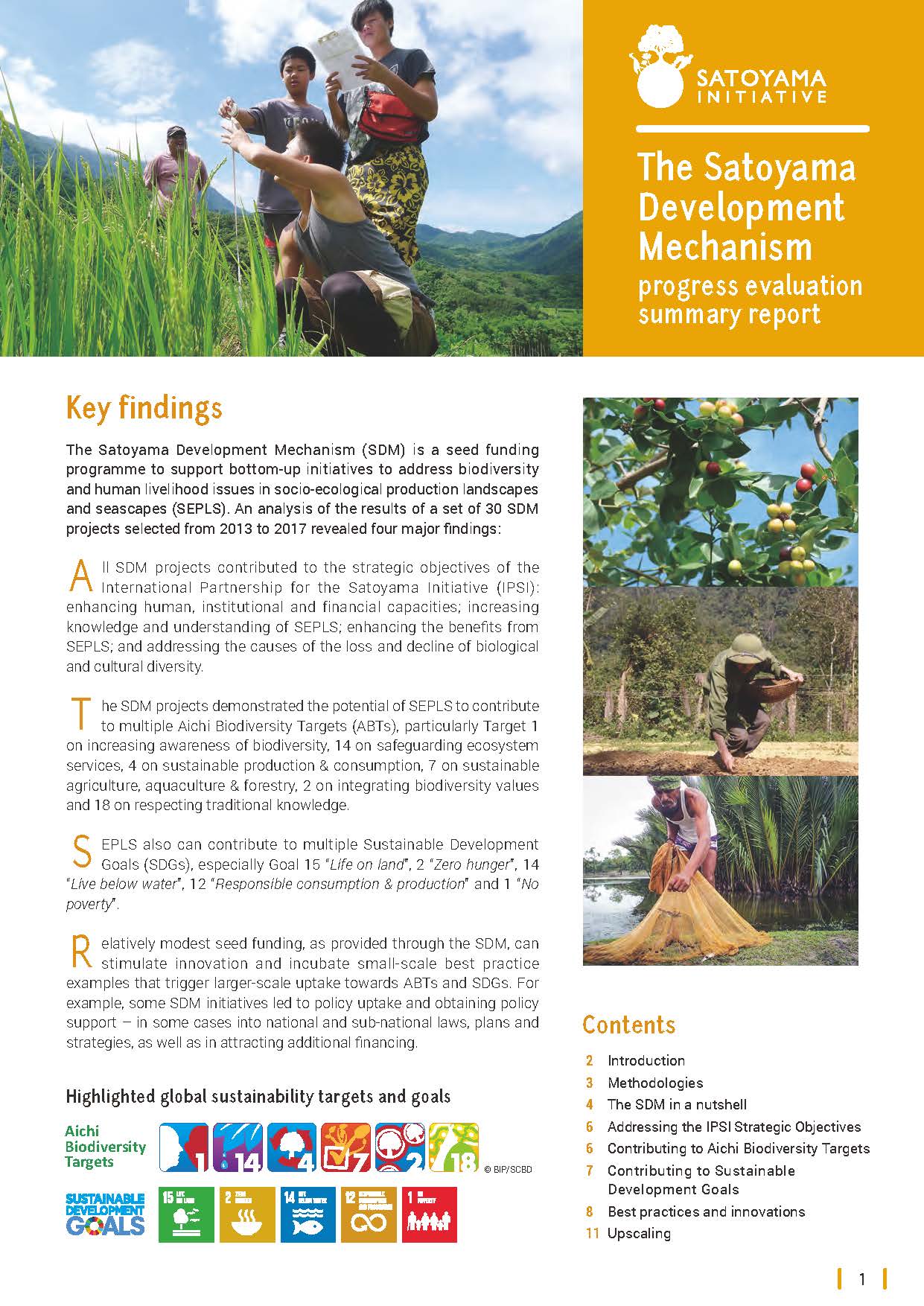
The Satoyama Development Mechanism (SDM) is a seed funding mechanism to encourage IPSI members to develop and accelerate sustainability actions in SEPLS. This report aims to present the SDM projects and their contributions to global goals, for the consideration of policymakers, businesses, researcher institutions, organizations and civil society...
This booklet provides an overview of the SDM, including its objectives and funding scheme, and summarises the overview of the projects newly selected in 2014.