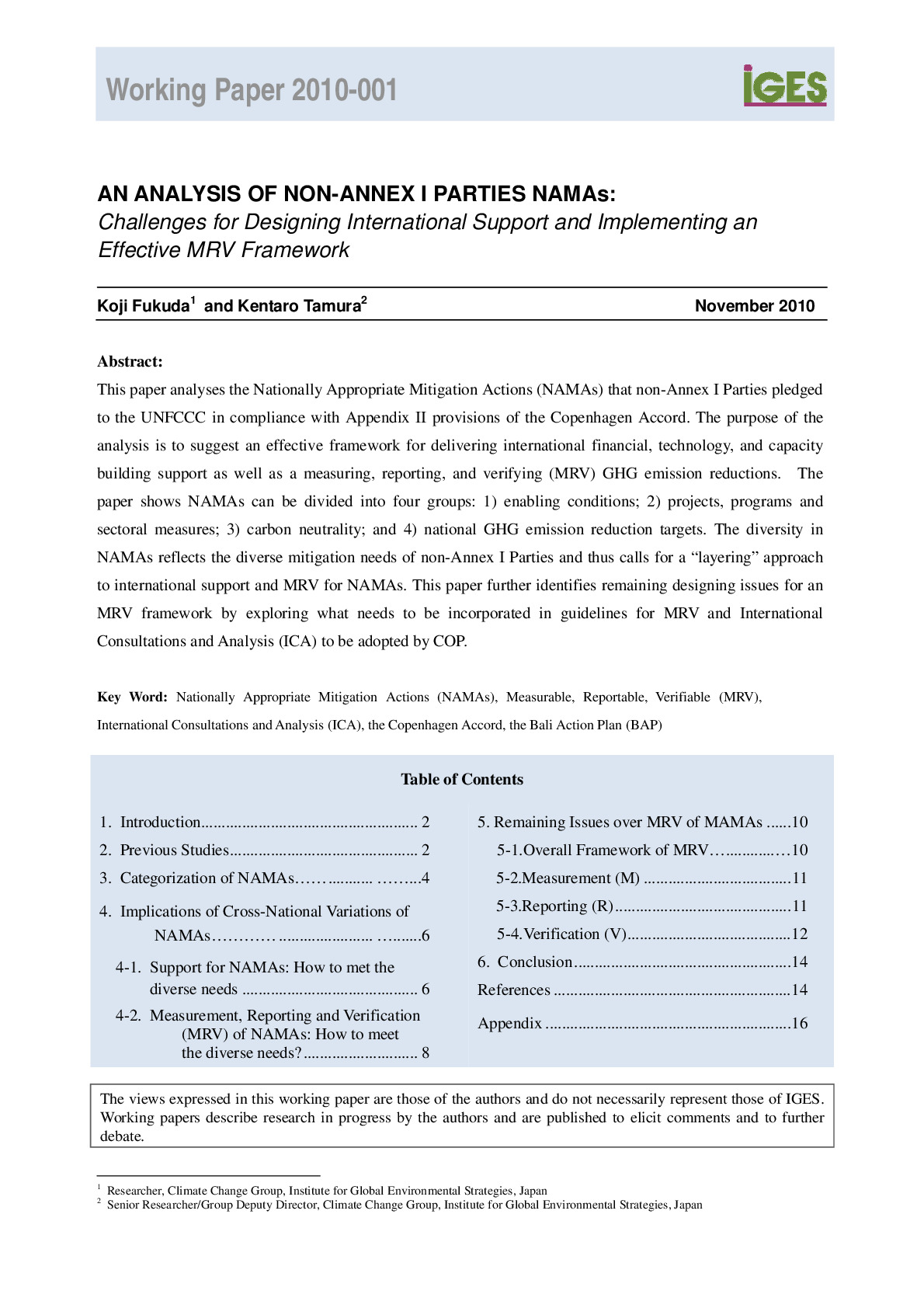
This paper analyses the Nationally Appropriate Mitigation Actions (NAMAs) that non-Annex I Parties pledged to the UNFCCC in compliance with Appendix II provisions of the Copenhagen Accord. The purpose of the analysis is to suggest an effective framework for delivering international financial, technology, and capacity building support as well as a...
10777件中 5361~5370件 (日付順)
On 22 September 2009, Chinese President Hu Jintao spoke at the UN Climate Change Summit that “(China is) to significantly reduce CO2 emissions per GDP (CO2 intensity) from 2005 level by 2020”. Around the same time, a government-related think tank in China published scenario analysis report that provided actual numbers to support such CO2 intensity...
As the largest developing country with about one sixth of global population and as a leading economy in South Asia, India has a key role in addressing the climate change issues. The country’s growing fossil fuel consumption and increasing carbon emission are key factors that necessitate considerable efforts towards climate change mitigation. The...
This paper analyzes the content and incentives for low carbon reforms in China’s 11th and 12th Five Year Plans. The analysis finds that China adopted a progressive slate of command-control reforms in the 11th Five Year Plan and strengthened their implementation with performance-based compliance incentives. In the 12th Five Year Plan China appears...
International Sociological Association - XVII World Congress of Sociology
IGES began research on environmental education in 1998, and in 2005 refocused on Education for Sustainable Development (ESD) in conjunction with the launching of the UN Decade of ESD. In the current year specifically, a critical need was identified to investigate how ESD moves beyond the formal education sector and into the informal sector to help...
With the aim of improving environmental management in the Asia region, several Japanese municipal governments have engaged in international co-operation with local governments in developing countries in the region. This kind of co-operation is not usually considered within the mandate of local governments, and it has occurred despite increasing...
一般市民を対象とした社会調査を横浜市と北九州市で行い,都市間環境協力の認知,支持の程度,及び協力において重視する点を尋ねた。協力事業をよく知っている市民ほど自治体の環境国際協力に支持的である。
About 30,000 tons of waste is generated daily in the Philippines, and this amount is likely to increase by 40% in the next decade if no interventions are provided (Aguinaldo, 2009). Varying approaches to manage waste include efforts to perform cleaner production, eco-efficiency or green productivity, and even sustainable consumption and production...
Waste management is the key stage that links anthroposphere and ecosphere. An ill-designed waste management system may lead to pollution and resource misuse. Furthermore, waste management involves LULU (Locally Unwanted Land Use) facilities, such as landfills and incinerators, and thus becomes a highly controversial public issue. Nowadays, the...