IGES Joint Crediting Mechanism (JCM) Database provides detailed information on the JCM methodologies, projects, and JCM feasibility studies to be utilized for research and development of JCM project. The JCM is being implemented under bilateral cooperation between Japan and 29 partner countries: Mongolia, Bangladesh, Ethiopia, Kenya, Maldives, Viet...
- クリア
- 地域 / 国: (-) Kazakhstan
- 地域 / 国: (-) Netherlands
- 地域 / 国: (-) Palau
13件中 1~10件 (日付順)
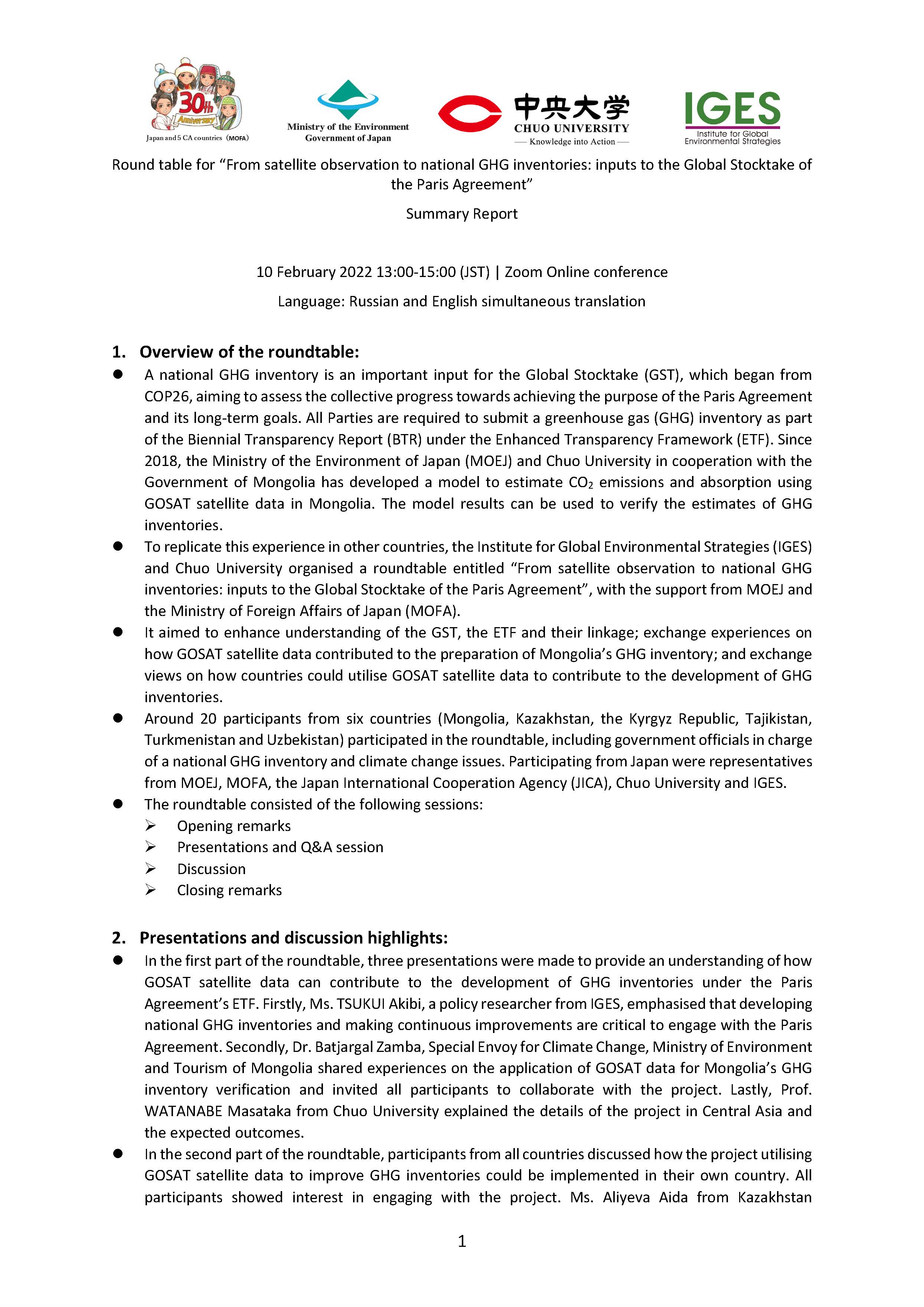
Round table for “From satellite observation to national GHG inventories: inputs to the Global Stocktake of the Paris Agreement”
A national GHG inventory is an important input for the Global Stocktake (GST), which began from COP26, aiming to assess the collective progress towards achieving the purpose of the Paris Agreement and its long-term goals. All Parties are required to submit a greenhouse gas (GHG) inventory as part of the Biennial Transparency Report (BTR) under the...
Round table for “From satellite observation to national GHG inventories: inputs to the Global Stocktake of the Paris Agreement”
This was presented at a roundtable entitled “From satellite observation to national GHG inventories: inputs to the Global Stocktake of the Paris Agreement” on February 2022. A national GHG inventory is an essential input for the Global Stocktake (GST), which began from COP26, aiming to assess the collective progress towards achieving the purpose of...
Ministry of Environment of Japan - Commissioned Report
This draft report documents progress made on the “Low Carbon Technology Transfer Preparedness Database Project”, supported by the Ministry of Environment Japan in FY 2014. The report’s key focus lies on documenting subnational data gaps, sources and access issues whilst also describing contributions made to international processes on data and...
The Sustainable Cities Database is a new information resource to help sustainable development actors identify potential partner cities for low-carbon technology transfer projects. Spatial and Demographic Indicators: Spatial and demographic characteristics are described using a range of indicators, including population size and density, natural...
Biodiversity offset policy indication in Japan based on the experiences in Japan, the US, Australia and Europe
アジア太平洋地域の発展途上国で進んでいる森林減少の最大の要因は、違法かつ持続可能でない伐採である。違法伐採によって木材輸入国が安価な木材を大量に輸入できる一方で、輸出国の自然環境、森林の管理・経営(ガバナンス)、そして森林に依存して暮らしている人々の生活が犠牲になっている。木材輸入国においても発展途上国の適正な森林管理を促進する義務があることを認識して、現在多くの政府が合法で持続可能な木材の調達を支援する公共調達政策を導入している。これは、持続可能な開発を進める上で国際貿易を活用する極めて重要な一歩である。 本ポリシー・ブリーフは、日本、英国、オランダ及びフランスで実施されている木材公共調達政策を比較し、各国の手法の共通点と相違点を検証しながら...
This policy brief includes a comparative analysis between Japan's public timber procurement policy and those of several European countries. In addition to identifying a set of elements that public timber procurement policies must include to favour legal and sustainable timber, it provides recommendations for further strengthening Japan's policy on...
This report presents the results of IGES research on public timber procurement policy to date. It includes a comparative analysis between Japan’s policy and those of several European countries. In addition to providing recommendations for further strengthening Japan’s policy, the report identifies a generic set of elements that public timber...