- English
Volume (Issue): 367 (2026) 121747


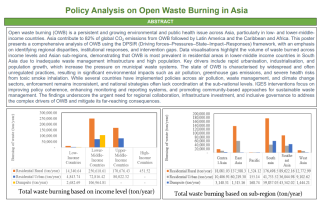
The open burning of municipal solid waste (MSW) remains a prevalent yet underreported source of greenhouse gas (GHG) and air pollutant emissions, particularly in developing and transition economies. This study updates the 2006 IPCC activity inventory methods and subsequent refinements to quantify emissions from open waste burning (OWB) in Asian countries. The emissions from OWB were estimated using updated emission factors for particulate matter 10 μm (PM10), 2.5 μm (PM2.5), carbon monoxide (CO), nitrogen oxides (NOx), sulphur dioxide (SO2), and dioxins, estimating a total release of approximately 16.51 Megatons (Mt) of CO, 1.50 Mt of PM10, 1.42 Mt of PM2.5, 0.50 Mt of NOx, and 0.20 Mt of SO2 annually. The total annual climate impact is estimated at 249 Mt CO2-equivalents (CO2e), with South Asia accounting for over 39 % of these emissions owing to high population densities and limited formal waste services. These findings highlight the urgent need to explicitly incorporate open burning in national emission inventories and waste strategies while also strengthening institutional capacity, regulatory enforcement, and community-based interventions to reduce this overlooked source of pollution and climate impact.
- English
Volume (Issue): 367 (2026) 121747