- English
Volume (Issue): 17 (20)



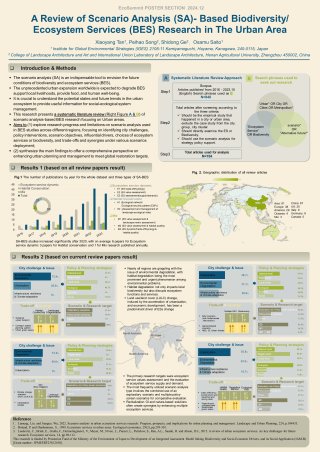
Over the last decade, L-band synthetic aperture radar (SAR) satellite data has become more widely available globally, providing new opportunities for biodiversity and ecosystem services (BES) monitoring. To better understand these opportunities, we conducted a systematic scoping review of articles that utilized L-band synthetic aperture radar (SAR) satellite data for BES monitoring. We found that the data have mainly been analyzed using image classification and regression methods, with classification methods attempting to understand how the extent, spatial distribution, and/or changes in different types of land use/land cover affect BES, and regression methods attempting to generate spatially explicit maps of important BES-related indicators like species richness or vegetation above-ground biomass. Random forest classification and regression algorithms, in particular, were used frequently and found to be promising in many recent studies. Deep learning algorithms, while also promising, have seen relatively little usage thus far. PALSAR-1/-2 annual mosaic data was by far the most frequently used dataset. Although free, this data is limited by its low temporal resolution. To help overcome this and other limitations of the existing L-band SAR datasets, 64% of studies combined them with other types of remote sensing data (most commonly, optical multispectral data). Study sites were mainly subnational in scale and located in countries with high species richness. Future research opportunities include investigating the benefits of new free, high temporal resolution L-band SAR datasets (e.g., PALSAR-2 ScanSAR data) and the potential of combining L-band SAR with new sources of SAR data (e.g., P-band SAR data from the “Biomass” satellite) and further exploring the potential of deep learning techniques.
- English
Volume (Issue): 17 (20)