- English


Using behavioral insights to increase reusable water bottle use
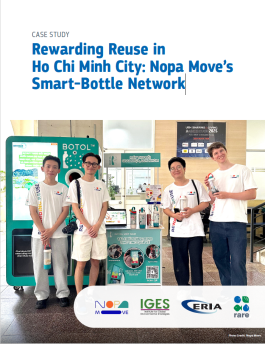
Nopa Move’s Smart Bottle Network, with support from the Economic Research Institute for ASEAN and East Asia (ERIA), Institute for Global Environmental Strategies (IGES), and Rare, addressed single-use plastic waste in Ho Chi Minh City’s commuter coffee culture, where disposables dominate due to convenience and fast-paced routines. The intervention centered on a reusable, NFC-enabled bottle connected to a network of partner cafés offering rewards, reframing reuse as convenient, rewarding, and socially desirable. By embedding reuse into daily routines like coffee runs, the system targeted habitual behavior at key “moments” of decision-making, achieving early traction with hundreds of bottles in circulation and thousands of engagement scans.
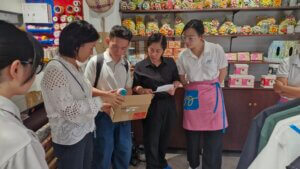
Photo Credit: Nopa Moves
The design was explicitly grounded in behavioral science, particularly insights around the intention-action gap, identity, and habit formation. Research revealed that although many consumers understand plastic pollution, behavior was constrained by convenience bias, hygiene perceptions, and friction. The solution therefore minimized effort through choice architecture (no-app NFC scanning), used material incentives (instant rewards and perks), and leveraged emotional and identity-based drivers (e.g., customizable bottles, limited editions). Importantly, it incorporated social influence and visibility. This turned bottle use into a status signal and created a sense of belonging, similar to social fitness platforms. The intended behavior was reinforced through observation and reputational effects.
The key behavioral insight was that incentives are most powerful when combined with identity and ease. Early iterations (e.g., deposit-return systems or standalone apps) failed due to friction, reinforcing that ease and integration into routines are critical for adoption. The current model succeeds by aligning rewards with habit windows (e.g., commuting patterns) and making reuse feel both effortless and socially meaningful. Overall, the case highlights that behavior change is driven not just by rewards, but by a combination of convenience, identity, and social norms, demonstrating how well-designed systems can shift everyday consumption habits at scale.
- English