- English
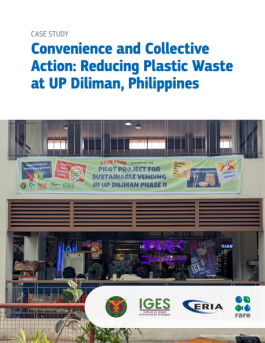


Using behavioral science to reduce plastic waste on the UP Diliman campus
The University of Philippines Diliman (UP Diliman) initiative, led by UP Diliman with support from the Economic Research Institute for ASEAN and East Asia (ERIA), Institute for Global Environmental Strategies (IGES), and Rare, tackled plastic waste generated by a dense campus food system where convenience-driven consumption and weak waste infrastructure reinforced reliance on single-use plastics. The intervention targeted multiple actors, including vendors, customers, and staff, and recognized that behavior is shaped by an interconnected system rather than individual choice alone. By combining infrastructure improvements (e.g., better waste bins and collection systems) with behavior-focused strategies, the project aimed to reduce plastic use, improve waste segregation, and promote reusable alternatives in a high-traffic environment.

The approach was deeply rooted in behavioral science, particularly in understanding how convenience, defaults, and environmental cues drive behavior. Insights showed that even when awareness was high, people defaulted to the easiest option, meaning sustainable choices must be equally or more convenient to succeed. The intervention applied choice architecture (e.g., “straw upon request” policies), visual nudges (clear bin labels and placement), material incentives (discounts and compostable alternatives), and social influence (public commitments like “Strawless Monday”). These elements reflected key behavioral principles: reducing friction, shifting defaults, and making desired behaviors visible and socially reinforced.
Results demonstrated that behavioral design can significantly shift outcomes when paired with enabling systems. Vendor adoption of non-plastic alternatives rose to ~93%, waste segregation improved substantially, and plastic straw use dropped by nearly 64%. However, the project also highlights a core behavioral insight: incentives alone are insufficient, and sustained change depends on aligning infrastructure, norms, and habits. The case underscores that behavior change is most effective when convenience, social norms, and system design work together, not in isolation.
- English