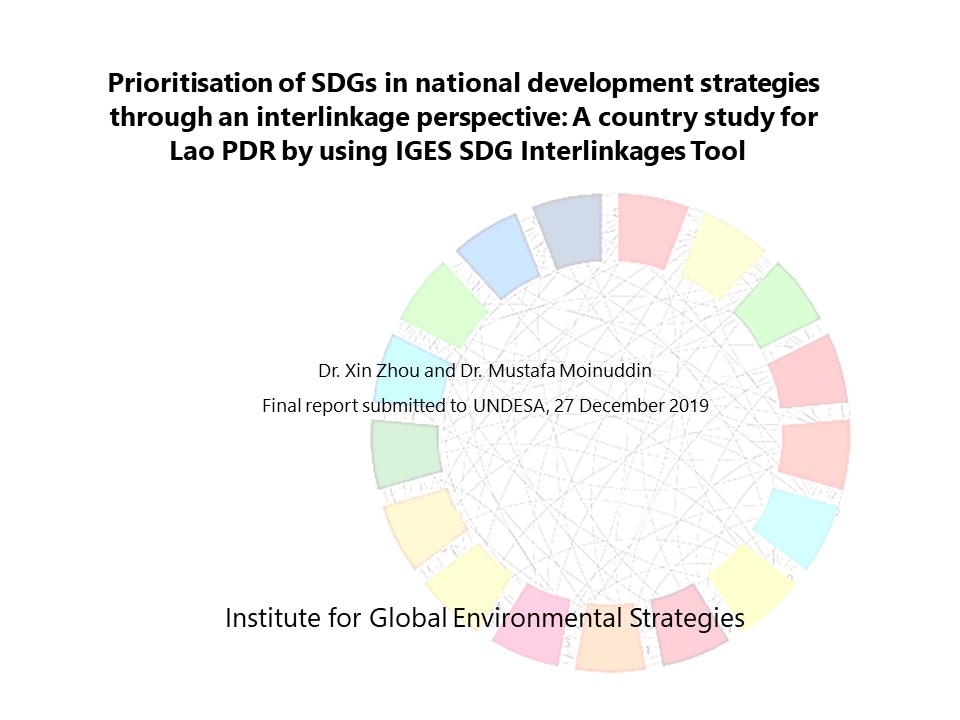
Building on the country’s momentum in economic growth and poverty reduction over the last couple of decades and aspiring to graduate from the least developed country (LDC) status, Lao PDR has developed a well-balanced policy framework for embracing the 2030 Agenda and the Sustainable Development Goals (SDGs). Being a least developed country with...
- クリア
- 発行年: (-) 2019
- 地域 / 国: (-) Oceania
- 地域 / 国: (-) South-Eastern Asia
63件中 1~10件 (日付順)
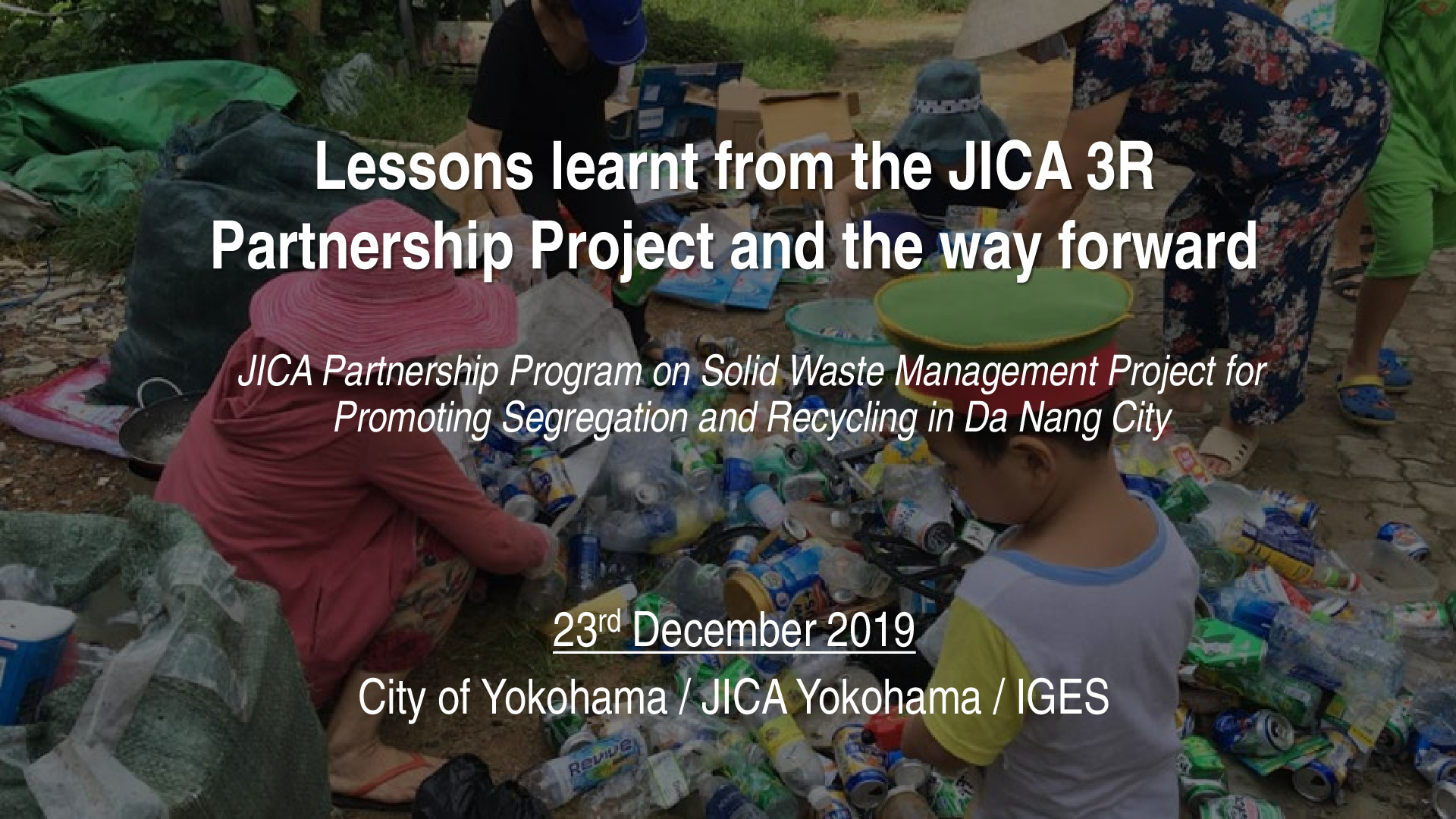
Closing Event of JICA Partnership Programe on Solid Waste Management Project for Promoting Segregation and Recycling in Da Nang CityClosing Event of JICA Partnership Programe on Solid Waste Management Project for Promoting Segregation and Recycling in Da
Lessons learnt from the JICA 3R Partnership Project was presneted. Also, the possible ideas for the next phase of the project was presented.
This work was presented as one of the keynote presentations at Da Nang city's development forum in December 2019. The author has develop an analysis of sustainable transformation scenario analysis applying SSPs framework for Da Nang city. Also Yokohama city's and Japanese experiences of sustainable development strategies were presented. The key...
Expert group meeting on establishing the ASEAN Resources Panel
As a follow-up to the 30th Meeting of ASEAN Senior Officials on the Environment last July, UNSCAP and ASEAN organized Expert Group Meeting on establishing the ASEAN Resources Panel on 18-19 December, at the United Nations Conference Centre in Bangkok. The recommendation to establish this panel has been featured in the report “Complementarities...
Just like in any city, the waste management has always been a major societal issue for Phnom Penh. The monthly amount of disposed waste at the landfill more than doubled in the past decade owing to factors such as population growth, economic growth, changes in industrial structure and of people’s lifestyle. While Phnom Penh Capital Administration...
Anthropogenic Tropical Forests所収
Rapid development in Bintulu has resulted in large-scale changes in land use, especially the conversion of forests into oil palm plantations and industrial tree plantations. Using high-resolution satellite imagery, we analysed land-cover types in the Kemena–Tubau–Lower Jelalong region of Sebauh subdistrict and classified them into nine major land...
Anthropogenic Tropical Forests: Human–Nature Interfaces on the Plantation Frontier所収
This chapter discusses the historical formation and current features of society in the Kemena and Tatau river basins in Bintulu, central Sarawak, where various ethnic groups live close together in a small area as a result of the historical migration of each group. We refer to previous studies and to interviews we conducted, mainly in 2011...
Anthropogenic Tropical Forests: Human–Nature Interfaces on the Plantation Frontier所収
While Borneo is a global biodiversity hotspot, its species-rich natural rainforests have been degraded and deforested in the past few decades by unsustainable shifting agriculture, commercial logging and the rapid development of industrial tree and oil palm plantations. Populations of some wildlife species have decreased drastically due to...
Anthropogenic Tropical Forests: Human–Nature Interfaces on the Plantation Frontier所収
The island of Borneo is regarded as one of the most biologically rich regions in the world, containing some of the oldest remaining tropical rainforests. However, it also suffers high levels of deforestation and degradation to meet the demands for timber extraction and agricultural activities. In Sarawak, areas designated as permanent forests...
Anthropogenic Tropical Forests: Human–Nature Interfaces on the Plantation Frontier所収
With rapid deforestation and forest degradation ongoing in tropical regions, the maintenance of biodiversity and high biomass/carbon stocks can bring additional benefits to the sustainable management of natural forests along with sustainable timber production. However, the measures for improving the maintenance of biodiversity and high biomass are...