- English
Volume (Issue): Volume 4, Issue 3, September 2026, 100332


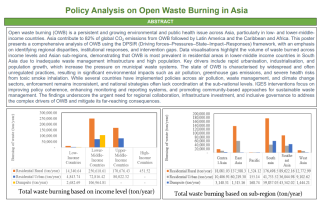
This study provides an indicative comparative assessment of the factors underlying these challenges by examining policy content, regulatory enforcement, and institutional capacity related to OWB across ten selected Asian countries: Cambodia, China, India, Iraq, Jordan, Laos, the Maldives, Nepal, Pakistan, and Thailand. The researchers employed a multi-method approach comprising policy content analysis, institutional capacity assessment (ICA), SWOT analysis, stakeholder interviews, and a review of relevant literature. The broader regional policy review indicates that fewer than 30% of Southeast Asian countries have specific regulations that comprehensively address OWB-related air pollution or e-waste management. The ICA results show that countries such as China and India demonstrate relatively stronger institutional capacity. However, this high overall capacity does not necessarily indicate uniform enforcement performance across all local contexts. Remaining challenges are therefore interpreted as uneven subnational implementation and localized enforcement gaps, rather than weak national enforcement capacity. Successful initiatives involving waste segregation, community composting, green financing, and public education provide replicable models. This study recommends an eight-pillar roadmap focused on legal reform, infrastructure investment, and capacity building. The study concludes that reducing OWB requires not only technical solutions but also strong institutional foundations aligned with the Sustainable Development Goals (SDGs) and Nationally Determined Contributions (NDCs). However, because this study is limited to ten selected Asian countries and relies partly on proxy indicators and stakeholder-based institutional assessment, the findings should be interpreted as an indicative governance assessment rather than a definitive representation of the entire Asia-Pacific region.
- English
Volume (Issue): Volume 4, Issue 3, September 2026, 100332