- English
Date: 25-30 August 2008


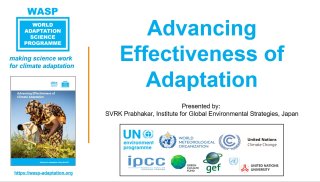
A wide range of options for adaptation to climate change is available in the agricultural sector. Prioritizing and monitoring such options for their effectiveness is vital for efficient utilization of financial, technological and human resources, and for addressing the issue of accountability in climate actions. However, the literature on measures to prioritize and monitor agricultural adaptations and on ways to assess the extent of integration of climate change adaptation into agricultural development and policy has been extremely limited. The objective of this presentation is to explore the concept of “adaptation metrics” and examine its utility in the agricultural sector at various scales ranging from a cropping system to the national level.
In April 2008, the Institute for Global Environmental Strategies (IGES) organized an international expert consultation on “adaptation metrics” in agriculture and water sectors. Adaptation metrics may be defined as the quantitative or semi-quantitative measures to monitor the effectiveness of adaptation actions. The experts concluded that adaptation metrics should be policy-relevant, transferable, context-specific, and comparable. They should capture the multi-dimensional nature of climate change impacts and the diversity in perceptions of stakeholders on their utility in decision making. Further should be applicable to diverse geographical and socioeconomic contexts and valid for a considerable period of time at both local and national levels. Some adaptation metrics in agriculture explored at the meeting included stability of crop yield above a threshold level with the threshold linked to the national food security needs, household income (with some of it contributed from non-farm sources), number of people below poverty line, % of malnourished population, and soil organic content. Developing a comprehensive set of metrics is challenging however. The metrics may be qualitative and quantitative indicators, direct and proxy and they may be suggested by external sources or chosen locally. Qualitative metrics are as important as quantitative measures, especially in data-poor regions and contexts. However, appropriate metrics may be identified by developing a framework that links adaptation actions and climate vulnerability in the agriculture sector. This presentation highlights some challenges and potential solutions in developing adaptation metrics in the agriculture sector.
Remarks:
Specific objectives of Symposium:
. To provide a central forum to develop an improved understanding and assessment of the climate change impacts on agriculture and the associated vulnerability in South Asia;
. To identify and discuss integrated mitigation and adaptation win-win options for the agricultural sector in different agroecosystems of South Asia;
. To discuss and propose a regional Agriculture Mitigation and Adaptation Framework for Climate Change in South Asia.
. To discuss and recommend policy and financial innovations to enable smooth implementation of the regional framework and it's integration into the sustainable development planning of South Asia countries; and
. To discuss appropriate options for strengthening information exchange on climate change impacts and cooperation on agriculture mitigation and adaptation actions among South Asia countries.
Outcomes:
. Senior experts in the field of climate change and agro-meteorology, sustainable agricultural development and national economic/financial planning agencies will be invited to prepare state-of-the-art discussion papers to address the above objectives. The programme for the symposium will be designed to engage all participants in discussions on these discussion papers and develop appropriate recommendations for all organizations involved in sustainable agricultural development in South Asia.
. The workshop should result in enhanced capacity to: identify/understand impacts, vulnerability and adaptation; select and implement adaptation actions; enhance cooperation among South Asian countries to better manage climate change risks; and enhance integration of climate change adaptation with sustainable agricultural development in South Asia.
. Proceedings of the Meeting will be published by WMO, FAO and ESCAP and will be widely distributed to promote the Climate Change Mitigation and Adaptation Framework for South Asian Agriculture.
Note: Presentation file of adaptation metrics and rapporteur report of Policy and Coordination session are available upon request.
- English
Date: 25-30 August 2008