- English
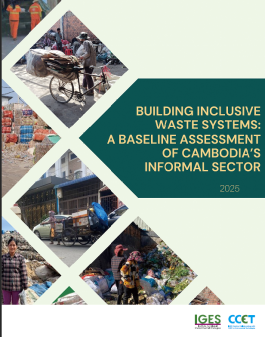


This report provides a baseline assessment of Cambodia’s informal waste sector, with a focus on Phnom Penh and Battambang. Informal waste workers, including street pickers, door-to-door collectors, pickers at landfills and junkshop operators, play a critical yet undervalued role in the country’s waste management system. They are responsible for a substantial amount of plastic and recyclable recovery, helping reduce environmental pollution and supporting low-income
livelihoods. Despite this contribution, they continue to operate under conditions of legal invisibility, financial precarity and social marginalisation.
Using a mixed-methods approach that combines field surveys, interviews, and secondary data analysis, this study explores the operational realities, socioeconomic vulnerabilities, and institutional barriers faced by informal waste workers. The findings show that most collectors work without protective gear, formal recognition or access to social services. Women are
overrepresented in low-paid, labour-intensive roles and underrepresented in leadership and decisionmaking. Although only 10% of respondents reported direct child involvement, education disruption remains a significant concern.
The collection capacity across Cambodia’s informal waste sector demonstrates significant disparity between individual collectors and junkshop operators. Survey results indicate that 49% of collectors collect less than 50 kg of recyclable materials per day, reflecting small-scale, labour-intensive operations. In contrast, high-volume junk shops, such as those operating in Phnom Penh, report handling up to 20,000 kg daily, underscoring the scale differences within the sector.
Transportation methods play a critical role in shaping productivity. Collectors using trucks and motorised carts achieve considerably higher collection volumes— up to five or six times more than those relying on sacks or manual means. This variation highlights the importance of mobility and equipment access in determining efficiency and earning potential. Plastic waste emerged as the most dominant material in the collection stream, with 100% of survey respondents reporting the recovery of plastic. Among specific plastic types, PET is the most targeted, collected by 88% of informal collectors and
78% of junkshop operators, driven by its widespread use and substantial resale value. The analysis highlights several structural challenges, including unsafe working conditions, exclusion from social protection systems, limited financial access,
and fragmented legal and institutional frameworks. Informal workers are not included in municipal waste planning, Extended Producer Responsibility (EPR) mechanisms, or national circular economy strategies. Many lack access to credit, secure workspaces, and supportive infrastructure. Data gaps further obscure their contributions and needs from policymaking
processes.
- English