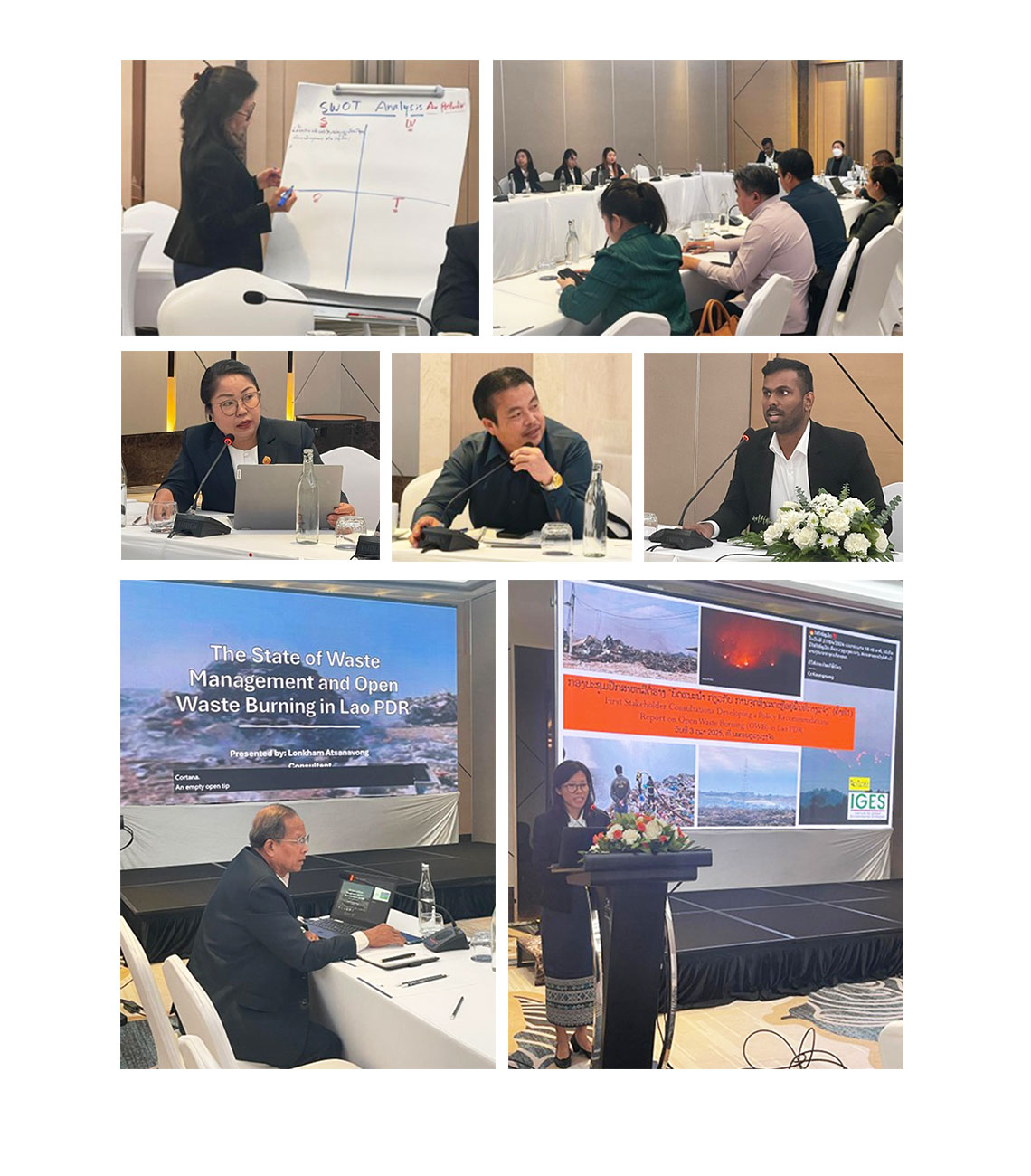
The national Stakeholder Consultation on Developing Policy Recommendations to end Open Waste Burning (OWB) in Lao PDR was held on October 3, 2025, at the DoubleTree by Hilton in Vientiane Capital. The event was co-organised by the Biotechnology and Ecology Institute (BEI) and the Institute for Global Environmental Strategies (IGES), in collaboration with Biotechnology and Ecology Institute (BEI) and the National University of Lao PDR.
The consultation marks an important milestone in addressing open waste burning in the Lao PDR, which remains a significant environmental, health, and development challenge. It served as a platform to validate the draft Policy Recommendations Report on OWB, strengthen intersectoral coordination, and build consensus on a national roadmap to eliminate open waste burning.
Background
Open waste burning (OWB) is a widespread practice in the Lao PDR, particularly in rural and peri-urban communities where waste collection services are limited. In Vientiane alone, approximately 700 tons of waste are generated daily, yet only 450–500 tons are formally collected, with the rest commonly dumped or burned. This practice contributes heavily to air pollution, greenhouse gas emissions, and health risks, especially for children, the elderly, and vulnerable populations. OWB also undermines efforts toward sustainable waste management, resource recovery, and circular economy goals.
The consultation builds on national commitments outlined in the Lao PDR’s Waste Management Strategy 2021–2030, its Sustainable Development Goals (SDGs), and obligations under the Paris Agreement. By bringing together stakeholders from across sectors, the consultation aimed to ensure the draft policy report reflects national priorities, technical realities, and viable implementation pathways.
Intent
The primary goal of the consultation was to solicit feedback and build consensus on the draft Policy Recommendations Report on OWB in Lao PDR. The meeting aimed to:
- • Present the draft report and invite comments from key national stakeholders.
- • Align proposed recommendations with existing policies and international commitments.
- • Discuss feasible actions and collaborative efforts to phase out OWB.
Summary
Opening Session The consultation began with welcome and opening remarks from the Associate Professor Dr. Somkith Boulidam, Dean of the Faculty of Social Science of NUL, followed by Mr. Lakshitha Paranagamage, Programme Coordinator, IGES, who outlined the objectives of the meeting.
Technical Presentations A keynote presentation titled “The State of Waste Management and Open Waste Burning in Lao PDR” was delivered by Lonkham Atsanavong, highlighting data on waste generation, OWB hotspots, and institutional gaps, followed by a detailed presentation on the draft Policy Recommendations Report on OWB, outlining key policy areas, proposed interventions, and implementation strategies. A Q&A session followed, allowing stakeholders to seek clarification, share feedback, and raise sector-specific concerns.
Brainstorming Session and Plenary Discussions
Participants discussed and developed SWOT analyses across five thematic areas:
1. Air Pollution
Discussions focused on the lack of real-time monitoring for OWB-related pollutants, the need for OWB-specific emission factors, and opportunities to integrate OWB data into the national Air Quality Index (AQI) and early warning systems.
2. Climate Change
Stakeholders discussed whether OWB reduction targets should be included in the Lao PDR’s updated Nationally Determined Contributions (NDCs) and explored opportunities to turn OWB mitigation into carbon offset projects.
3. Waste Management
Participants identified gaps in infrastructure and the need to scale low-cost, decentralised solutions such as composting, waste banks, and small-scale recycling. They also discussed integrating informal waste pickers and debated regulatory versus incentive-based approaches to ending OWB.
4. Health
Stakeholders highlighted urgent health concerns linked to OWB, especially among women and children, as they are mainly involved in burning at the household level and tend to stay longer at home to inhale pollutants from waste burning. Proposals included treating OWB as a public health emergency during peak seasons, integrating OWB messaging into health promotion campaigns, and conducting health impact assessments (HIAs).
5. Gender and Youth
Discussions highlighted the disproportionate impact of OWB on women and the untapped potential of youth-led campaigns. Ideas included school-based “No Burning” campaigns, innovation grants for youth champions, and integrating waste topics into education curricula.
Key cross-sectoral themes included:
- • The urgent need for data-driven decision-making.
- • Integration of OWB into broader haze management and disaster risk reduction frameworks.
- • Financing models such as public-private partnerships (PPPs) and climate finance.
- • Engaging religious and community leaders to shift social norms around waste burning.
Closing Session
The Vientiane City Government emphasise that the end of open waste burning is essential and needs immediate attention. Furthermore, the city government pledged to endorse the policy recommendations on open waste burning in its planning and strategies. The consultation concluded with a summary of key outcomes, followed by closing remarks from Bounmany Soulideth, Biotechnology and Ecology Institute, Ministry of Agriculture and Environment, who thanked all participants for their contributions and reaffirmed the government’s commitment to ending OWB.
イベントの詳細
DoubleTree by Hilton, Vientiane, Lao PDR
IGES Centre Collaborating with UNEP on Environmental Technologies
2108-11 Kamiyamaguchi, Hayama, Kanagawa, 240-0115 Japan
Phone: +81-46-855-3840
https://ccet.jp/
発表資料
| Time Schedule (ICT) | Description | Facilitator/Presenter | |
|---|---|---|---|
| 08:30 – 09:00 | Registration Opening Session | ||
| 09:00 – 09:20 | Opening Session | ||
| Welcome Remarks | Khamsene Ounekham, Director General of BEI, MAE | ||
| Opening Remarks | Lakshitha PARANAGAMAGE, Program Coordinator, IGES | ||
| Objectives of the Consultation Meeting | Bounmany Soulideth, BEI, MAE | ||
| 09:20 – 09:45 | Technical Session | ||
| Keynote Presentation | |||
| “The State of Waste Management and Open Waste Burning in Lao PDR” | Lonkham Atsanavong, Consultant | ||
| 09:45 – 10:10 | Presentation | ||
| “Draft Policy Recommendations Report on OWB” | Lonkham Atsanavong, Consultant | ||
| 10:10 – 10:20 | Q & A | Lonkham Atsanavong, Consultant | |
| 10:20 – 10:35 | Coffee / Networking Break | ||
| 10:35 – 11:15 | Brainstorming of policy gaps on OWB in Lao PDR | Lakshitha PARANAGAMAGE, Program Coordinator, IGES | |
| 11:15 – 12:30 | Group Discussions | ||
SWOT Analysis of Sectors
| Dr. Champathong Phochanthilath Lonkham Atsanavong Lakshitha Paranagamage | ||
| 12:30 – 13:30 | Lunch Break | ||
| 13:30 – 14:30 | Group Presentations | Dr. Champathong Phochanthilath | |
| 14:30 – 15:30 | Q & A and Way Forward | ||
| 15:30 – 15:45 | Closing Session | ||
| Summary of main outcomes | Bounmany Soulideth, BEI, MAE | ||
| 15:45 – 16:00 | Closing remarks | Khamsene Ounekham, Director General of BEI, MAE | |
Photo