- English


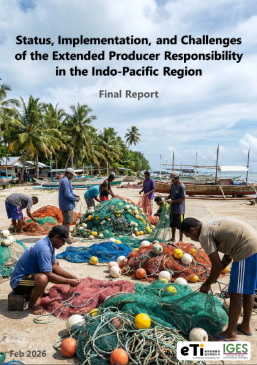
The global environmental governance landscape is undergoing a paradigmatic shift from state-centric pollution control to market-based Extended Producer Responsibility (EPR). This report provides an exhaustive analysis of the EPR landscape within the Indo-Pacific region, contrasting the mature, strict-liability frameworks of East Asia (Japan, South Korea, Taiwan) with the rapidly evolving, hybrid legislative transitions occurring in Southeast and South Asia. While significant progress has been made in codifying EPR for consumer packaging, the report identifies a critical policy gap regarding the management of Abandoned, Lost, or otherwise Discarded Fishing Gear (ALDFG). Despite ALDFG constituting a dominant fraction of marine debris by weight, it remains largely outside mandatory producer responsibility schemes due to unique structural hurdles, including involuntary loss, transboundary drift, and extreme material complexity.
Drawing upon a comparative analysis of global benchmarks—ranging from the European Union’s regulatory mandates and France’s eco-modulation schemes to Iceland’s market-based deposit systems—this study assesses the applicability of these models to the Indo-Pacific context. The analysis highlights specific regional challenges, such as the "copy-paste" policy trap, the necessity of integrating the informal waste sector, and the "low-hanging fruit" economic trap that neglects difficult-to-recycle materials.
To address the ALDFG crisis, the report proposes a tailored Hybrid EPR Framework. This "Dual-Track" model synthesizes an upstream Producer Responsibility Fund, utilizing eco-modulated fees to finance infrastructure, with a downstream Deposit-Refund System (DRS) designed to incentivize gear recovery among artisanal fisheries. The framework advocates for a Single-PRO governance structure and digital credit trading to ensure compliance. Concluding with a strategic way forward, the report positions Taiwan’s established technical leadership in advanced chemical recycling—specifically regarding nylon recovery—as a critical regional asset capable of bridging the infrastructure gap and enabling a robust circular economy for marine gear.
- English