- English
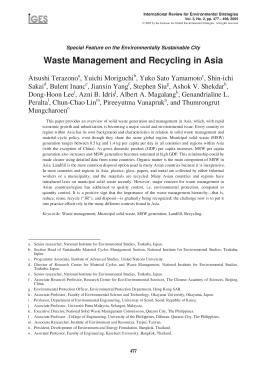


This paper provides an overview of solid waste generation and management in Asia, which, with rapid economic growth and urbanization, is becoming a major social and environmental issue. Every country or region within Asia has its own background and characteristics in relation to solid waste management and material-cycle policy, even though they share the same global region. Municipal solid waste (MSW) generation ranges between 0.5 kg and 1.4 kg per capita per day in all countries and regions within Asia (with the exception of China). As gross domestic product (GDP) per capita increases, MSW per capita generation also increases and MSW generation becomes saturated at high GDP. This relationship could be made clearer using detailed data from some countries. Organic matter is the main component of MSW in Asia. Landfill is the most common disposal option used in many Asian countries because it is inexpensive. In most countries and regions in Asia, plastics, glass, papers, and metal are collected by either informal workers or a municipality, and the materials are recycled. Many Asian countries and regions have introduced laws on municipal solid waste recently. However, major concern for waste management in Asian countries/region has addressed to quality control, i.e. environmental protection, compared to quantity control. It is a positive sign that the importance of the waste management hierarchy?that is, reduce, reuse, recycle (“3R”), and disposal?is gradually being recognized; the challenge now is to put it into practice effectively in the many different contexts found in Asia.
Remarks:
http://pub.iges.or.jp/modules/envirolib/view.php?docid=434
Full text is available on EBSCOhost database: http://www.ebscohost.com/
- English