- English


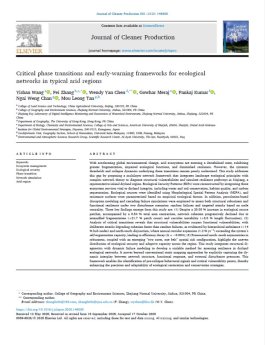
With accelerating global environmental change, arid ecosystems are entering a destabilized state, exhibiting
greater fragmentation, impaired ecological functions, and diminished resilience. However, the systemic
thresholds and collapse dynamics underlying these transitions remain poorly understood. This study addresses
this gap by proposing a multilayer network framework that integrates landscape ecological principles with
complex network theory to diagnose structural vulnerabilities and simulate resilience pathways in Xinjiang, a
representative inland dryland region. Ecological Security Patterns (ESPs) were reconstructed by integrating three
ecosystem services vital to dryland integrity, including water and soil conservation, habitat quality, and carbon
sequestration. Ecological sources were identified using Morphological Spatial Pattern Analysis (MSPA), and
resistance surfaces were parameterized based on empirical ecological factors. In addition, percolation-based
disruption modeling and cascading failure simulations were employed to assess both structural robustness and
functional resilience under two disturbance scenarios: random failures and targeted attacks based on node
centrality. Three key findings emerge from this study are: (1) Despite a 20.08 % increase in ecological source
patches, accompanied by a 0.54 % total area contraction, network cohesion progressively declined due to
intensified fragmentation (+21.7 % patch count) and corridor instability (+8.8 % length fluctuation); (2)
Analysis of critical transitions reveals that structural vulnerabilities surpass functional vulnerabilities, with
deliberate attacks degrading cohesion faster than random failures, as evidenced by hierarchical imbalance (<14
% hub nodes) and north-south disjunction, where annual corridor expansion (1.2 % yr 1) exceeding the system’s
self-organization capacity, leading to efficiency decay (Δ = 0.004); (3) Pronounced north–south asymmetries in
robustness, coupled with an emerging “two cores, one belt” spatial risk configuration, highlight the uneven
distribution of ecological security and adaptive capacity across the region. This study integrates structural diagnostics
with dynamic failure modeling to develop a scalable method for assessing resilience in dryland
ecological networks. It moves beyond conventional static mapping approaches by explicitly capturing the dynamic
interplay between network structure, functional response, and external disturbance pressures. This
framework enables the identification of pre-collapse behavioral signals and critical vulnerability points, thereby
enhancing the precision and adaptability of ecological restoration and conservation strategies.
- English