- English
Volume (Issue): 33 (87)


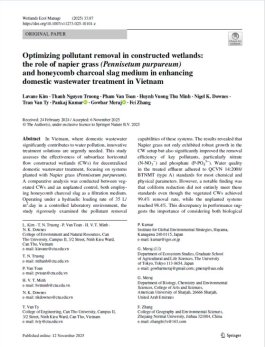
In Vietnam, where domestic wastewater significantly contributes to water pollution, innovative treatment solutions are urgently needed. This study assesses the effectiveness of subsurface horizontal flow constructed wetlands (CWs) for decentralized domestic wastewater treatment, focusing on systems planted with Napier grass (Pennisetum purpureum).
A comparative analysis was conducted between vegetated CWs and an unplanted control, both employing honeycomb charcoal slag as a filtration medium. Operating under a hydraulic loading rate of 35 L/m2.day in a controlled laboratory environment, the study rigorously examined the pollutant removal capabilities of these systems. The results revealed that Napier grass not only exhibited robust growth in the CW setup but also significantly improved the removal efficiency of key pollutants, particularly nitrate (N-NO3−) and phosphate (P-PO43−). Water quality in the treated effluent adhered to QCVN 14:2008/ BTNMT (type A) standards for most chemical and physical parameters. However, a notable finding was
that coliform reduction did not entirely meet these standards even though the vegetated CWs achieved 99.4% removal rate, while the unplanted systems reached 98.4%. This discrepancy in performance suggests the importance of considering both biological and physical processes in the design and operation of CW systems. Furthermore, the study demonstrated that CWs with Napier grass exhibited higher Mass Removal Rates (MRR) for organic matter and nitrogenous compounds compared to the non-vegetated counterparts, indicating the additional benefits of integrating vegetation. These findings highlight the critical role of both plant-based and physico-chemical mechanisms in effective pollutant removal and reinforce the potential of Napier grass CW systems as a viable plant-based wastewater treatment solution. This approach aligns with the goals of environmental sustainability and public health protection in regions grappling with wastewater management challenges.
- English
Volume (Issue): 33 (87)