- English


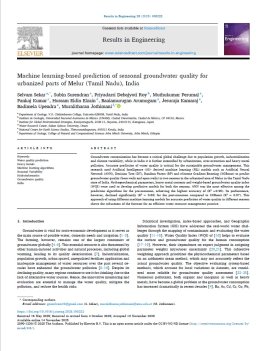
Groundwater contamination has become a critical global challenge due to population growth, industrialization
and climate variability, while in India it is further intensified by urbanization, over-extraction and heavy metal
pollution. Accurate prediction of water quality is critical for the sustainable groundwater management. This
research used Artificial Intelligence (AI)- derived machine learning (ML) models such as Artificial Neural
Network (ANN), Decision Tree (DT), Random Forest (RF) and eXtreme Gradient Boosting (XGBoost) to predict
groundwater quality (bore wells and open wells) in two seasons in the urbanized area of Melur in the Tamil Nadu
state of India. Hydrogeochemical parameters, heavy metal contents and weight-based groundwater quality index
(WQI) were used to develop predictive models for both the seasons. ANN was the most effective among the
prediction algorithms for the pre-monsoon, achieving the highest accuracy of (R² =0.95). Its performance,
however, declined significantly (R² = 0.68) for the post-monsoon compared to XGBoost (R² = 0.87). This
approach of using different machine learning models for accurate prediction of water quality in different seasons
shows the robustness of the forecast for an efficient water resource management practice.
- English