- English


Key Messages
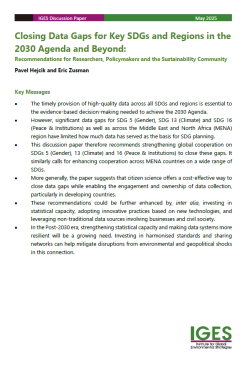
• The timely provision of high-quality data across all SDGs and regions is essential to the evidence-based decision-making needed to achieve the 2030 Agenda.
• However, significant data gaps for SDG 5 (Gender), SDG 13 (Climate) and SDG 16 (Peace & Institutions) as well as across the Middle East and North Africa (MENA) region have limited how much data has served as the basis for SDG planning.
• This discussion paper therefore recommends strengthening global cooperation on SDGs 5 (Gender), 13 (Climate) and 16 (Peace & Institutions) to close these gaps. It similarly calls for enhancing cooperation across MENA countries on a wide range of SDGs.
• More generally, the paper suggests that citizen science offers a cost-effective way to close data gaps while enabling the engagement and ownership of data collection, particularly in developing countries.
• These recommendations could be further enhanced by, inter alia, investing in statistical capacity, adopting innovative practices based on new technologies, and leveraging non-traditional data sources involving businesses and civil society.
• In the Post-2030 era, strengthening statistical capacity and making data systems more resilient will be a growing need. Investing in harmonised standards and sharing networks can help mitigate disruptions from environmental and geopolitical shocks in this connection.
<日本語要約>
「2030アジェンダおよびその先に向けた主要なSDGs と地域におけるデータギャップの解消:研究者、政策立案者、サステイナビリティ分野のコミュニティに向けた提言」
キーメッセージ
- 2030アジェンダを達成するのに必要なエビデンスに基づく意思決定には、すべてのSDGs(持続可能な開発目標)および地域にわたって質の高いデータをタイムリーに提供することが不可欠です。
- しかし、SDG5(ジェンダー)、SDG13(気候変動)、SDG16(平和)および中東・北アフリカ(MENA: Middle East & North Africa)地域全体において大きなデータギャップが存在していることから、SDGs計画策定にデータが十分に活用されてきませんでした。
- 本ディスカッションペーパーでは、これらのギャップ解消に向け、SDG5、SDG13、SDG16に関する国際協力を強化することを提言します。同様に、幅広いSDGsに関してMENA諸国間で協力を強化することも呼びかけています。
- より一般的に、本ディスカッションペーパーは、特に開発途上国において、シチズン・サイエンス(市民科学)がデータ収集への参画とオーナーシップを可能にしつつ、データギャップを埋める費用対効果の高い手段となりうることを示唆しています。
- 統計能力への投資、新技術に基づく革新的な手法の導入、企業や市民社会を巻き込んだ非伝統的なデータソースの活用などを通じて、これらの提言はさらに強化される可能性があります。
- 2030年以降の時代において、統計能力を強化し、データシステムを強靭化することは、ますます必要になります。この点においては、調和のとれた標準への投資と共有ネットワークの構築が、環境的・地政学的ショックによる混乱を緩和するのに役立ちます。
- English