- English
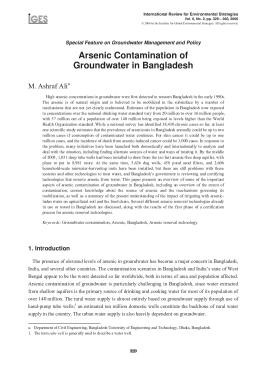


High arsenic concentrations in groundwater were first detected in western Bangladesh in the early 1990s. The arsenic is of natural origin and is believed to be mobilized in the subsurface by a number of mechanisms that are not yet clearly understood. Estimates of the population in Bangladesh now exposed to concentrations over the national drinking water standard vary from 20 million to over 36 million people, with 57 million out of a population of over 140 million being exposed to levels higher than the World Health Organization standard. While a national survey has identified 38,430 chronic cases so far, at least one scientific study estimates that the prevalence of arsenicosis in Bangladesh annually could be up to two million cases if consumption of contaminated water continues. For skin cancer it could be up to one million cases, and the incidence of death from arsenic-induced cancer could be 3,000 cases. In response to the problem, many initiatives have been launched both domestically and internationally to analyze and deal with the situation, including finding alternate sources of water and ways of treating it. By the middle of 2005, 1,851 deep tube wells had been installed to draw from the (so far) arsenic-free deep aquifer, with plans to put in 8,981 more. At the same time, 5,626 dug wells, 458 pond sand filters, and 2,606 household-scale rainwater-harvesting units have been installed, but there are still problems with these systems and other technologies to treat water, and Bangladesh's government is reviewing and certifying technologies that remove arsenic from water. This paper presents an overview of some of the important aspects of arsenic contamination of groundwater in Bangladesh, including an overview of the extent of contamination, current knowledge about the source of arsenic and the mechanisms governing its mobilization, as well as a summary of the present understanding of the impact of irrigating with arsenicladen water on agricultural soil and the food chain. Several different arsenic removal technologies already in use or tested in Bangladesh are discussed, along with the results of the first phase of a certification process for arsenic removal technologies.
Remarks:
http://pub.iges.or.jp/modules/envirolib/view.php?docid=445
Full text is available on EBSCOhost database: http://www.ebscohost.com/
- English