- English
Date: September 15-17, 2025 (Taipei, Taiwan)


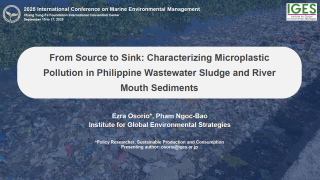
Microplastic pollution poses a significant threat to marine ecosystems, with land-based activities being the primary source. Wastewater treatment plants (STPs) and river systems act as key pathways, concentrating and transporting these plastics from urban areas to the sea. This presentation establishes a direct link between these sources and their marine impacts by characterizing microplastic contamination in two critical locations in the Philippines: municipal wastewater sludge from a decentralized STP in a public market in the province of La Union draining to Lingayen Gulf, and sediments from major river mouths flowing into Manila Bay.
A harmonized methodology was applied to both sludge and sediment samples. The process involved sample collection and sieving, drying, and wet peroxide oxidation to remove organic matter. A high-density salt solution (NaCl) was then used to separate the plastic particles, which were subsequently filtered. Suspected microplastics were quantified and identified using a stereo microscope, and their polymer types were confirmed with spectroscopic analysis (ATR-FTIR and Raman).
Significant findings reveal that STPs concentrate microplastics, with sludge containing up to 46,867 particles/kg. In parallel, sediments from the river mouths of Manila Bay—specifically the Cañas, Meycauayan, Parañaque, Pasig, and Tullahan rivers—showed high contamination, with up to 1,357 particles/kg. The dominant microplastics were directly linked to proximate sources: fragments of polypropylene (PP) and polyethylene (PE) originated from the breakdown of plastic containers from public markets, while fibers were traced to synthetic textiles and fishing gear like ropes and nets. Notably, the deposition of low-density polymers (e.g., PE, PP) was confirmed in sediments, a phenomenon attributed to biofouling, where microbial growth increases particle density, causing them to sink.
These combined findings demonstrate a clear source-to-sink pathway for plastic pollution, identifying wastewater sludge and river sediments as major collection points for land-based plastic waste. Hence, protecting marine environments requires a focus on more than just downstream waste and wastewater management, but also implementing upstream source-reduction policies that target specific, identified pollution drivers.
- English
Date: September 15-17, 2025 (Taipei, Taiwan)