- English


Lower rainfall coupled with higher evapotranspiration leads to enhanced salinity and inorganic contamination of
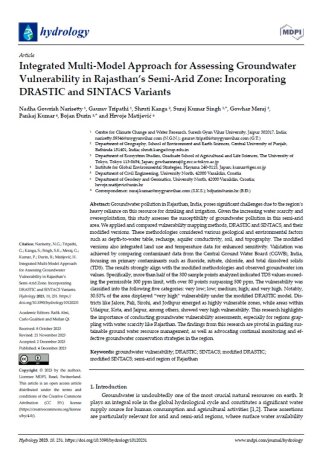
groundwater in arid and semi-arid regions. In this study, 100 groundwater samples were collected from a part of
the Thar Desert of India and analysed for various physico-chemical water quality parameters for quality assurance
for potable water supply. The electrical conductivity of the samples showed an ion-enriched aquifer environment with
high alkalinity. The concentration of Na+, SO42 , Cl , NO3 and F ions in most of the samples were above the
World Health Organization (WHO) guidelines for drinking water, posing a major public health concern. Saturation
indices (SI) indicates that the dissolution of calcite bearing minerals and ion-exchange were major processes
controlling the groundwater chemistry in the region. Most of the samples are oversaturated with
aragonite, calcite, chalcedony, and dolomite while undersaturated with anhydrite, gypsum, halite. The results
suggest that weathering of aquifer minerals and salinization due to high evaporation controls the quality and
origin of major ions. The Na–Cl and Na–HCO3 water facies indicates the influence of evaporation and thus
conducive condition for F enrichment in groundwater while NO3 is mostly due to anthropogenic activities. The
health index (HI) for risk assessment suggests both F and NO3 contribute to the health risk of the residing
population as the HI values were found to be > 1 in 97% and 93% for children and adults, respectively. The
treatment technologies should be adopted to remove the multiple contaminants present in the groundwater of
this region.
- English