- English
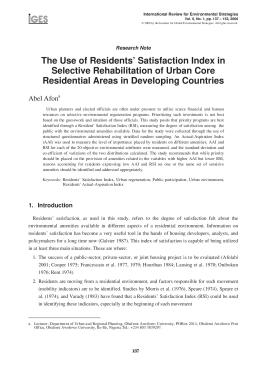


Urban planners and elected officials are often under pressure to utilize scarce financial and human resources on selective environmental regeneration programs. Prioritizing such investments is not best based on the guesswork and intuition of those officials. This study posits that priority programs are best identified through a Resident' Satisfaction Index (RSI), measuring the degree of satisfaction among the public with the environmental amenities available. Data for the study were collected through the use of structured questionnaires administered using stratified random sampling. An Actual-Aspiration Index (AAI) was used to measure the level of importance placed by residents on different amenities. AAI and RSI for each of the 20 objective environmental attributes were measured, and the standard deviation and co-efficient of variations of the two distributions calculated. The study recommends that while priority should be placed on the provision of amenities related to the variables with higher AAI but lower RSI, reasons accounting for residents expressing low AAI and RSI on one or the same set of sensitive amenities should be identified and addressed appropriately.
Remarks:
http://pub.iges.or.jp/modules/envirolib/view.php?docid=446
Full text is available on EBSCOhost database: http://www.ebscohost.com/
- English