- English


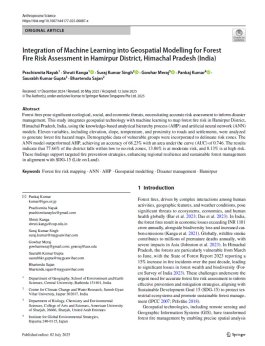
Forest fires pose significant ecological, social, and economic threats, necessitating accurate risk assessment to inform disaster
management. This study integrates geospatial technology with machine learning to map forest fire risk in Hamirpur District,
Himachal Pradesh, India, using the knowledge-based analytical hierarchy process (AHP) and artificial neural network (ANN)
models. Eleven variables, including elevation, slope, temperature, and proximity to roads and settlements, were analyzed
to generate forest fire hazard maps. Demographic data of vulnerable groups were incorporated to delineate risk zones. The
ANN model outperformed AHP, achieving an accuracy of 68.23% with an area under the curve (AUC) of 0.746. The results
indicate that 77.66% of the district falls within low to no-risk zones, 13.86% is at moderate risk, and 8.13% is at high risk.
These findings support targeted fire prevention strategies, enhancing regional resilience and sustainable forest management
in alignment with SDG-15 (Life on Land).
- English