- English
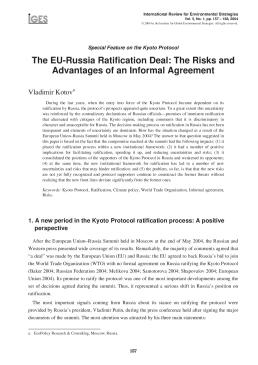


During the last years, when the entry into force of the Kyoto Protocol became dependent on its ratification by Russia, the protocol’s prospects appeared quite uncertain. To a great extent this uncertainty was reinforced by the contradictory declarations of Russian officials?promises of imminent ratification that alternated with critiques of the Kyoto regime, including comments that it is discriminatory in character and unacceptable for Russia. The decision-making process on ratification in Russia has not been transparent and elements of uncertainty are dominant. How has the situation changed as a result of the European Union?Russia Summit held in Moscow in May 2004? The answer to that question suggested in this paper is based on the fact that the compromise reached at the summit had the following impacts: (1) it placed the ratification process within a new institutional framework; (2) it had a number of positive implications for facilitating ratification, speeding it up, and reducing uncertainties and risks; (3) it consolidated the positions of the supporters of the Kyoto Protocol in Russia and weakened its opponents; (4) at the same time, the new institutional framework for ratification has led to a number of new uncertainties and risks that may hinder ratification; and (5) the problem, so far, is that that the new risks are not yet fully recognized and protocol supporters continue to counteract the former threats without realizing that the new front lines deviate significantly from the former ones
Remarks:
http://pub.iges.or.jp/modules/envirolib/view.php?docid=433
Full text is available on EBSCOhost database: http://www.ebscohost.com/
- English