
Results 1 to 10 of 53 (Sorted by date)
Policy Report
As the Asia-Pacific region navigates the complex intersections of climate change, biodiversity loss, and systemic pollution, the need for integrated, cross-sectoral action has never been more evident. While high-level reports frequently emphasize the theoretical value of synergistic approaches—strategies that align multiple policy goals to maximize...
Policy Report
The Asia-Pacific Synergies Report synthesizes experiences from the Asia-Pacific region on translating synergies into practical, policy-relevant lessons for national and subnational policymakers and other stakeholders. The report argues that synergies should be positioned as a core organizing principle in policies and actions toward 2030 and beyond...
Report Chapter
In Asia-Pacific Synergies Report: Advancing Synergistic Solutions to the Triple Planetary Crisis and the SDGs
The triple planetary crisis of climate change, biodiversity loss and pollution threaten not only the global environment but the global economy. International agreements, such as the Paris Agreement and the Kunming-Montreal Global Biodiversity Framework (KMGBF), increasingly call for decision makers to recognize this crisis’ interrelated causes and...
Technical Report
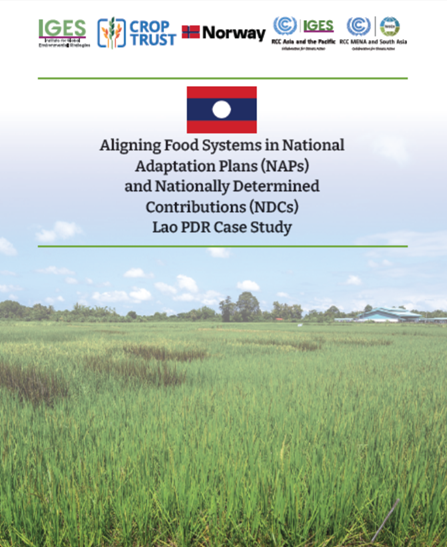
Lao PDR is at a pivotal moment in its development trajectory. As a least developed country (LDC) on track to graduate by 2026, its food systems face increasing pressure from climate change, structural transformation, and resource constraints. Agriculture remains central to livelihoods, food security, and poverty reduction, employing nearly three...
Technical Report
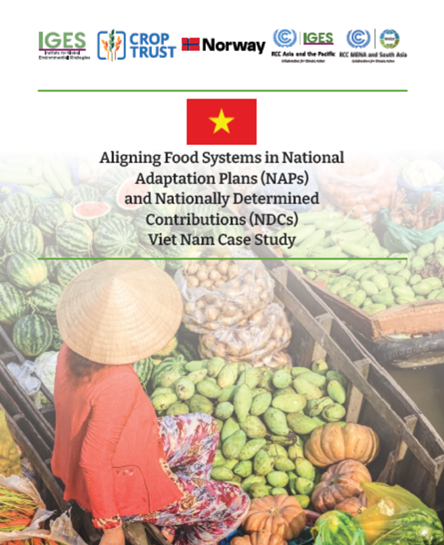
Viet Nam stands at a critical juncture. Its status as a global agricultural powerhouse faces an escalating threat from climate change. This case study outlines the strategic integration of food systems into Viet Nam’s National Adaptation Plans (NAP) and Nationally Determined Contributions (NDC), emphasizing the pivotal role of genebanks and seed...
Technical Report
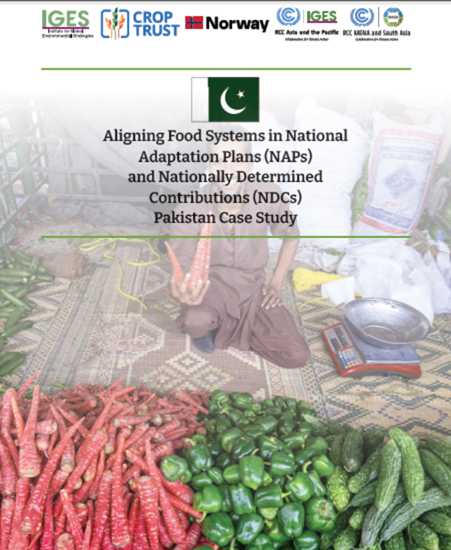
As one of the world’s most climate-vulnerable nations and a country in which agriculture underpins the livelihoods of tens of millions, making food systems climate resilient is a key priority for Pakistan. This case study examines the strategic integration of food systems into Pakistan’s National Adaptation Plan (NAP) and Nationally Determined...
Commissioned Report
本業務は、アジア太平洋地域の国々の取組強化に資するとともに、同地域の動向や先駆的な取組を国際社会へ発信し、国連における2030年以降の持続可能な開発に関する国際枠組の議論へのインプットを目指すため、アジア太平洋地域特有の観点からシナジー推進の優良事例や展開方策を「アジア太平洋シナジーレポート」としてとりまとめることを目的としたものである。昨年度(令和6年度)業務において策定された企画書に基づき、ESCAP、UNEP、ADB等の関係機関と調整しつつ、生物多様性や都市等の個別テーマ(チャプター)の検討、地域特有の課題抽出、及びシナジーアプローチ実施に向けた提言の策定に向け、事務局として各種とりまとめ作業を進めた。
Conference Proceeding
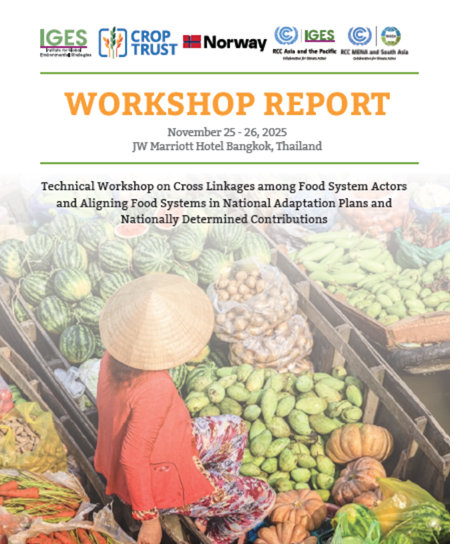
The Technical Workshop on Cross Linkages among Food System Actors and Aligning Food Systems in National Adaptation Plans (NAPs) and Nationally Determined Contributions (NDCs) was convened from November 25–26, 2025 in Bangkok, Thailand. Organized by Institute for Global Environmental Strategies (IGES), the Crop Trust, and the UNFCCC RCC Asia-Pacific...
Conference Proceeding
Asia-Pacific Regional Workshop on Scaling Climate Solutions in Agrifood Systems: Climate-Smart Technologies, Carbon Market Pathways and COP30 Preparation
Agrifood systems in Asia-Pacific are increasingly vulnerable to the impacts of climate change, facing risks from floods, droughts, and shifting weather patterns, while also contributing to greenhouse gas (GHG) emissions. At the same time, the sector offers enormous potential for adaptation and mitigation through climate-smart practices, innovative...
Policy Report
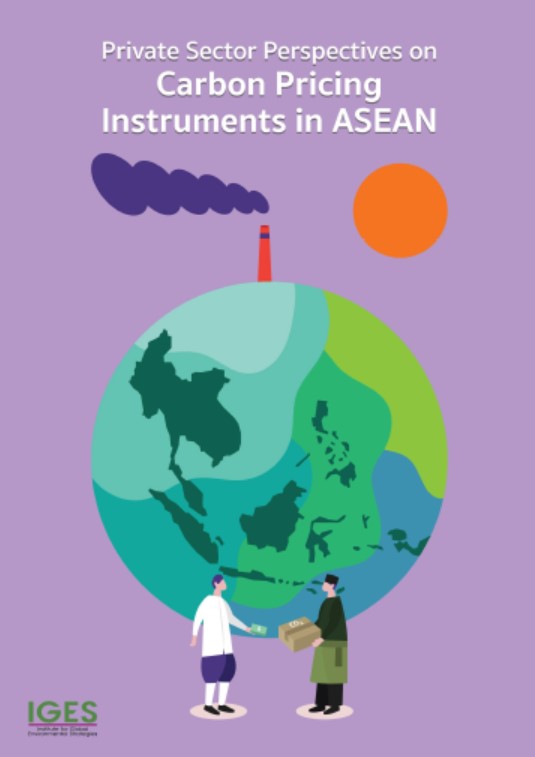
Carbon pricing instruments (CPIs) are being developed at different rates and in different forms in ASEAN Member States. The CPI survey focused on six AMS—Indonesia, Malaysia, the Philippines, Singapore, Thailand and Viet Nam (hereafter referred as AMS-6). Taking into account the availability of facility-level MRV guidelines as well as the sectoral...
Keywords:
No Projects Found.