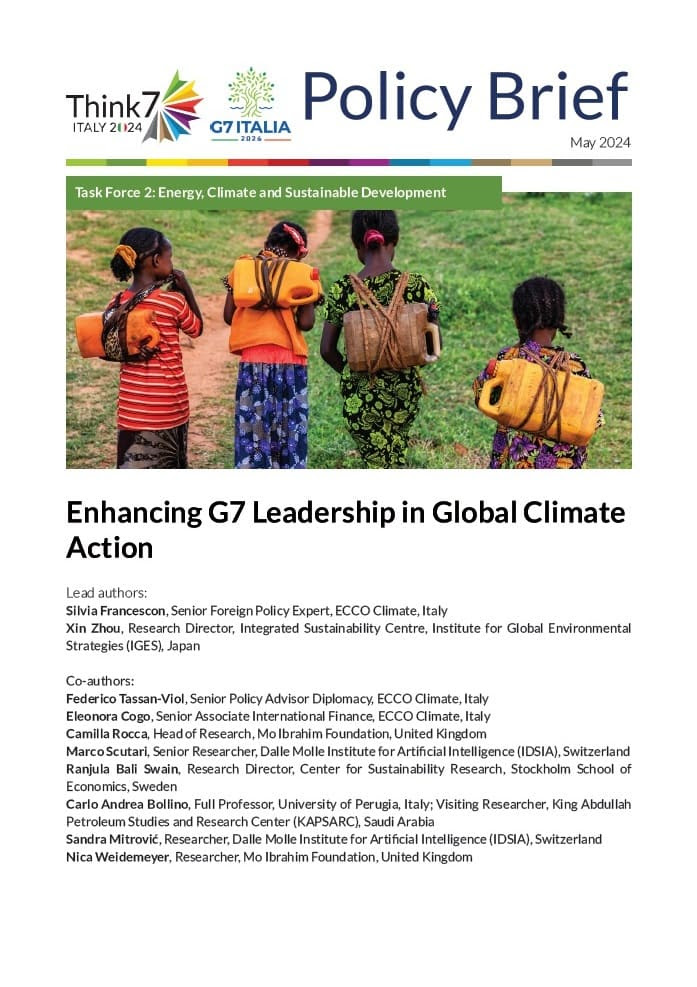
Accounting for around 40 per cent of the world’s economy, 30 per cent of its energy demand and 25 per cent of energy system CO2 emissions, the G7 is called to play a leading role in building consensus towards implementing the goals of the 2015 Paris Agreement. This policy brief argues for the urgency for the G7 to intensify its climate ambition...

Results 831 - 840 of 6464 (Sorted by date)
Other Page
E-newsletter(English)| 14 May 2024
E-newsletter (English) | 14 May 2024 News on IGES research activities and events. View on your browser. 日本語 14 May 2024 NEWS Mikiko Kainuma, Research Advisor at IGES, was selected as one of the 15th Group of Inductees into the Earth Hall of Fame...
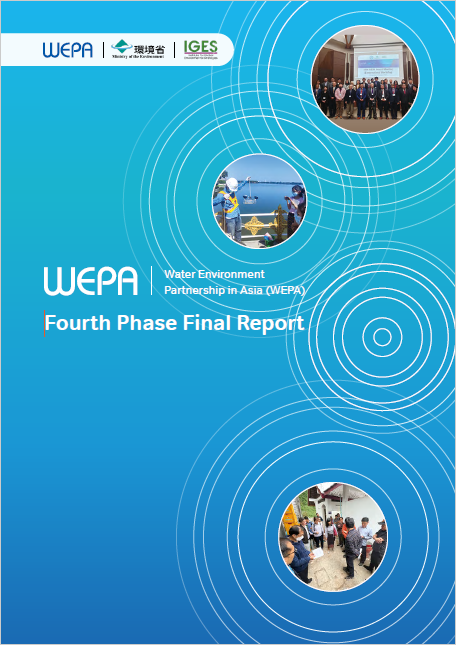
WEPA Fourth Phase Final Report
Recognizing that the improvement of water environmental governance is essential to solve water pollution problems in the Asian Region, the Water Environment Partnership in Asia (WEPA) was launched in 2004 by the Ministry of the Environment, Japan. During the fourth phase of WEPA, which began in FY2019, the objective of WEPA’s fourth phase was...
Azerbaijan Pavilion Side Event, COP28
The presentation was presented at a side event organised by the Ministry of Ecology and Natural Resources (MENR), the Azerbaijan Branch of the Regional Environmental Centre for the Caucasus (REC), and others in the Azerbaijan Pavilion during the COP28 in UAE. It explians the Mutual Learning Program for Enhanced Transparency (MLP), which we focus on...
In Sensors
Research on transformers in remote sensing (RS), which started to increase after 2021, is facing the problem of a relative lack of review. To understand the trends of transformers in RS, we undertook a quantitative analysis of the major research on transformers over the past two years by dividing the application of transformers into eight domains...
In Sixth ASEAN State of the Environment Report
• Since its inception, ASEAN has had a vision of an integrated, sustainable, harmonious, peaceful, and productive region, with its “One Vision, One Identity, One Community”. • The three complementary communities, APSC, AEC, and ASCC, all include aspects of the future environmental conditions and quality of life desired for all ASEAN people, aligned...
In Sixth ASEAN State of the Environment Report
• In ASEAN’s organizational structure, environmental cooperation is under the ASCC. • Environmental cooperation within ASEAN is overseen by AMME, managed by ASOEN, and implemented through seven Working Groups under the ASOEN, supported by the ASEAN Secretariat. • ASEAN conducts international cooperation on the environment at all levels, from the...
In Sixth ASEAN State of the Environment Report
• The SDGs encourage countries to develop synergies between the environment and the social and economic dimensions of sustainable development. This could help gain more support for environmental measures by the public as well as a broader range of policymakers. • AMS have extensively engaged with the SDG process, developing data and indicators and...
In Sixth ASEAN State of the Environment Report
• The drivers of resource consumption are population growth and economic development, leading to unsustainable consumption and production in the ASEAN region. • Increased consumption will lead to higher material extraction and processing. The current model of resource consumption has a linear flow (production→consumption→waste) and will lead to...
In Sixth ASEAN State of the Environment Report
▪ Environmental education (EE) and education for sustainable development (ESD) are needed to develop individuals’ and communities’ capacities through transformative education to build sustainable environments, economies, and societies through reconfiguring the relationship between people, the environment, the economy, and society. ▪ AMS face...