
Results 1 - 10 of 5560 (Sorted by date)
Technical Report
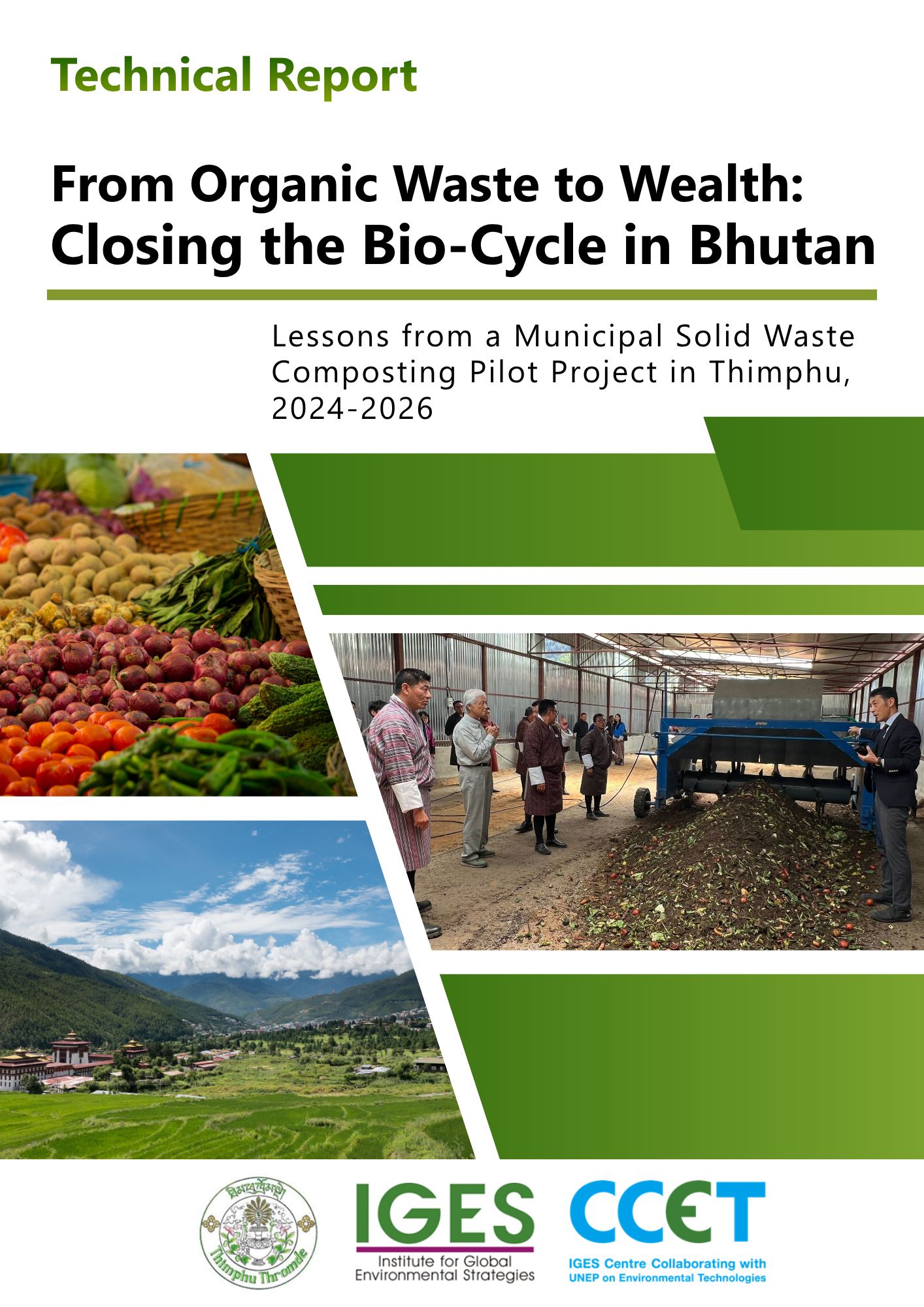
Bhutan faces mounting pressure on its municipal solid waste (MSW) management systems. Its capital city, Thimphu, generates approximately 50 tonnes of MSW per day, of which roughly 30 tonnes per day is organic (wet) waste that is currently deposited at the Memelakha landfill — an ageing open-dumpsite already well beyond its intended lifespan. At the...
Briefing Note
The Association of Southeast Asian Nations (ASEAN) has become one of the most important regions in the global climate debate because it combines rapid economic growth, rising energy demand, and high climate vulnerability. This regional context has become more urgent after the outcome of the first Global Stocktake (GST 1) adopted at CMA.5 in 2023...
Keywords:
Peer-reviewed Article
In Environment, Development and Sustainability
Flood-dominated floodplains are undergoing rapid land-use and land-cover (LULC) change, with consequences for exposure, ecosystem condition, and local development planning. This study examines historical LULC change, transition intensity, trend-consistent land-use scenarios, and event-based flood exposure in Bongaigaon District, located in the...
Peer-reviewed Article
In Microplastics
Microplastic pollution in tropical urban rivers has become an increasing environmental concern due to rapid urbanization, inadequate waste management, and hydrological transport processes. This study investigated the occurrence, characteristics, and spatiotemporal distribution of microplastics in the Can Tho River, Vietnam, along an urban– peri...
Report Chapter
In Asia-Pacific Synergies Report: Advancing Synergistic Solutions to the Triple Planetary Crisis and the SDGs
The triple planetary crisis of climate change, biodiversity loss and pollution threaten not only the global environment but the global economy. International agreements, such as the Paris Agreement and the Kunming-Montreal Global Biodiversity Framework (KMGBF), increasingly call for decision makers to recognize this crisis’ interrelated causes and...
Report Chapter
In Asia-Pacific Synergies Report: Advancing Synergistic Solutions to the Triple Planetary Crisis and the SDGs
From a planetary-health perspective, the transgression of planetary boundaries through climate change, biodiversity loss and pollution is shrinking the safe operating space for humanity. The degradation of air, water, soil and ecosystems undermines nutrition, disease control and resilience. The planetary-health framing therefore highlights the need...
Report Chapter
In Asia-Pacific Synergies Report: Advancing Synergistic Solutions to the Triple Planetary Crisis and the SDGs
Just as nature is the foundation of life on Earth, biodiversity provides the essential ‘ecosystem services’ required to sustain that foundation (e.g. food, water, medicines, fuel, water and climate regulation, pollination, aesthetic value, recreation, spirituality, education). Yet, globally that foundation is weakening as at least a million animal...
Report Chapter
In Asia-Pacific Synergies Report: Advancing Synergistic Solutions to the Triple Planetary Crisis and the SDGs
With more than 2.2 billion urban residents, cities in Asia and the Pacific are well placed to drive the urban transitions needed to accelerate progress on the Sustainable Development Goals (SDGs) (ESCAP, 2025b). Their large and growing urban population gives them significant influence, but the real strength of cities is in their role as delivery...
Report Chapter
In Asia-Pacific Synergies Report: Advancing Synergistic Solutions to the Triple Planetary Crisis and the SDGs
The Asia-Pacific region stands at a historic crossroads. Rapid economic growth and urbanization over recent decades have delivered major social gains, including higher living standards, reduced poverty and expanded access to education. Yet the resource intensive, linear production and consumption model that has underpinned this growth is now...
Report Chapter
In Asia-Pacific Synergies Report: Advancing Synergistic Solutions to the Triple Planetary Crisis and the SDGs
Achieving the Sustainable Development Goals (SDGs) in the Asia-Pacific region requires understanding the deeply interconnected nature of the triple planetary crisis: climate change, biodiversity loss and pollution, while advancing socioeconomic development. Progress depends not only on sectoral achievements, but on the ability of policymakers and...