- English
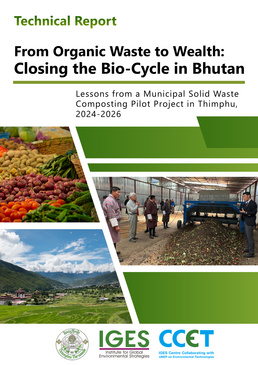


Bhutan faces mounting pressure on its municipal solid waste (MSW) management systems. Its capital city, Thimphu, generates approximately 50 tonnes of MSW per day, of which roughly 30 tonnes per day is organic (wet) waste that is currently deposited at the Memelakha landfill — an ageing open-dumpsite already well beyond its intended lifespan. At the same time, Bhutan has committed to becoming the world’s first 100% organic nation by 2035, a goal that requires a dramatic expansion in domestic organic fertiliser production.
Against this backdrop, the Institute for Global Environmental Strategies (IGES), with support of the United Nations Environment Programme (UNEP), implemented a pilot project during August 2024 – June 2026 to establish a centralised MSW composting centre in Thimphu. The project builds on an earlier technical cooperation initiative supported by the Japan International Cooperation Agency (JICA) in 2017–2021, which successfully introduced the Takakura Composting Method (TCM) at the community scale. This report documents the project’s activities, results, challenges, and lessons learned.
- English