

Programme Director/ Director of Integrated Sustainability Centre
Research Topics & Areas of Expertise
Co-benefits
Political economy of low carbon development
Air pollution regulation
Climate policy
Sustainable transport
SDGs
Multilevel governance
Education
Rutgers University, Chinese Department
The University of Texas at Austin, LBJ School of Public Affairs, Department of Asian Studies
The University of California, Los Angeles, Political Science Department
Results 311 to 320 of 362 (Sorted by date)
Presentation
Working Paper
Research on short-lived climate pollutants (SLCPs) has been based more on air pollution and energy models than how existing policies affect the model’s recommended actions. This article analyses how Thailand’s policies influenced attempts to control a critical source of SLCPs: open burning. In 2012, Thailand’s Pollution Control Department (PCD) led...
Presentation

Society for Environmental Economics and Policy Studies (SEEPS)
Conference Paper
The 18th Annual meeting of the society for Environmental Economics and Policy Studies, Kobe University, 21-22 September 2013.
Issue Brief
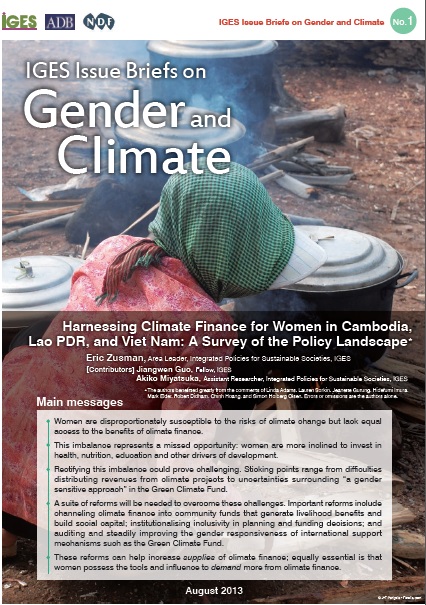
[Main messages] - Women are disproportionately susceptible to the risks of climate change but lack equal access to the benefits of climate finance. - This imbalance represents a missed opportunity: women are more inclined to invest in health, nutrition, education and other drivers of development. - Rectifying this imbalance could prove challenging...
Non Peer-reviewed Article
In Carbon Management
Most environmental policies are meant to achieve a single goal such as reducing pollution, preserving ecosystems or mitigating climate change. Yet environmental issues are frequently interlinked and approaches that exploit these linkages can deliver more than one desirable outcome. The collection of benefits accruing to actions linking climate...
Policy Report

MRV – Measurement/Monitoring, Reporting and Verification - is commonly understood as a series of processes to quantify GHG emission and their change over time. It is a key instrument to understand the level of emissions and the impact of actions aimed at changing emission levels. For this reason, MRV became a keyword as many developed and...
Presentation
Climate change is naturally a complex and dynamic issue. The past decade has seen a marked increase in the development of equally dynamic low carbon strategies. Many of these strategies benefited from the proliferation of networks; networks not only help connect diverse stakeholders, they facilitate experience and information sharing in rapidly...
Working Paper

Asia could accrue significant air quality, public health, and climate co-benefits from mitigating short-lived climate pollutants (SLCPs) such as black carbon and tropospheric ozone (O3). Realizing these co-benefits will require bridging a research-policy divide. This policy brief outlines pragmatic steps to help narrow that divide in Asia.
PR, Newsletter or Other

Results 11 to 11 of 11 (Sorted by date)
Project
Updated: August 2023
IGES Activity on "High-level Political Forum on Sustainable Development (HLPF)"
This special webpage presents publications related to the High-level Political Forum on Sustainable Development (HLPF), which as the main United Nations platform on sustainable development, is dedicated to the follow-up and review of the 2030 Agenda