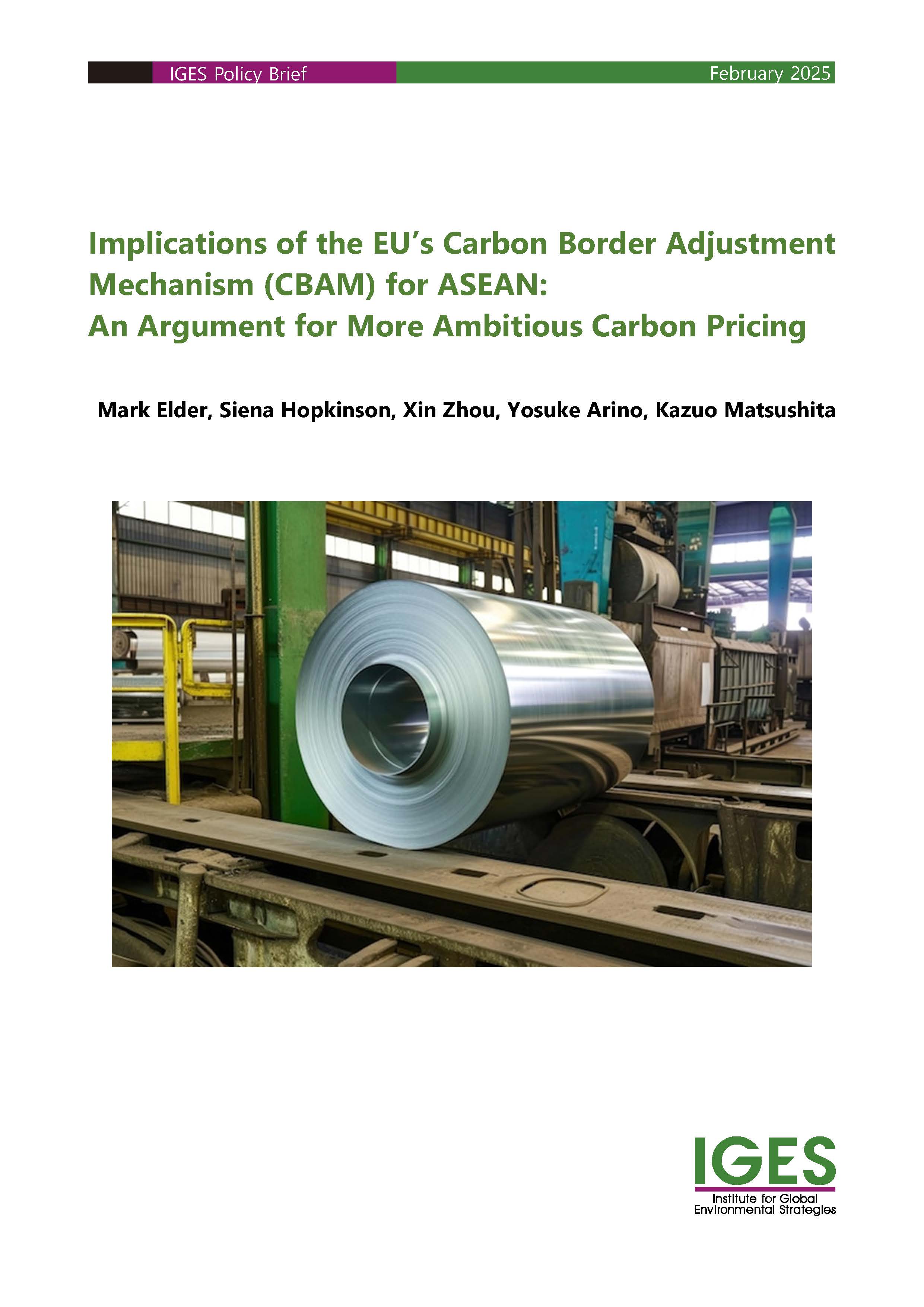
This policy brief examines the implications for ASEAN Member States (AMS) of the European Union’s Carbon Border Adjustment Mechanism (CBAM) and suggests an overall direction for responses. The EU’s CBAM aims to minimize carbon leakage and the loss of the EU’s trade competitiveness due to its more ambitious climate mitigation policies, particularly...

Results 601 - 610 of 6464 (Sorted by date)
International Forum
Stakeholder Engagement Forum on the Management of Persistent Organic Pollutants (POPs) in E-waste in Thailand
The Stakeholders Engagement Forum on the Management of Persistent Organic Pollutants (POPs) in E-Waste was held on December 23-24, 2024, in Bangkok, Thailand, co-organised by the Institute for Global Environmental Strategies (IGES) and the...
In Catena
Net primary productivity (NPP) reflects the carbon sequestration capacity of terrestrial ecosystems, serving as a crucial indicator of ecosystem health. Arid and semiarid regions, which are ecologically fragile, respond strongly to climate change and human activities, necessitating adequate NPP monitoring. However, large-scale NPP studies for...
International seminar on the city of the future
This is a series of international seminars at the UNAM in Mexico City. The objective is to identify the foundations of the cities of the future and to analyse the concepts, problems and examples of this theme in the world. The author presented tha case studies of Tokyo, Bhutan, and Mexico City as a scenario analysis of the future of cities.
Climate-related Security Risks - Introductory Training
From December 4th to 6th, 2024, IGES, in collaboration with adelphi, Germany, hosted an introductory training focused on climate-related security risks at its headquarters in Kanagawa, Japan. This event was part of the broader "Asia-Pacific...
In Climate
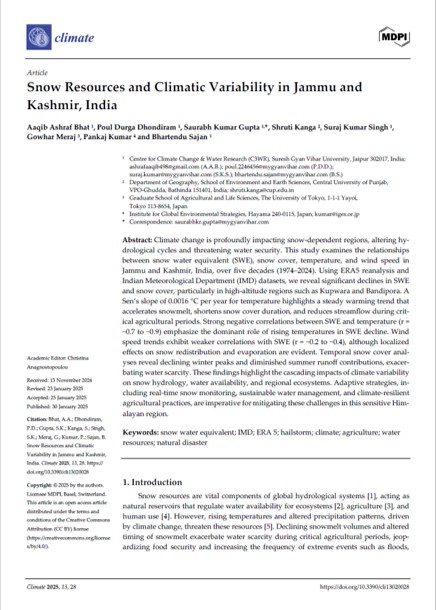
Climate change is profoundly impacting snow-dependent regions, altering hydrological cycles and threatening water security. This study examines the relationships between snow water equivalent (SWE), snow cover, temperature, and wind speed in Jammu and Kashmir, India, over five decades (1974–2024). Using ERA5 reanalysis and Indian Meteorological...
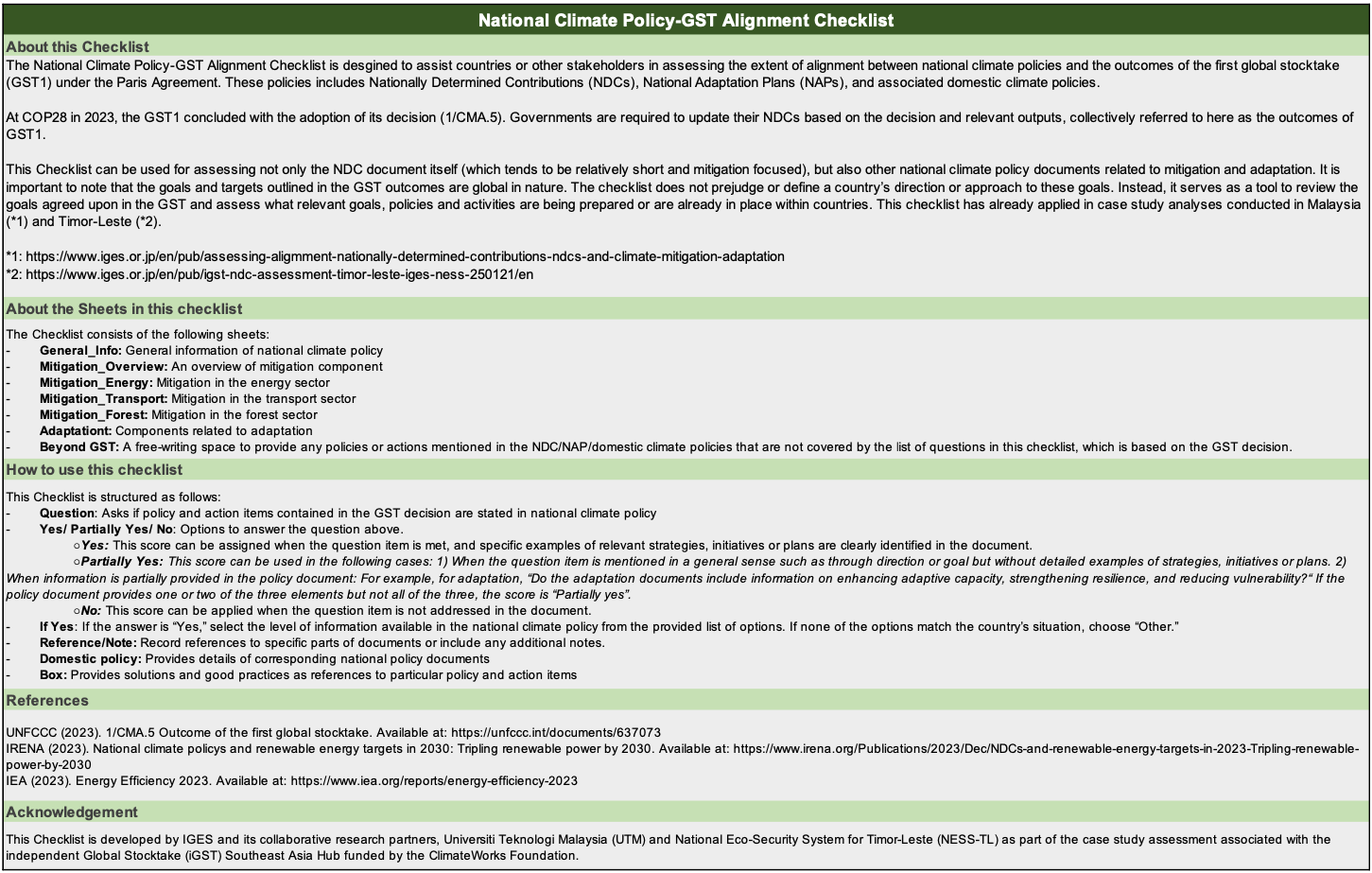
The National Climate Policy-GST Alignment Checklist is desgined to assist countries or other stakeholders in assessing the extent of alignment between national climate policies and the outcomes of the first global stocktake (GST1) under the Paris Agreement. These policies includes Nationally Determined Contributions (NDCs), National Adaptation...
Keywords:
This assessment explored the extent to which Timor-Leste’s nationally determined contribution (NDC) and national adaptation plan (NAP) align with the outcomes of the first global stocktake (GST), using a systematic review based on a structured checklist. The alignment between the NDC and GST outcomes on mitigation was limited, as Timor-Leste’s NDC...
Keywords:
Seminar on City-to-City Collaboration for Zero Carbon Society 2025 – Contributing to Local Decarbonisation through Technology & International Solidarity –
Cities account for approximately 70% of global greenhouse gas emissions and energy consumption. Accelerating urban decarbonisation while addressing challenges such as environmental pollution and circular economy is critical to achieving the Paris...
High Level Talks
A Review on Progress made for Smart, Zero Carbon and Climate-Resilient Cities in Malaysia and Japan
Malaysia and Japan have enjoyed solid and friendly cooperation for many years. This has recently been elevated by the “Comprehensive Strategic Partnership” agreed upon in December 2023. Under the partnership, the two nations have renewed their...