日本語 / English
The Asia Pacific Climate Security (APCS) page provides a space to share research findings and relevant information on climate security. Across different topics —including international trends analysis, energy security, food security, climate-induced human mobility, climate adaptation and humanitarian action, ocean security, and more— the goal of this page is to facilitate multidisciplinary discussions and to provide insights into these critical issues.
What’s New
Relevant Publications
About the project
The core question of this project is: Does the prioritisation of traditional security inevitably lead to a retreat from climate change measures?
The project argues that climate change must instead be effectively integrated into the foreign and security policy agenda. Given the growing recognition of climate change as a security threat across various parts of Asia-Pacific countries, it is essential to comprehensively examine how climate action can contribute to regional and global peace and stability, and how such perspectives can be incorporated into the diplomatic and security policies of Japan and the broader region.
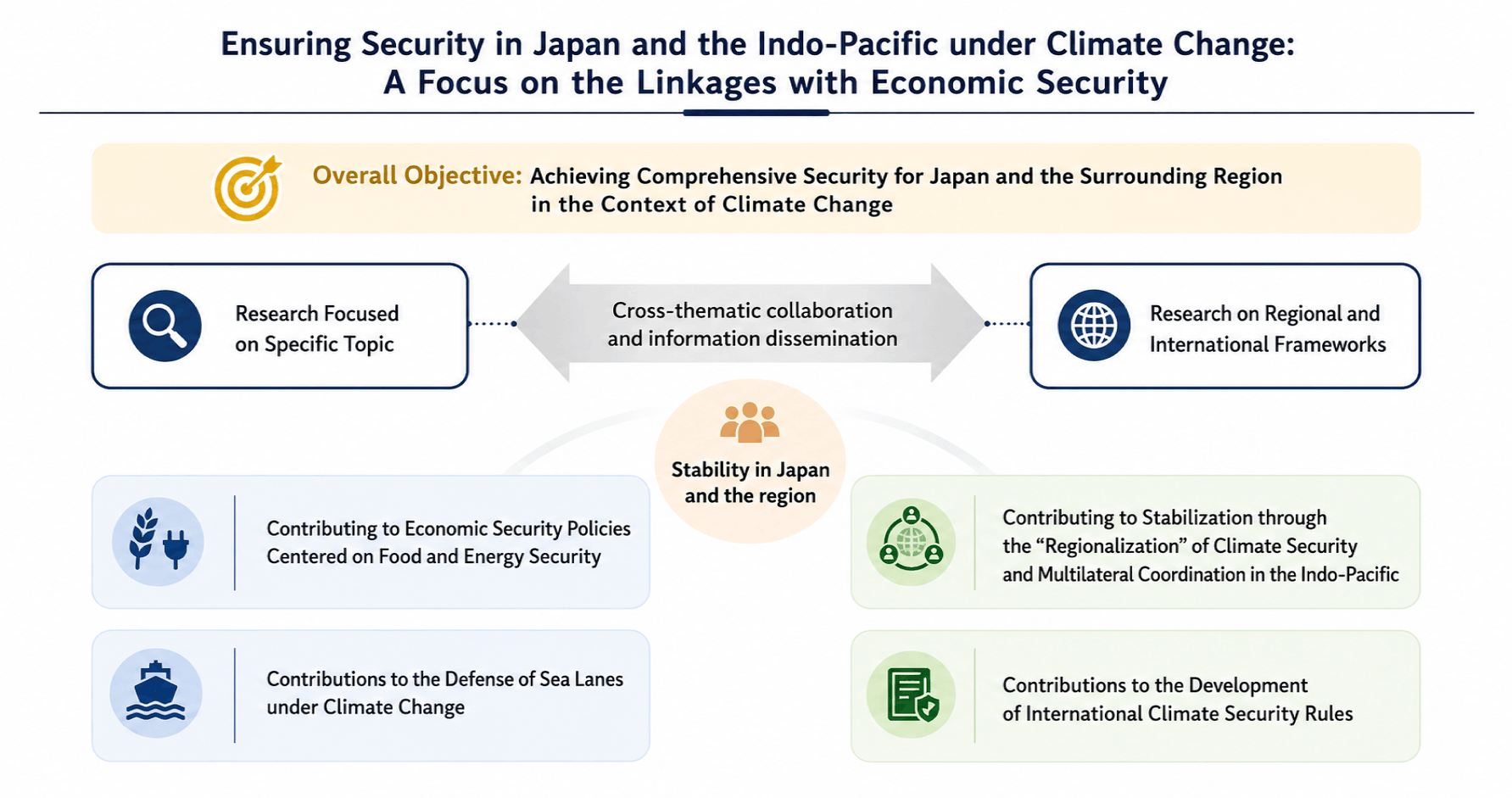
The objective of this project is to explore ways of integrating climate change into the security strategies of Japan and the Indo-Pacific region. The project consists of two main pillars.
First is the relationship between climate change and economic security. Since the war in Ukraine and the advent of the second Trump administration, the economy has increasingly become a tool of diplomacy and security. As a result, economic security has gained increasing importance, particularly in areas such as securing supply chains for food and other essential goods. This project will examine a range of issues that may affect economic security, including geopolitical shifts surrounding energy resources associated with the transition to renewable energy, their implications for food production, and the strengthening of supply chain resilience against natural disasters.
Second is the pursuit of international cooperation, including regional approaches. At a time when multilateralism is facing increasing uncertainty, cooperation among like-minded countries within regions is becoming more important, alongside international climate frameworks centred on the Paris Agreement. To better understand the evolving international landscape surrounding climate policy and identify effective diplomatic approaches, this project will analyse trends in regionalism within both the United Nations system and regional organisations such as the Association of Southeast Asian Nations (ASEAN) and the Pacific Islands Forum (PIF), and explore approaches that can sustain and strengthen international cooperation.
Project Members
- 【Project Representative】 Osamu Mizuno, Programme Director, IGES
- 【Advisor】 Yoshinori Kodama, Principal Fellow/Honorary Advisor, TERI, IGES
Theme 1: Contributing to Economic Security Policies Centered on Food and Energy Security
- Kei Kurushima, Chief Policy Researcher, IGES
- Nazia Hussain, Assistant Professor, Institute for Future Initiatives, the University of Tokyo
- Kentaro Tamura, Research Director, IGES
- Nanda Kumar Janardhanan, Deputy Director/Senior Research Manager, IGES
- Hajime Takizawa, Policy Researcher, IGES
- Pankaj Kumar, Senior Research Manager, IGES
Theme 2: Contributions to the Defense of Sea Lanes under Climate Change
- Takashi Sekiyama, Professor, Graduate School of Advanced Integrated Studies in Human Survivability, Kyoto University
- Takeshi Sakade, Professor, Graduate School of Economics, Kyoto University
- Azusa Uji, Associate Professor, Graduate School of Law, Kyoto University
Theme 3: Contributing to Stabilization through the "Regionalization" of Climate Security and Multilateral Coordination in the Indo-Pacific
- Naoko Kimura, Policy Researcher, IGES
- Miki Fukuda, Chief Policy Researcher, IGES
- Fumiko Noguchi, Research Fellow, JICA Ogata Research Institute
- Masashi Tsudaka, Deputy Director of Strategic Operations, IGES
- Krishna Prabhakar Sivapuram Ventaka Rama, Principal Policy Researcher, IGES
- Faris Salman, Policy Researcher, IGES
Theme 4: Contributions to the Development of International Climate Security Rules
- Naoyuki Okano, Programme Officer, United Nations University
- Miko MAEKAWA, Senior Research Fellow, Sasakawa Peace Foundation
- Okitasari Mahesti, Research Fellow and Academic Associate, United Nations University
- Gupta Himangana, Research Fellow and Academic Associate, United Nations University
- Akane MATSUO, Research Manager, IGES
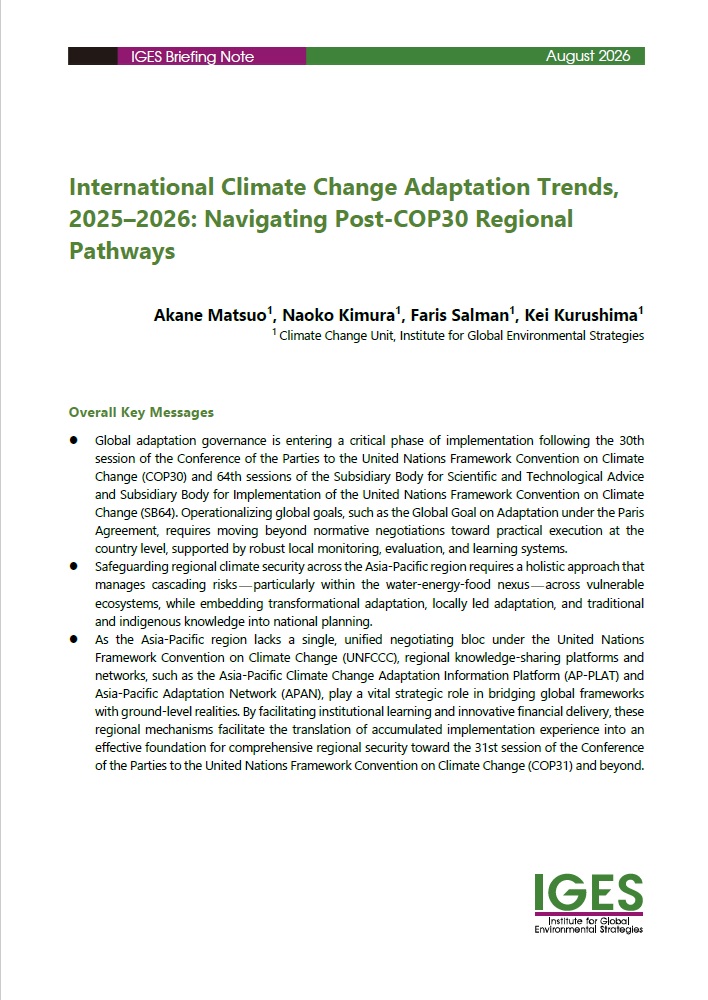
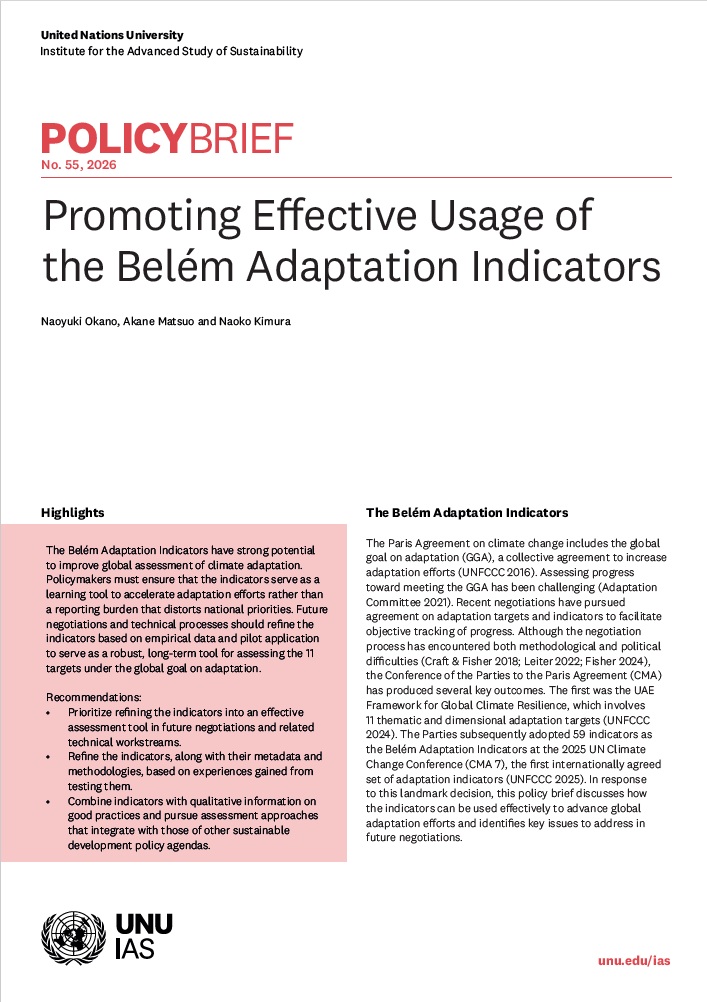
Phase 1 Research Results
The Asia-Pacific Climate Security (APCS) discussion paper series are a collection of policy and analysis papers aimed at scholars, policymakers, and practitioners working at the intersection of climate change and security in the Asia-Pacific region.
Drawing on case studies from South and Southeast Asia and the Pacific, this series examines how climate change acts as a risk multiplier in one of the world's most vulnerable and strategically significant regions. Rather than adopting a single technical lens, the papers draw on multiple conceptions of security —human, national, and economic— to offer a nuanced and comprehensive picture of the challenges ahead.
This work, produced over three years of dedicated research, reflects IGES long-standing commitment to producing actionable knowledge that bridges environmental science, policy, and regional realities. We encourage you to read the series. Share it with your networks. And help bring climate security to the top of the policy agenda.
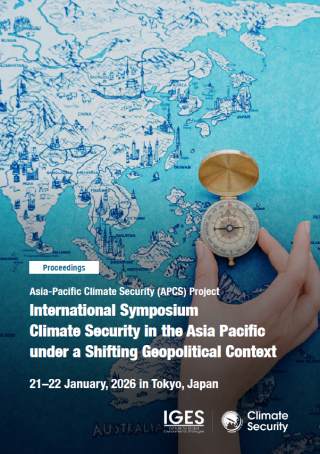
Climate Security in the Asia Pacific under a Shifting Geopolitical Context
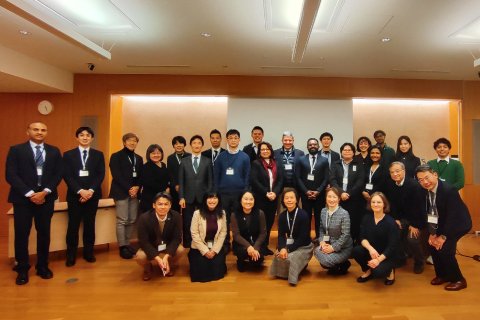
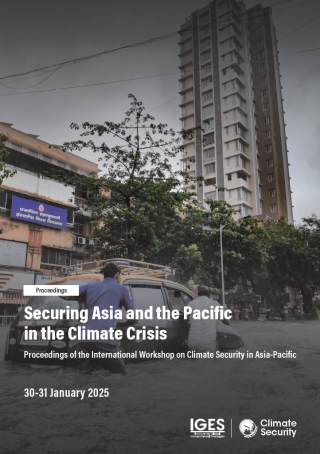
International Workshop on Climate Security in Asia-Pacific

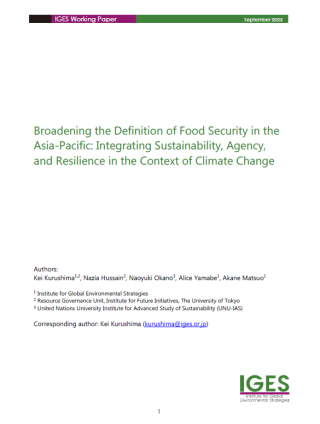
International Workshop "Ensuring Food Security under Climate Crisis"
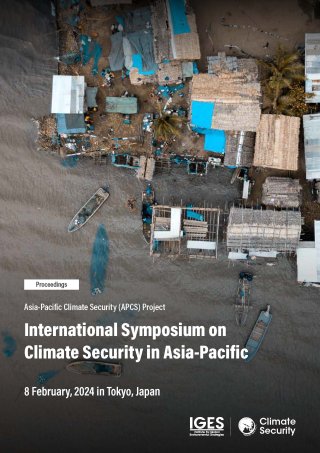
International Symposium on Climate Security in Asia-Pacific
Related Publications
This research will focus on five thematic areas:
1. energy security
2. food security
3. climate induced migration
4. climate change adaptation and security
5. maritime security.
Through field research and analysis, we aim to shed light on these issues and develop potential solutions to address them. Furthermore, we contribute to develop a clear understanding of climate security, which can sometimes seem an elusive term. Specifically, we want to pursue policymakers to consider climate security and what possible approaches can be considered in doing so. While the emergence of climate risks and the promotion of measures to deal with them can contribute to conflict and confrontation, they can also provide an opportunity to promote international cooperation. IGES is committed to helping the international community move in such direction.
IGES is looking forward to working with many partners in the future as a research institute for strategic research on climate security, with a focus on the Asia-Pacific region. We look forward to your broad interest and support.
Climate security draws on an extensive body of prior initiatives and research undertaken across various countries and regions. This project will analyse and examine implications relevant to Japan, prioritizing the following approaches.
| A science-based policy approach |
|---|
| This study carries out an assessment of the necessary policy approaches while identifying the reach and limitations of scientific knowledge on the impacts of climate change. For example, the movement of people partly due to climate change (sometimes referred to as 'climate refugees') is often recognised as a national security challenge as well as as a migration crisis issue in the developed countries that host them, but in reality, migration is overwhelmingly internal, and frequently unavoidable. In addition, making decisions that incorporate climate change predictions is challenging due to the handling of uncertainties in forecasts and the lack of sufficient data. With the understanding that this knowledge base is incomplete and subject to diverse interpretations, we contemplate how to make decisions related to national security. |
| A multi-layered approach to security |
|---|
| This study examines the concept of climate security, taking into consideration a multi-dimensional perspective that goes beyond traditional national security and includes aspects such as human security and economic security. We will also consider geopolitical perspectives, such as the Free and Open Indo-Pacific (FOIP) initiative led by Japan and other countries. Furthermore, perspectives from the Global South, which includes many countries with relatively high vulnerability to climate risks, will become increasingly important in shaping security approaches in the future. |
| Collaboration based on networks with institutions across countries |
|---|
| IGES is committed to interdisciplinary and practical research that brings about societal transformations under the mission of developing global strategies for environmental issues.In this project, we will continue to emphasise co-creation with partners, formulating questions and deriving policy insights. At the same time, we will work to build an extensive network with relevant institutions in various countries through international teams with diverse academic backgrounds.We aim to conduct impactful research, considering the significance and limitations of introducing such an approach in terms of security-related issues and their impact on society. |
7 November 2025 | Climate Change and Security Nexus

The Organization for Security and Co-operation in Europe (OSCE) is the world's largest regional security organization, with 57 participating States across North America, Europe, and Asia. It works to prevent conflicts, manage crises, and promote stability through political dialogue and field operations. Japan is one of the OSCE's five Asian Partners for Co-operation (alongside Afghanistan, Australia, the Republic of Korea, and Thailand), actively collaborating with the organization to share expertise and address common security challenges. At a meeting of the OSCE's Asian Partners for Co-operation Group, IGES had a significant opportunity to share our research findings under APCS Project.
Climate change is already a significant security issue outlining a paradigm shift in how security policies and defense strategies are formulated. The impacts of climate change are interconnected, affecting not only national security but also energy, food, and individuals' lives. We must acknowledge that the concept of security, and the term 'climate security' itself, are taken differently across the Asia-Pacific region. Finally, because the risks are geographically-localised, regional cooperation and locally grounded solutions based on regional data are essential.
The conceptual challenge and policy gaps
The main challenges lie in achieving a shared understanding and effective cooperation. It can be argued that countries in the Asia-Pacific often perceive climate security differently from how it has been discussed in the Global North. This reveals a fundamental limitation: top-down scientific scenarios alone cannot bridge these perspectives. Science must evolve from being 'delivered' to being 'co-developed' with regional stakeholders.
Overcoming Challenges Scientifically: Co-development and Human Security
It is critical that the scientific assessment of climate-related risks integrates socio-economic and cultural factors. This is a complex challenge, but the effort to understand these dynamics is paramount. Not only the top-down approach, but we also need a bottom-up, participatory process where affected communities can participate in decision-making, in a language they understand, to ensure multiple perspectives inform the process.
This process of 'Co-development' and 'Localisation' requires that scientists, policymakers, civil society, and local experts participate from the initial stages of risk assessment. The scientific knowledge produced must be translated into an actionable format that addresses the region's diverse needs—such as the existential threats to land and cultural identity, as we confirmed in our study in the Asia-Pacific region.
In a region with such cultural, economic, and political diversity, the concept of Human Security—focusing on the protection of individuals' dignity and survival—can serve as a powerful, shared basis for dialogue. In conclusion, we need to implement science in our methods, and do so through common frameworks that allow coordinated action. To do so effectively, we must move beyond data gaps by embedding scientific knowledge within a collaborative and region-specific process.
28 April 2025 | T7 Policy Brief and Policy Recommendations to the G7

Think7 (T7) is an engagement group in which think tanks provide policy recommendations to the G7 based on their research findings. As part of the Asia-Pacific Climate Security Project (APCS) coordinated by the Institute for Global Environmental Strategies (IGES), we jointly submitted recommendations with adelphi and Manzil Pakistan. Originally, it was a joint proposal between adelphi and IGES, but due to the strong synergies between the themes, we worked together with Manzil Pakistan's proposal to finalise the recommendations.
- Each year, T7 sets several themes for recommendations that reflect the intentions of the chair country. This year, the themes included "Transformative Technologies (AI and quantum technology)," "Digitalization of the Global Economy," "Environmental, Energy, and Sustainable Development," and "Global Peace and Security." Our proposal, "Ensuring Future Security: Climate Change and Energy Security Risks and the Role of the G7," falls under the theme of Environmental, Energy, and Sustainable Development. The main messages are as follows:
- Climate change undermines national and human security in and beyond G7 countries, especially in fragile regions, through indirect pathways, such as compromised livelihoods and displacement, food and water insecurity, and resource competition.
- The G7 countries must reconcile the need for energy security with global climate goals. This involves securing critical mineral supply chains while accelerating energy transition and decarbonization.
- Critical minerals are central to geopolitics due to their uneven distribution and concentration. By strengthening diplomatic and trade ties, the G7 countries can reduce geopolitical risks while promoting sustainable extraction practices globally.
- G7 countries must uphold climate justice commitments to the Global South to strengthen multilateralism and international solidarity.
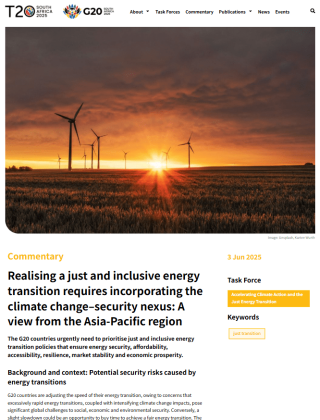
The IGES Asia-Pacific Climate Security Project addresses a variety of risks, including energy, food, and forced migration. Based on the findings of this project, we emphasise the role of the G7 in addressing challenges in climate-vulnerable regions concentrated in the Global South, and argue that particular attention should be paid to energy security and geopolitical risks arising from the uneven distribution of critical minerals. These are perspectives that have not always been adequately addressed in existing climate change mitigation and adaptation efforts, but are essential for strengthening climate action and achieving sustainable development. We hope that the messages we have presented will capture the attention of many policymakers and lead to concrete action.
24 April 2025 | Progress Report on Climate Security Research in the Pacific



The IGES climate security team recently conducted a research expedition to Fiji to explore climate change adaptation and security measures. With assistance from a local coordinator, we visited communities impacted by climate change.
During our survey, we initially inquired about the short-term and long-term objectives of community members. Subsequently, we assessed these goals in light of the anticipated effects of climate change, performing a thorough analysis of how the challenges associated with achieving them have evolved. This process allowed us to observe how the community's original aspirations have been modified to align with realistic and achievable outcomes, even amidst the challenges posed by climate change. One clear observation that emerged during this mission has been that the local communities see climate security in a holistic perspective covering food, livelihoods, standard of living, health, education, and energy, even though issues such as internal displacement and migration may receive undue attention globally and regionally. This methodology, previously applied in Sri Lanka, enables us to draw comparative insights between different contexts, while such comparisons need to be made with caution related to local contexts and what such comparisons mean for the policy processes.
Fiji was among the first countries globally to establish a National Adaptation Plan (NAP) in 2018 and is currently in the process of revising it. We will engage with the Fijian government and other stakeholders to understand how the updated NAP will bolster community climate security and facilitate adaptation to climate change. The findings from our research will be compiled as part of the project's outcomes.
3 March 2025 | Climate Security Challenges for Japan's Energy Transition

As the Asia-Pacific region accelerates its energy transition, several challenges associated with climate security emerge as key concerns for the energy sector. Ongoing research at IGES identifies various challenges critical to Japan's energy sector from the climate security perspective. First, regarding its planned transition to net-zero by 2050, Japan's continued reliance on imported fuels and resources faces policy-driven risks and geopolitical challenges. Securing access to cheap and adequate clean fuels, equipment and mineral resources could witness challenges. Additionally, availability of overseas carbon storage sites, which is part of Japan's decarbonisation strategy could face hurdles, depending on the target countries' climate policy changes. Secondly, Japan's dependence on import fossil fuels with long, cross-border supply chains increase the vulnerability to various, physical risks associated with climate. Third, climate security concerns present a significant challenge for the country's industrial and trade competitiveness. Without heavily decarbonising industries, trade barriers in potential supply destinations could significantly affect Japan. Our research examines these challenges and explores effective strategies for integrating them into Japan's domestic policymaking.
30 August 2024 | IGES researcher, Naoyuki Okano spoke at a seminar hosted by the Global Peacebuilding Association.
Online Seminar on "Climate Security in Conflict Settings" was held on August 30th, 2024. As Climate Change becomes a growing concern on our daily life, in this seminar, we discussed how Climate Change was related to conflict and peacebuilding.
9 January 2024 | Implications of COP28 Results for Climate Security
Significant developments in the field of climate security were marked by the dedication to the Health/Relief, Recovery & Peace Day at COP28. However, these are the initiatives outside the negotiation. Then, regarding the negotiation outcome labelled the UAE Consensus, what implication does it hold for climate security? Here are three points from the UAE Consensus that seem particularly relevant to climate security:
Agreement on the operationalisation of the new funding arrangements, including the Loss and Damage Fund
Loss and Damage refer to the adverse effects of climate change despite efforts in climate change mitigation and adaptation, and arguably its content significantly overlaps with initiatives of climate security. For example, in the GST decision, such approaches as disaster risk reduction, humanitarian assistance, recovery, displacement, planned relocation, and migration were cited as responses to Loss and Damage (-/CMA.5, paras. 125, 131). Climate security highlights the direct and indirect impacts of climate change across various societal facets, potentially leading to instability, division, and conflicts. The progress in concrete responses through the anticipated Loss and Damage Fund is crucial in shaping climate security policies.
What the Loss and Damage Fund agreed upon on the first day of COP28 is based on discussions held over the past year in the transitional committee following the agreement to establish the fund and funding facilities at COP27. Immediate pledges to the fund swiftly followed, totalling more than $700 million. The management of the fund and its associated facilities, alongside the ongoing discussions within the Warsaw International Mechanism and the Santiago Network—key drivers of technical discourse on Loss and Damage under the UNFCCC—warrant considerable attention from the standpoint of climate security.
Call to transition away from fossil fuels: Global Stocktake (GST) Document (‐/CMA.5, paras. 28(d))
In response to the GST decision, the acceleration in the transition away from fossil fuels is anticipated. Countries will renew their NDCs by 2025, building on this language included in the GST decision. Considering energy security perspectives, such as securing critical materials necessary for the widespread adoption of renewable energy, is crucial in this energy transition. Striking a balance between advancing decarbonisation efforts and ensuring energy security will require cautious yet bold decision-making in the future policy formations of each nation.
Agreement on the framework for operationalising the Global Goal on Adaptation(GGA)
Significant decisions have also been made in the context of climate change adaptation. The agreement on the GGA framework is expected to provide distinct guidelines for each country's adaptation efforts. Notably, sector-specific goals related to adaptation in water, food, health, ecosystems, infrastructure/housing, poverty reduction, and cultural heritage are included in the framework (-/CMA.5, para. 9). This emphasises the integration of adaptation across diverse sectors, fostering comprehensive climate risk responses and suggesting a direction for policy formulation towards ensuring climate security. International discussions on the direction of climate risk responses, including acknowledging cross-border and cascading risks in the GST decision (-/CMA.5, para. 52), are steadily progressing. Policy formation in the field of climate security must be linked to these discussions.
Matters relating to the global stocktake under the Paris Agreement
Glasgow–Sharm el-Sheikh work programme on the global goal on adaptation referred to in decision 7/CMA.3
13 December 2023 | Progress on Climate Security at COP28 - A Declaration that Leads to Action

For the first time in COP, Climate security was named one of the agenda items at COP28. Notably, COP28 was the first time COP dedicated a day to Health, Relief, Recovery, and Peace, marking heightened global attention to climate security. I would like to spotlight two events closely associated with climate security during COP28.
A high-level event, "Climate Security Moment: Assuming Joint Leadership," hosted by the Munich Security Conference on December 1st, emphasised the critical need for global cooperation in tackling climate-related risks. The event featured high-level speakers, including the Prime Ministers of Estonia and Iceland, the NATO Secretary-General, and the U.S. Special Presidential Envoy for Climate. The conversation transcended the oversimplified view of climate change as solely a matter of rising sea levels or extreme weather, delving deeper to critically and strategically assess the emerging security threats and risks posed by climate change on a global scale.
On December 3rd, the United Nations Office for Disaster Risk Reduction (UNDRR) orchestrated a thematic event, "Launch of the Climate, Relief, Recovery, and Peace Declaration". Esteemed attendees, including the Deputy Prime Minister of Somalia, Ministers from Norway and the Marshall Islands, alongside leaders from the Green Climate Fund and WFP, engaged in discussions regarding the significance of the "Climate, Relief, Recovery, and Peace Declaration." Released on the same day, this declaration garnered endorsement from over 70 countries, including Japan, and more than 40 international organisations. Its primary objective is to offer a comprehensive set of solutions to augment adaptation funds for regions confronted with conflict and susceptibility to the impacts of climate change.
The global drive for climate security is steadily gaining traction. Addressing the security risks posed by climate change demands proactive leadership from every nation, translating dialogue into actionable initiatives. Collaborative efforts among countries can directly contribute to resilient societies in the face of climate challenges and play a crucial role in humanitarian aid and peacebuilding efforts.
"Climate, Relief, Recovery and Peace Declaration" https://www.cop28.com/en/cop28-declaration-on-climate-relief-recovery-and-peace
16 November 2023 | From G20 to COP28: Energy, Climate and Growth
I was invited by the Observer Research Foundation (ORF), a prominent think tank influential in India's foreign and security policy, and its energy and climate change policy, to attend the international conference "From G20 to COP28: Energy, Climate and Growth" at the Abu Dhabi Energy Center in the United Arab Emirates (UAE) on November 12.
The conference was meant to globally showcase the success of this year's Group of Twenty (G20) host country, India, and to pass the baton to the UAE, which is chairing the forthcoming 28th Conference of the Parties (COP28) to the UN Framework Convention on Climate Change (UNFCCC).
The meeting was opened by COP28 President-designate, and UAE's Special Envoy for Climate Change, H.E. Dr. Sultan Al Jaber, Minister of Industry and Advanced Technology. Since Minister Sultan is also the CEO of Abu Dhabi National Oil Company (ADNOC), there are some in the West who question his appointment as COP President to discuss climate change. However, Minister Sultan is also the chairman of Masdar, one of the world's largest state-owned renewable energy companies.
The UAE developed its Energy Strategy 2050, which states that the country will achieve net-zero emissions by 2050. It has also developed National Hydrogen Strategy and aims to become the world's leading hydrogen exporter, producing 15 million tonnes of low-carbon hydrogen per year by 2050.
At the same time, in July 2023, Japanese Prime Minister Fumio Kishida visited the UAE and signed a joint declaration of interest with President H.H. Sheikh Mohamed bin Zayed Al Nahyan on the establishment of the Energy Security and Industry Accelerator framework for the hydrogen, ammonia and renewable energy sectors.
Masdar is also a pioneer in the production of green hydrogen and is developing a global value chain. The appointment of Minister Sultan, who oversees both companies, as COP28 President is an appropriate choice for the face of COP28, which will be hosted by the UAE, a country that is shifting from fossil fuels to clean energy transition.
The conference was attended by about 100 representatives from developing and emerging countries in Asia and Africa located in the southern hemisphere, known as the Global South. Especially in the least developed countries, climate change is causing climate disasters such as torrential rains, floods, and droughts, resulting in food shortages due to crop failure and the emergence of climate refugees due to forced displacement from their familiar lands. Those most vulnerable to such disasters are women, children, the elderly, and other socially vulnerable groups. Participants at the conference voiced their concerns about the plight of these developing countries and called for support from developed countries.
At COP15, developed countries committed to mobilize USD 100 billion a year in public and private climate finance by 2020 for developing countries to combat climate change, but this was not achieved; at COP27, a decision was taken to establish a loss and damage fund to support loss and damage associated with the adverse impacts of climate change on developing countries, with details carried over to COP28.
At COP28, to be held from 30 November this year, it will be significant to see how far the oil-producing UAE, as the presidency, can take its leadership in advancing global decarbonisation and how far developed countries can agree to provide funds to support developing countries.
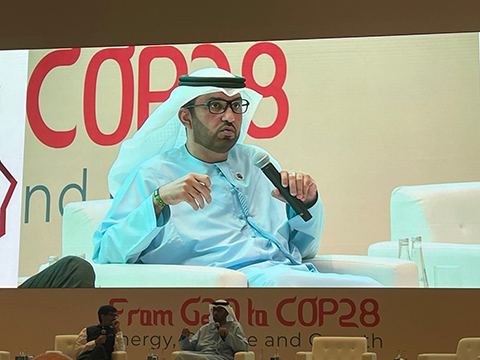
Summary of remarks by Dr. Sultan Al Jaber:
- At COP28, we are committed to climate action as an opportunity for growth and aim for an ambitious and balanced outcome through the Global Stocktake (GST).
- We will engage in open dialogue to resolve climate finance to make it available, accessible and affordable for the Global South.
- The still unfulfilled 14-year old USD 100 billion commitment must be fully implemented. Adaptation finance must be doubled and the fund for loss and damage must be fully operational.
Agenda: https://www.orfonline.org/research/from-g20-to-cop28-energy-climate-and-growth/
15 November 2023 | Insights into Climate Induced Human Mobility in Bangladesh

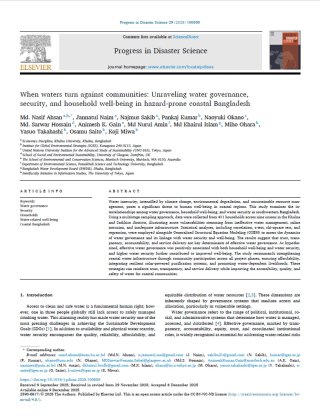
Under the theme of climate induced human mobility within our ongoing project on the Asia Pacific Climate Security APCS initiative, we initiated our project activities with a field visit to Bangladesh between 30 October to 2 November, 2023. To comprehensively understand the intricate issue of climate induced human mobility, we conducted a preliminary visit to our study area in Koyra, Khulna district, Bangladesh. The main objective of this visit is to develop a robust hypothesis and research methodology based on the ground reality. We achieved this through a comprehensive household questionnaire survey and key informant interview using open ended questions. For the latter, we partnered with Unnayan, the largest NGO actively engaged in addressing climate security, human well-being and sustainable in this area.
For the household surveys, we visited both the regions severely affected by the climate crisis in Koyra and two informal settlements in Khulna where climate-affected people are relocated.
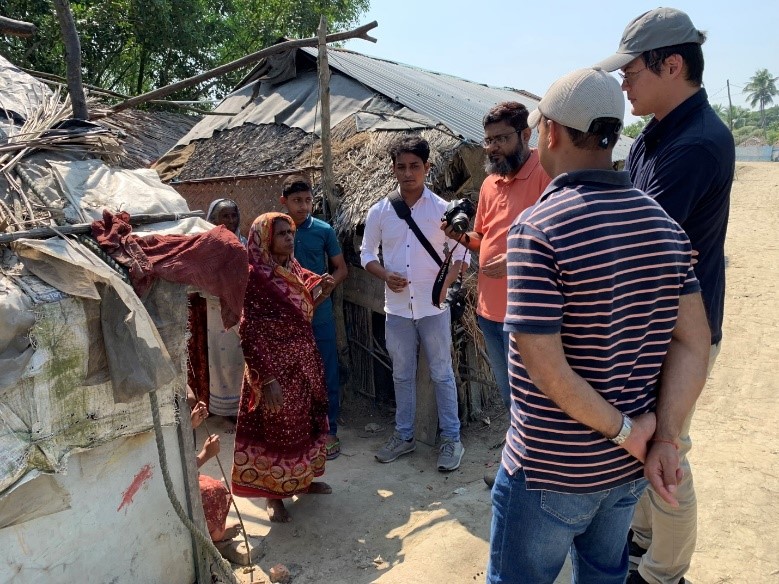
The household and focus group discussions gave us fundamental insights into the key drivers and pressures contributing to climate induced human mobility in this region. These discussions unveiled the associated risks that the local populations face. It is evident that the people in this region endure severe hardships due to extreme weather events induced by climate change such as typhoons and flooding. The gradual salinisation of groundwater aquifers, which is the only source of usable freshwater compounds their challenges. These issues are exacerbated by inadequate governance, inadequate resource management, lack of nexus approach, and insufficient coordination among key players responsible for addressing this critical matter. Crop failure, lack of livelihood, and lack of sufficient drinking water are the main percussions leading to poor well-being and mental stress, leading to migration and occupation shift.
We aim to establish a transdisciplinary team in collaboration with Khulna University to address the multifaceted challenge of climate-induced human mobility comprehensively.
20 October 2023 | Building a Climate for Peace and Solutions for Fragile Contexts: Berlin Climate and Security Conference 2023 (BCSC)

BCSC, co-hosted by the renowned German think tank adelphi and the German Federal Foreign Office, has been held annually since 2019. This year's meeting was held on 6 October, under the theme of "Building a Climate for Peace" and brought together policymakers and climate security experts from around the world.
The 2023 BCSC highlighted concrete actions for climate change mitigation and peacebuilding, emphasising initiatives and tools aimed at reducing risks, such as conflicts related to issues like food and water security, through climate change mitigation.
The need for fragile context climate measures, which aim to reduce conflict risks, was repeatedly underscored. It is vital to consider both the view that climate change can exacerbate conflict risks and the perspective that conflict risks can hinder climate change mitigation efforts. Many countries with high conflict risks are also vulnerable to climate change, and the international community must work together to break the vicious cycle between conflict and climate change.
The conference highlighted several examples from African countries which are heavily impacted by climate change and face elevated conflict risks due to various reasons. While drawing insights from concrete initiatives in Africa, it is essential to take action connecting climate change and peacebuilding in other regions. The Asia-Pacific region, which itself faces increased climate-related disasters and the threat of rising sea levels, would also benefit from incorporating climate security into its decision-making.
Associated Staff
-
-
-
-
-
-
-
-
-
-
-
-
 Deputy Director of Strategic Operations / Senior Strategic Operations Coordinator / Research Administrator
 -
-
-