
Results 851 - 860 of 5563 (Sorted by date)
Non Peer-reviewed Article

In Satoyama Initiative
At 14:46 on March 11, 2011, the largest earthquake ever recorded, with a magnitude of 9.0 on the Richter scale, occurred, and together with the subsequent tsunami, caused extensive damage along the Pacific coast of the Tohoku region in Japan. The human casualties, as reported by the National Police Agency on April 10, 2015, were 15,891 dead and 2...
Non Peer-reviewed Article
In Satoyama Initiative
The 1637 Shimabara-Amakusa Rebellion occurred in the early Edo period of Japan. This was an uprising against harsh regime enforced in the Shimabara domain, including heavy taxation and the violent prohibition of Christianity. The rebels fought against the shogunate forces, but the uprising was suppressed and the rebels executed. The “Minami...
Non Peer-reviewed Article
In Satoyama Initiative
At the end of World War II, the Battle of Okinawa was fought between Allied and Japanese forces on the Okinawa islands. The Battle of Okinawa was a ground war directly involving the people of the prefecture, and 120,000 of the then population of approximately 490,000 were killed. Of these, 94,000 were civilian casualties. After the war, Okinawa was...
Non Peer-reviewed Article
In Satoyama Initiative
Larch forestry has thrived in Atsuma town under a relatively mild climate and clear-cutting operations have been carried out with well-developed forest roads. Besides, a new trend is emerging. It is a trial-and-error process to find diversity in the way people relate to the forest and reflect it in the way they make a living. The horse logging...
Conference Proceeding
Online Course on Municipal Solid Waste Management (MSWM) towards Circular Economy
This event was organised as part of IGES-CCET’s collaboration with ADB on improving waste management and the circular economy in Asia and the Pacific. This online course was a capacity-building programme for Asian Development Bank (ADB) personnel and technical staff that aimed to provide them with the planning knowledge and skills needed to perform...
Presentation
2nd Technical Working Group Meeting on Formulation of National Plastic Action Plan in Myanmar
The 2nd Technical Working Group meeting to develop National Plastic Action Plan in Myanmar was organized on January 11, 2023 as an online event. During the TWG meeting, Hotta presented the current status of internatonal cooperation on plastic pollution in ASEAN countries as well as its implications to interanational negotiation to develop...
PR, Newsletter or Other
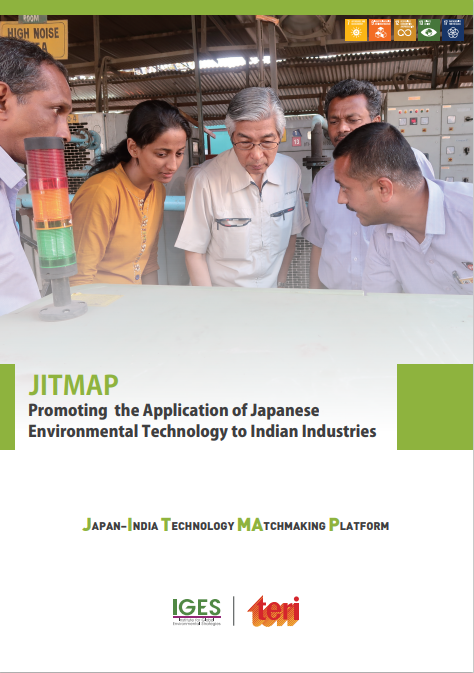
This brochure was prepared to publicize the Japan-India Technology Matchmaking Platform (JITMAP), which was established in FY2016 by IGES-KRC in collaboration with The Energy and Resources Institute (TERI) of India and is being operated in India, with the aim of increasing awareness and expanding the number of new Implementing Partners. JITMAP is a...
Peer-reviewed Article
In Sustainability
In recent times, environmental stewardship of mangroves has provided the impetus to protect and restore these ecosystems for their inherent ability to protect coastal regions from climate change, sequester carbon dioxide as rich blue carbon, and support human well-being through a multitude of ecosystem services. Participatory stakeholder assessment...
Peer-reviewed Article
In Climate
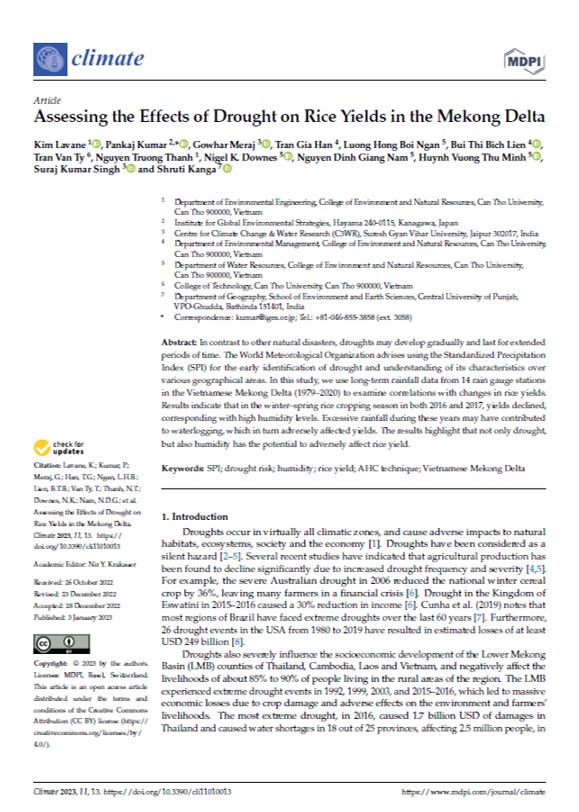
In contrast to other natural disasters, droughts may develop gradually and last for extended periods of time. TheWorld Meteorological Organization advises using the Standardized Precipitation Index (SPI) for the early identification of drought and understanding of its characteristics over various geographical areas. In this study, we use long-term...
Book
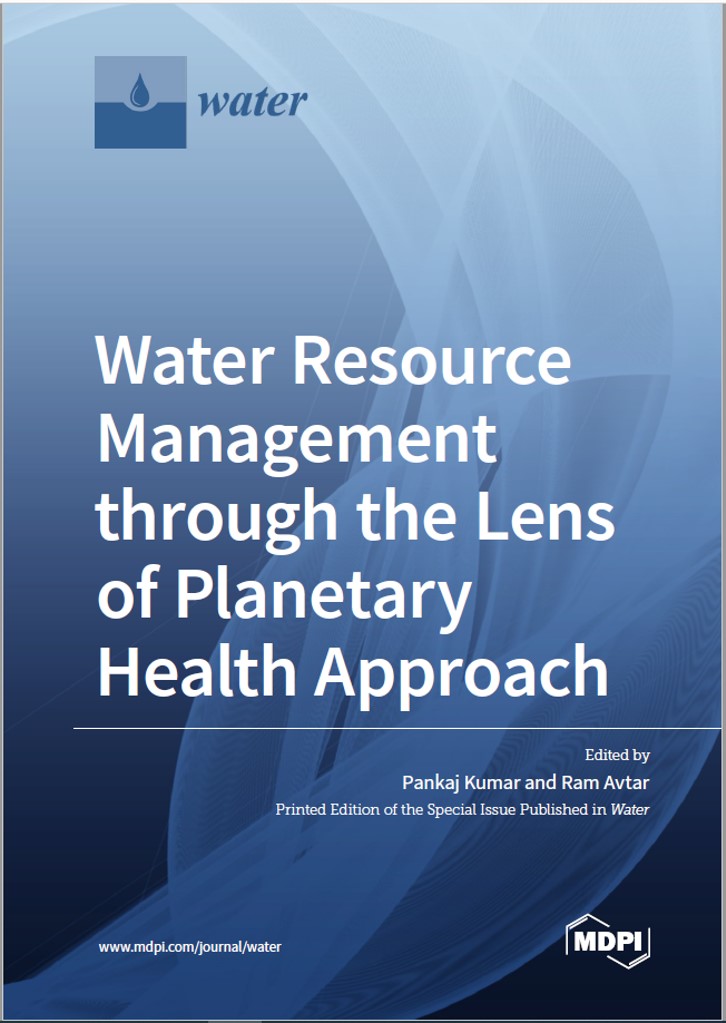
For eternity, water resources have proven to be the key to inclusive social development and human well-being. However, the spatio-temporal variation of this finite resource over various landscapes makes it prone to misuse and mismanagement. Rapid global changes such as urbanization, population growth, socio-economic change, change in lifestyle...