
Results 51 - 60 of 5560 (Sorted by date)
Technical Report
Lao PDR is at a pivotal moment in its development trajectory. As a least developed country (LDC) on track to graduate by 2026, its food systems face increasing pressure from climate change, structural transformation, and resource constraints. Agriculture remains central to livelihoods, food security, and poverty reduction, employing nearly three...
Peer-reviewed Article
In Small Scale Forestry
Sustainable use of biodiversity in the Sundarbans- the world’s largest mangrove forest shared between Bangladesh and India has become increasingly complex due to rising climatic and livelihood pressures. There has been a general agreement that traditional ecological knowledge (TEK) is key to supporting ecosystem services (ES) and community...
Peer-reviewed Article

In Sustainability Science
Achieving sustainable food systems that align with planetary and human health goals requires assessments of dietary patterns, supply structures, and environmental impacts. This study presents the first comprehensive evaluation of Japan’s food system, using the EAT-Lancet Healthy Reference Diet (EHRD) as a benchmark. First, this study developed an...
Peer-reviewed Article
In Environment: Science and Policy for Sustainable Development
The term “transformative change” has evolved into a one-stop-shop concept in sustainability circles. In peer-reviewed journals in the fields of environmental science, agricultural and biological sciences, and earth and planetary sciences, it appeared only 75 times prior to 2010, but 1,012 times from 2010 to 2019, and 3,534 times in just the first...
Presentation
Peer Learning Cohort Event on Monitoring, Evaluation, and Learning (MEL) Systems for NAP Processes
Monitoring, Evaluation, and Learning (MEL) systems are essential for effective National Adaptation Plans (NAPs), a need intensified by the adoption of the Belém Adaptation Indicators at COP30. Japan addresses this through a statutory framework under the Climate Change Adaptation Act, managing progress via a systematic five-year PDCA cycle. This...
Peer-reviewed Article
In Water
Suspended sediment concentration (SSC) and sediment flux (SF) are critical indicators of sediment delivery in the Lower Mekong and underpin deltaic geomorphic stability and ecosystem services. With recent evidence of declining sediment supply caused by upstream regulation and intensive in-channel extraction, there is a pressing need for...
Peer-reviewed Article
In Environmental Research
Fluvial sediment fluxes are reshaping coastal water colour, geomorphology, and ecological processes, yet schemes based on single-river loads or shoreline change may miss land-sea responses. We combine SSC records from 19 river stations across nine Chinese basins (2004-2024) with MODIS reflectance to characterize clearing, brightening, regional...
Peer-reviewed Article
In Water Research X
Changes in land use over space and time are key drivers of water pollution. However, current studies on landuse–water-quality relationships in small watersheds are insufficient to support regional development. Comparative research across large-scale watersheds can better inform water environmental protection, yet such studies remain limited. This...
Commissioned Report
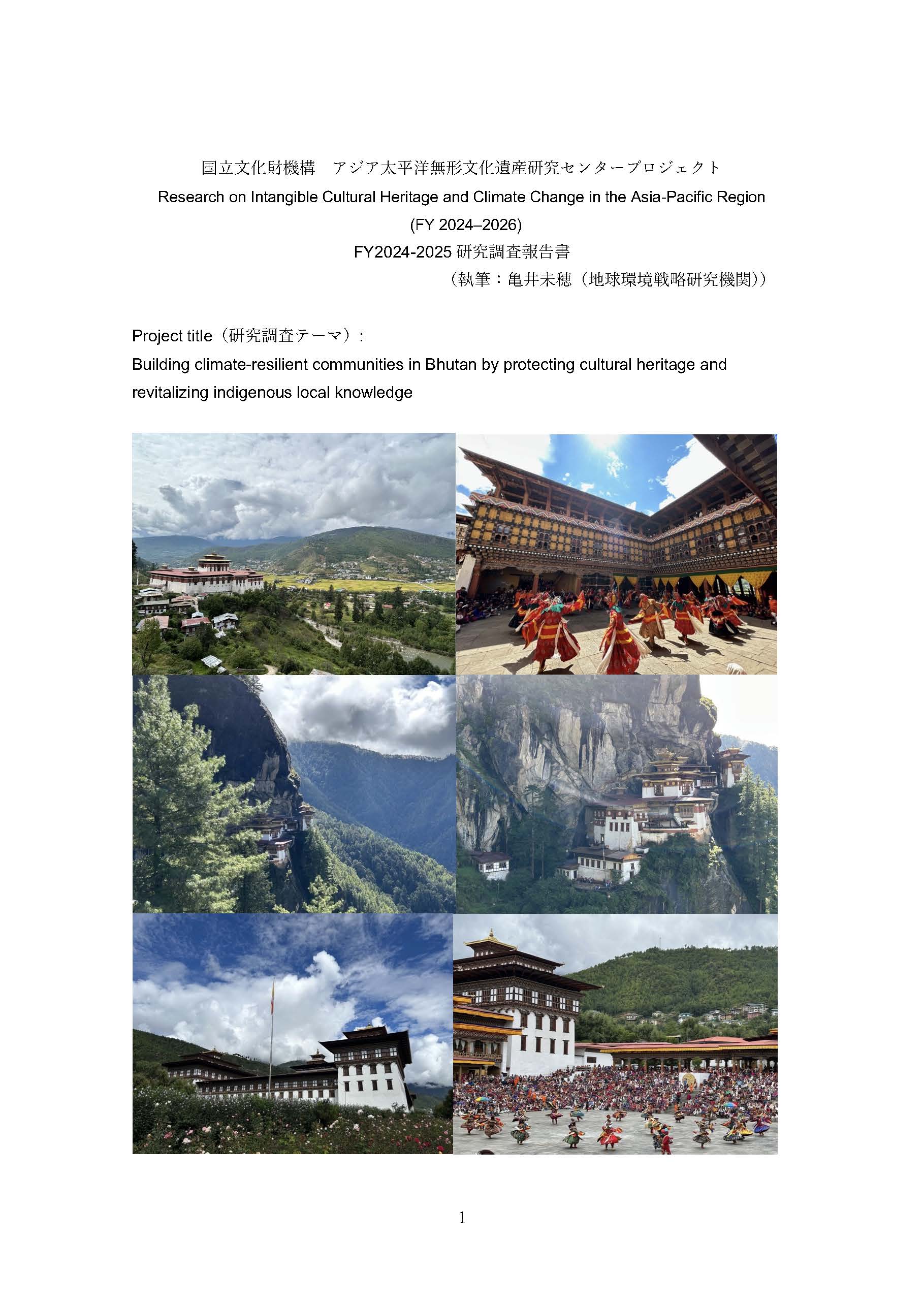
This research aims to contribute to the new scientific knowledge related to the adaptation and climate resilient development strategies. In particular, cultural heritage is a new element for the Global Goals on Adaptation (GGA) in the UAE Framework for Global Climate Resilience, which was adopted in Dubai 2023. Creating new scientific knowledge on...
Presentation
Research on Intangible Cultural Heritage and Climate Change in the Asia-Pacific Region/ Second Online Meeting
Presentation at the year-end project meeting : Research on Intangible Cultural Heritage and Climate Change in the Asia-Pacific Region, coordinated by International Research Centre for Intangible Cultural Heritage in the Asia-Pacific Region (IRCI)