
Results 2321 - 2330 of 5566 (Sorted by date)
Presentation
The 12th Policy Consultation Forum of Seoul Initiative Network on Green Growth
The presentation discussed importance of nexus approach for sustainable use of environmental resources. Taking the case of India, it presented how current sectoral approach approaches creates trade-off. It also suggested solutions to minimize trade-off and capture multiple benefits across the water energy and food nexus.
Data or Tool

IGES made a proposal of an MRV methodology for the JCM projects which installs solar PV systems to the JCM Joint Committee between Japan and Costa Rica. The Joint Committee approved a methodology CR_AM001 Ver1.0 "Installation of Solar PV System" on the basis of this proposal. The attached version (PM_001) includes three documents: the JCM Proposed...
Presentation

ISIE/ISSST 2017 Joint Conference
We showed the difficulty to realise sustainable living in terms of reduction of ecological footprint of final demand (EF_FD). In Japan, a high rate carbon tax effectively reduces carbon footprint of production (50% reduction from the base year), but EF_FD reduces much less (24.7% reduction by upstream carbon tax and 27.0% by midstream carbon tax)...
Conference Proceeding
The 9th biennial conference of the International Society for Industrial Ecology (ISIE) and the 25th annual conference of the International Symposium on Sustainable Systems and Technology (ISSST)
Developing methodology to evaluate decoupling economic growth from environmental impacts of materials use in Japan. The study estimates environmental impact at macro level associated with material use using MFA and LCA.
Policy Brief
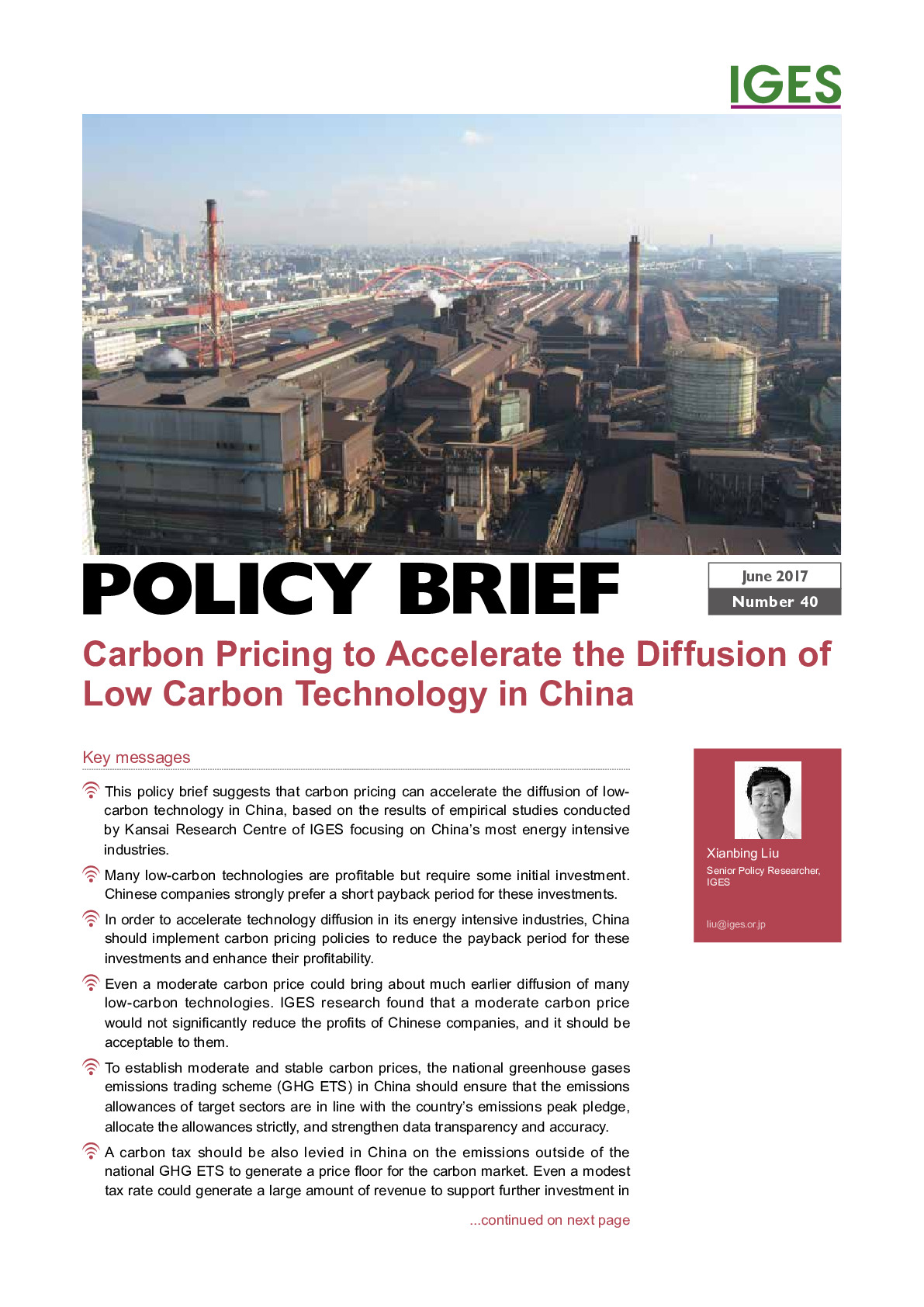
This policy brief suggests that carbon pricing can accelerate the diffusion of low-carbon technology in China, based on the results of empirical studies conducted by Kansai Research Centre of IGES focusing on China’s most energy intensive industries.
Data or Tool

IGES Climate and Energy Area has gathered responses and comments from national and local governments, international organisations, leading companies/industry associations, NGOs, think tanks, etc. on the decision of the US to withdraw from the Paris Agreement announced by President Donald J. Trump on 1 June 2017 and compiled them into one tabulated...
Training or Learning Material
This is the second video of two e-learning and training videos based on the content and activities of the project entitled "Harnessing Climate Change Mitigation Initiatives to Benefit Women" funded by the Asian Development Bank (ADB). This 15-minute instructional video presents the nine step process that helps mainstream gender into climate...
Training or Learning Material
This is the first video of two e-learning and training videos based on the content and activities of the "Harnessing Climate Change Mitigation Initiatives to Benefit Women" project funded by the Asian Development Bank (ADB). This 10-minute case study documentary demonstrates the urgent need to ensure women benefit from activities that mitigate...
Working Paper
This paper goes through the three historical experiences of carbon taxation in France and provides a detailed overview of the past attempts and current challenges to effectively put a price on carbon. By analysing the characteristics of each case, it explains the reasons for failure and success in adopting such tax and tries to help the reader...
Peer-reviewed Article

In Journal of Forestry Research
Incentive design is among the decisive factors behind active community participation and long-term sustainability of participatory forest management. Especially in case of mangroves, where multiple interests apply, it requires a careful integration of several ecological, economic and institutional factors. The primary objective of this paper is to...