- English
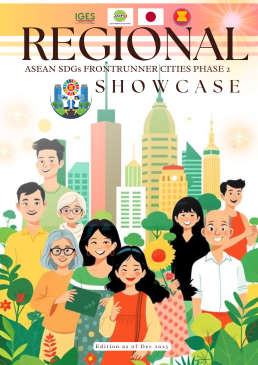


From "Islands of Excellence" to a "Sea of Change": How ASEAN's Secondary Cities are Localising the SDGs in the region
As the ASEAN region rapidly urbanises, the focus often falls on its mega-cities. However, a quiet transformation is underway in the region’s secondary cities -- the agile urban centres that are proving to be fertile ground for sustainability experiments.
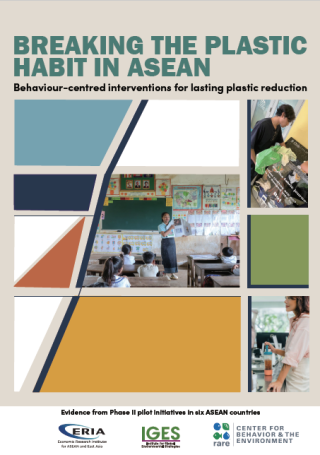
The SDGs Frontrunner Cities Programme (Phase 2), supported by the Japan-ASEAN Integration Fund (JAIF), demonstrates that impactful actions often begins at the local level. This report provides a snapshot of how ten Frontrunner cities across ASEAN are now scaling "bottom-up" innovations that address marine plastic pollution and enhance urban resilience,
Key Highlights and Case Studies in the Report
• Nature-Based Solutions for Flood Management: In the highly flood-susceptible Prik Municipality, Thailand, local administrators have adopted the nature-based solutions sucha s "Monkey Cheeks" (Kaem Ling), solar-powered water utilities, municipality-designed local disaster education curriculum and participatory methods of smart, data-driven water management. They present an exemplary case of next-generation disaster management in line with the UN Sendai Framework, by anticipating, preventing, and reducing risks before hazards turn into disasters.
• Circular Economy and Social Enterprise: On Malaysia’s Redang Island, the "Hermie’s Hub" initiative has been successfully incubated and registered as a social enterprise. By upcycling marine plastic into souvenir products and linking it as a potential tourism activity in cooperation with a local hotel, the project aims to create new economic opportunities for the local community, while also testing a new approach to raise awareness on the marine plastic pollution crisis.
• Inclusive Technology: In Saensuk Municipality, Thailand, inclusivity and multi-stakeholder collaboration drives innovation. To support the senior-aged volunteers who lead public beach clean-up and awareness raising campaigns, a new ergonomic rake was designed to reduce physical strain, demonstrating how technology can be tailored to demographic shifts and an ageing volunteer workforce. Community social enterpreneurs are also joining forces with the local university to upcycle waste plastic into a municipality-branded range of craft products, towards a new model of Community-based Tourism aligned with Zero Waste vision.
• Institutionalising Informal Waste Sectors: Surakarta, Indonesia, is expanding the "Waste Bank" model by establishing a a central Waste Bank hub for strategic expansion empowered with research oversight. By boosting satellite waste bank performance through a centralised capacity support platform, a larger number of residents gain opportunities to turn waste management into new jobs and tangible resources, while also generating newfound social capital.
• Data-Driven Air Quality Management: Parañaque City, Philippines, has established its first Clean Air Action Plan (CAAP) targeting the mobile sector. By conducting emissions inventories, creating multi-departmental taskforces and allocating implementation resources, the city is moving from reactive measures to institutionalised air quality management.
• Climate-Adaptive Communities: In Banda Aceh, Indonesia, the 2004 tsunami has spurred significant recovery efforts and the development of improved disaster management systems. The city has established climate-conscious villages in line with the National 'PROKLIM" programme. Local model communities integrate urban greening, gardening and waste management with climate adaptation, enhancing food security while also strengthening social resilience.
• Decentralised Waste Management: Xay City, Lao PDR, is piloting waste separation in schools to capture recyclables in collaboration with the private sector, creating a replicable model for public-private cooperation in waste management for the country.
• Decentralised Waste Management: Xay City, Lao PDR, is piloting waste separation in schools to capture recyclables in collaboration with the private sector, creating a replicable model for public-private cooperation in waste management for the country.
• Participatory Urban Greening: Kep and Kampot City in Cambodia, as well as Xay City, Lao PDR, demonstrate a shift away from top-down tree planting projects. By inventorying and labelling valuable trees, embedding local communities in the whole project cycle, establishing city-led tree nursery programmes and recruiting regular volunteers from diverse social segments, a new culture and generation of nature-positive and tree-loving guardianship is emerging.
- English