Results 1 - 10 of 59 (Sorted by date)
Issue Brief
The economic disruptions from the Ukraine war have intensified short term concerns about energy and food security, as well as access to critical minerals. Climate security is also increasingly urgent. This paper urges governments to speed up, not slow down, transitions away from fossil fuels and toward more sustainable development patterns. The war...
Commissioned Report
The study was conducted under the ITTO Project PDD/21 Rev. 1.2 "Promotion of Sustainable Domestic Wood Consumption in Vietnam" to examine policies and initiatives for promoting sustainable wood use by Japan's public/private sectors and identify key approaches and measures to draw lessons for other countries seeking to promote sustainable wood use...
Policy Report
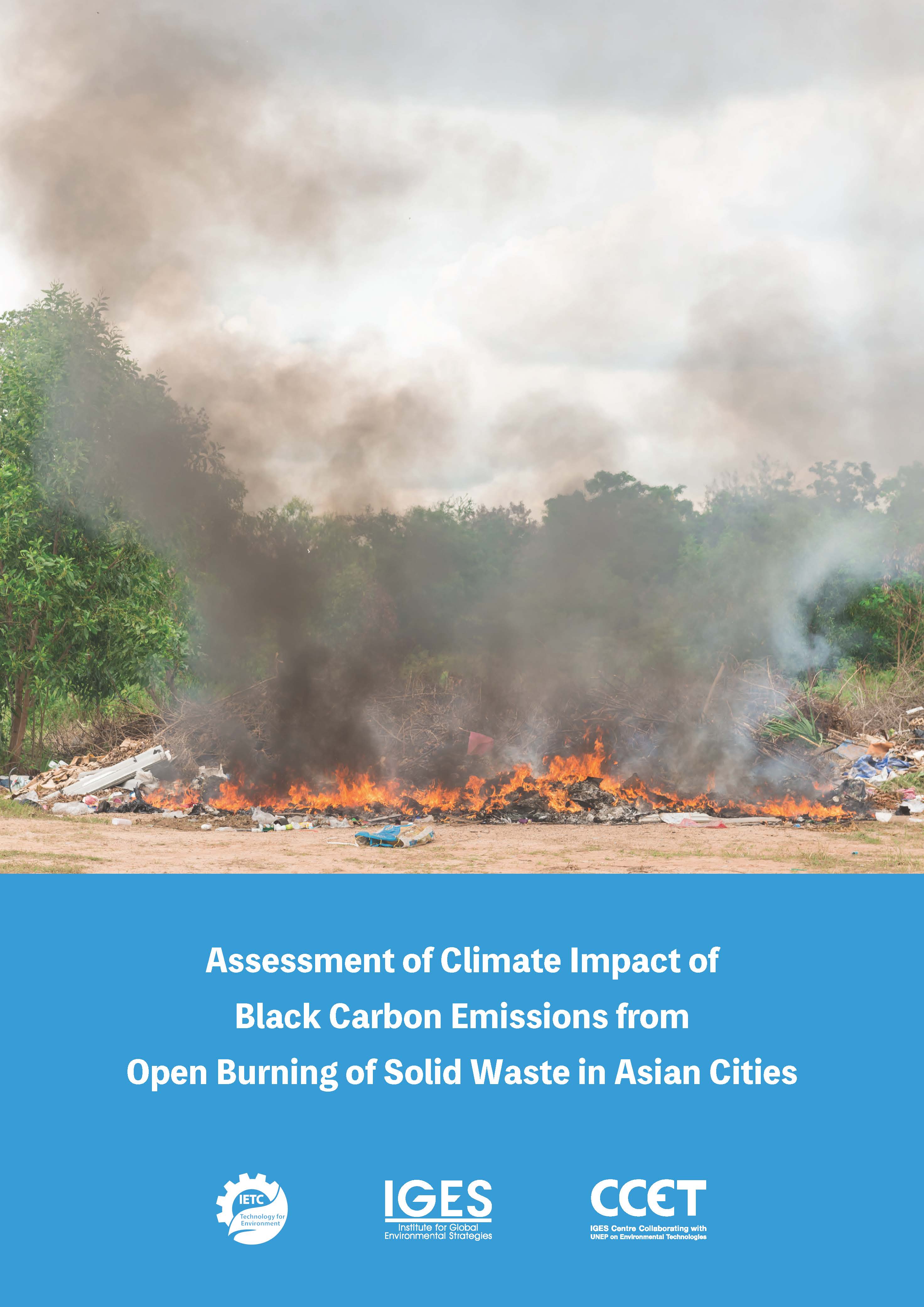
Open waste burning is a widespread practice that is provoked by a lack of systematic waste collection, the unavailability of other disposal options, and inadequate land for the final disposal of the collected waste, especially in low- and middle-income countries. From a global perspective, two billion people have no waste collection at all, and the...
Presentation
ERIA-IGES-APRSCP Hybrid Event: ‘The Implementation of Extended Producer Responsibility in the Asian Context: Challenges and Lessons Learned'
Dr Yasuhiko Hotta, Vice President of APRSCP and Programme Director of Sustainable Consumption and Production Area at IGES, identified six challenges for adopting EPR: interpretation of EPR, the difficulty of identifying producers, the infeasibility of the take-back scheme, competition with the informal waste management sector, waste collection and...
Presentation
APRSCP Side Event "Plastic Free Rivers for Resilient Riverine Communities"
For a pollution free planet, UNEP has been implementing plastic pollution-related projects in the Mekong basin countries since 2019. Past projects aimed to identify a region-based model for monitoring and assessment of plastic leakage and pollution reduction targeting land-based plastic leakage entering waterways such as rivers and canals or...
Presentation
16th Asia Pacific Roundtable of Sustainable Consumption and Production
At the session 2 of 16th APRSCP, along with GIZ, SWITCh-Asia, and UNEP, IGES presented a key concept for APRSCP Strategy, IGES emphasized the changing emphasis of SCP over the last 30 years. Also, considering many ongoing international initiatives on SCP and circular economy, it is necessary to consider collaboration and synergies among many on...
Policy Report
The objective of this report is to provide an analysis of the current policy environment for garment production in Cambodia, applying a systems lens to identify challenges and opportunities for enhancing the sustainability of the sector. To maintain the competitiveness of Cambodia’s garment sector in the global market, a shift to sustainable...
Presentation
SETAC North America
Author:
Valentina
Pauna
Susanne
Brander
Kara
Wiggin
A global agreement to end plastic pollution must be based on pertinent, multi-disciplinary knowledge. Consideration of the full life cycle impacts of plastics and substitutes is important to achieve sustainable solutions rather than shifting the burden. Hence, this process requires considerations of fossil-based and biobased feedstocks for plastic...
Training or Learning Material
Online Course on Municipal Solid Waste Management (MSWM) towards Circular Economy for Asian Development Bank Staff
IGES organized a training course on muncipal solid waste management and circular economy on November 14-16, 2022 for ADB staff. During the training, Hotta provided a lecture as follows; Hotta shared that with economy and social development, policy is shifting towards CE. He buttressed his case with Japan as a case study. He stressed that in 60s and...
Research Report
The objective of this Guideline is to provide a systems approach to sustainable consumption and production (SCP) in the seafood sector in Vietnam that considers all stages of the production chain. SCP is conceived as a crucial framework for achieving the social and economic benefits, and minimizing the environmental burden, of Vietnam’s seafood...