The indicator “co-benefits of the 3Rs (reduce, reuse, recycle) of municipal solid waste on climate change mitigation” aims to maximize use of resources which can significantly contribute not only to reduce GHG emissions but also to receive other co-benefits such as creating green jobs, improving social well-being, reducing health risks, enhancing...
Results 4671 - 4680 of 6422 (Sorted by date)
Editor:
Ryoko
SEGUCHI
Th is report was developed by Friends of the Earth Japan (FoE Japan) and the Institute for Global Environmental Strategies (IGES) with updated case studies as an English-language version of the Japanese report “Yori sukunai shigen de yori yutakana kurashi wo (A Richer Life with Fewer Resources),” published by FoE Japan in March 2013. This report...
The indicator “promoting full-scale use of agricultural biomass residue and livestock waste” aims to maximise use of agricultural biomass residue and livestock waste through reuse and recycling measures. This would bring about a number of co‐benefits, including GHG emission reduction, energy security, poverty reduction, sustainable livelihoods in...
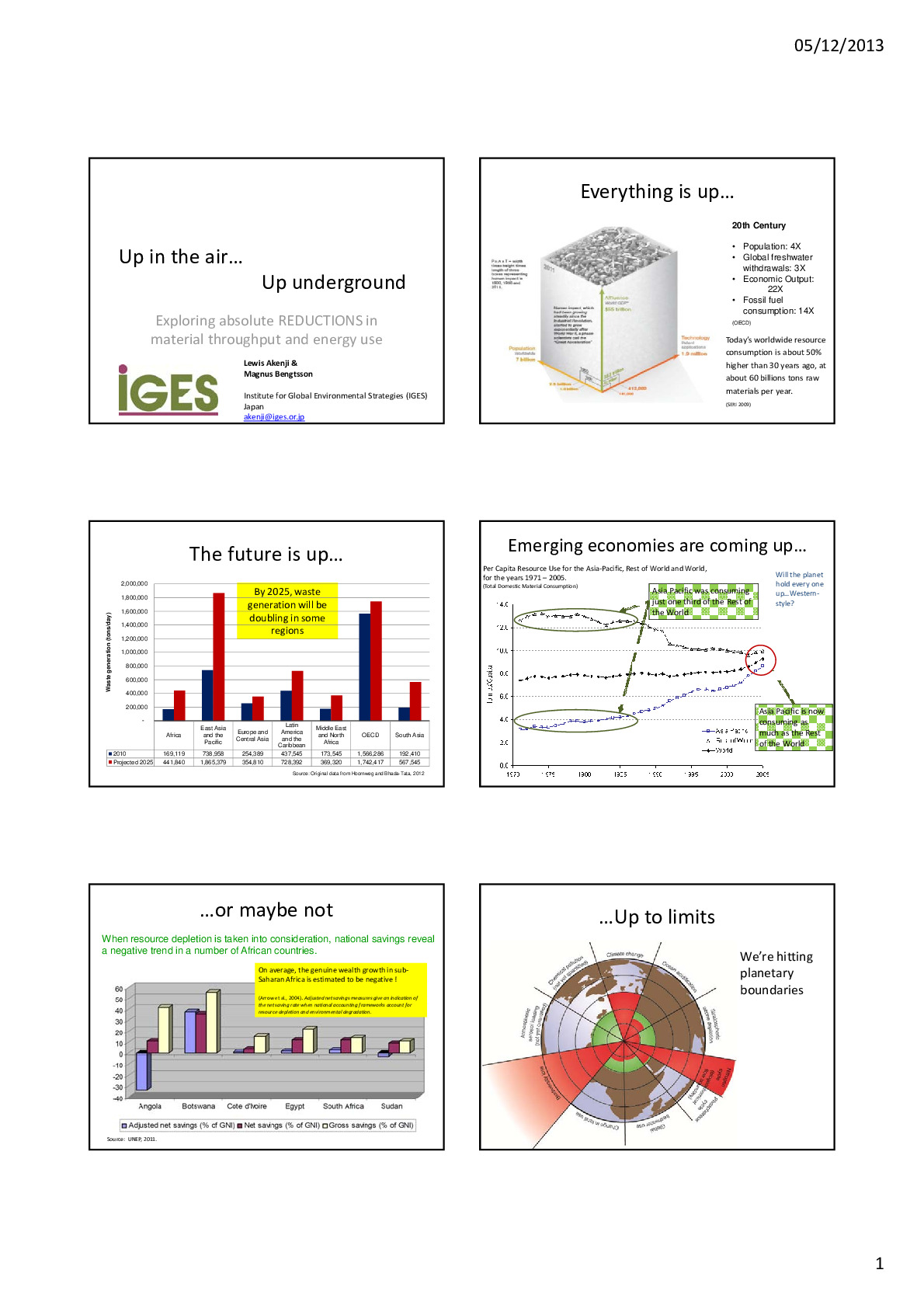
MSW (municipal solid waste) generation and MSW generation per capita refer to indicators of environmental pressures humankind exerts on the environment (OECD, 2003), and by extension, environmental pressures caused by the use of natural resources. Currently, 340 million tons of MSW is generated a year in South Asia, East Asia and the Pacific Region...
Most industrial operations are linear processes in which raw materials are processed into products, with waste as a by-product. However, waste is also generated at the time of raw material extraction, during processing, and ultimately at the end-of-life stage of a product. To minimise, reutilise or recycle waste at each stage, industrial operations...
The basic qualitative indicator Hazardous Waste refers to the existence of regulations controlling hazardous waste. The presence of regulations themselves should also promote environmentally sound management of hazardous waste. Amounts and rates of generation of hazardous waste are the main quantitative indicators. To assess a country’s hazardous...
Public awareness of appropriate solid waste management practices (3Rs; Reduce, Reuse, Recycle) is the starting point for and fundamental ingredient of a sound material-cycle and resource-efficient society. Public awareness forms the basis of public capacity, which enables the public to undertake actual actions of each element of the 3Rs. Such...
Material Flow Analysis/Accounting (MFA) is one of the analytical tools that make it possible to monitor countries’ resource consumption trend and efficiency in resource use at the macro level. It uses already available production, consumption and trade data in combination with environmental statistics (OECD 2008). In principle, MFA can show not...
UCI Machine Learning Repository
Data set for monitoring Japanese forest health using satellite imagery and machine learning techniques. Published in the UCI Machine Learning Repository (http://archive.ics.uci.edu/ml/datasets/Wilt), the largest machine learning database worldwide. Researchers can use the data set to learn, develop, and improve methods for forest monitoring using...
In developing Asian countries, recycling is carried out under market mechanisms. Recyclable waste is not only collected in the region, but also imported from other regions, such as Europe and North America. Concerns have been raised about issues such as occupational health and pollution associated with recycling. In particular, the safety and...