

Results 1651 - 1660 of 5565 (Sorted by date)
Book Chapter

In Anthropogenic Tropical Forests: Human–Nature Interfaces on the Plantation Frontier
It is important to understand carbon (C) dynamics in terrestrial and coastal ecosystems in order to develop a strategy to control carbon dioxide effluxes. However, the factors determining concentrations of riverine carbon are still largely unknown, especially in Southeast Asia. We investigated the spatial distribution of dissolved and particulate...
Book Chapter
In Anthropogenic Tropical Forests: Human–Nature Interfaces on the Plantation Frontier
Over the last few decades, the landscape of Borneo has drastically changed from primary forests to a mosaic of secondary forests and crop plantations, and more recently to the monocultures of single crop plantations. At the same time, livelihoods have become more linked to urban economies. To evaluate the effects of these changes on hunting...
Book Chapter
In Anthropogenic Tropical Forests: Human–Nature Interfaces on the Plantation Frontier
The island of Borneo is regarded as one of the most biologically rich regions in the world, containing some of the oldest remaining tropical rainforests. However, it also suffers high levels of deforestation and degradation to meet the demands for timber extraction and agricultural activities. In Sarawak, areas designated as permanent forests...
Book Chapter
In Anthropogenic Tropical Forests: Human–Nature Interfaces on the Plantation Frontier
While Borneo is a global biodiversity hotspot, its species-rich natural rainforests have been degraded and deforested in the past few decades by unsustainable shifting agriculture, commercial logging and the rapid development of industrial tree and oil palm plantations. Populations of some wildlife species have decreased drastically due to...
Book Chapter
In Anthropogenic Tropical Forests: Human–Nature Interfaces on the Plantation Frontier
This chapter discusses the historical formation and current features of society in the Kemena and Tatau river basins in Bintulu, central Sarawak, where various ethnic groups live close together in a small area as a result of the historical migration of each group. We refer to previous studies and to interviews we conducted, mainly in 2011...
Book Chapter
In Anthropogenic Tropical Forests
Rapid development in Bintulu has resulted in large-scale changes in land use, especially the conversion of forests into oil palm plantations and industrial tree plantations. Using high-resolution satellite imagery, we analysed land-cover types in the Kemena–Tubau–Lower Jelalong region of Sebauh subdistrict and classified them into nine major land...
Book Chapter
In Anthropogenic Tropical Forests: Human–Nature Interfaces on the Plantation Frontier
In the traditional agricultural land-use pattern of the indigenous peoples of inland Sarawak, there are small areas of primary forests, referred to as a pulau or communally reserved forests (CRFs), which are customarily reserved by local communities. Here, we investigate the current condition and geographic distribution of CRFs in the human...
Book Chapter
In Unmanned Aerial Vehicle: Applications in Agriculture and Environment
Geospatial data of urban green spaces (UGS) is mostly unavailable for emerging Indian cities, which effects their provisioning, maintenance and monitoring. In absence of spatial data, the strategic vision and comprehensive urban planning to enhance urban environment of cities witnessing transition are compromised. Owing to the direct link between...
Submission to Policy Process
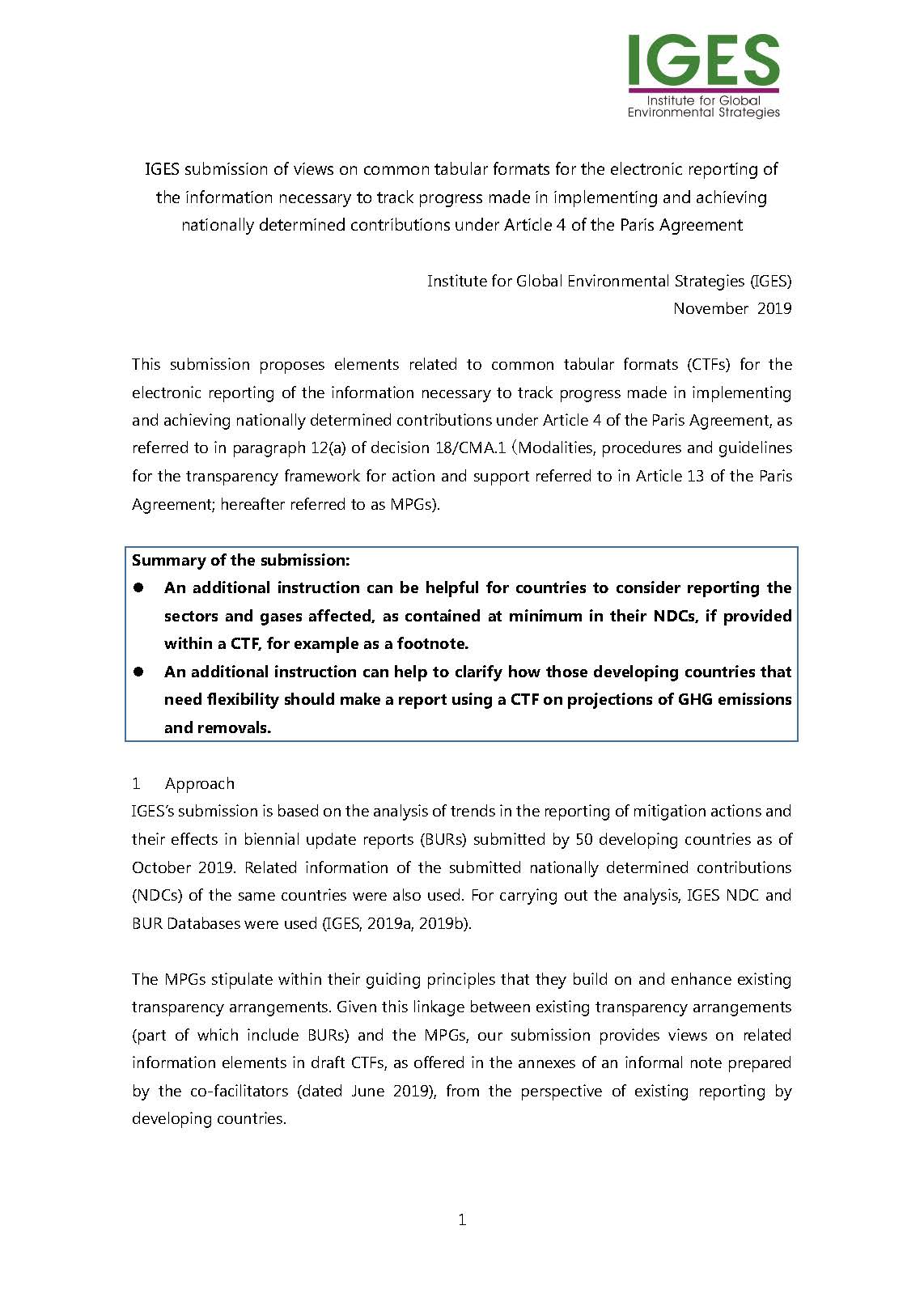
This submission proposes elements related to common tabular formats (CTFs) for the electronic reporting of the information necessary to track progress made in implementing and achieving nationally determined contributions under Article 4 of the Paris Agreement. Summary of the submission: An additional instruction can be helpful for countries to...
Book Chapter
In Anthropogenic Tropical Forests: Human–Nature Interfaces on the Plantation Frontier
The biodiversity of stream-dwelling fish and the effects of oil palm and acacia plantations on this biodiversity were evaluated by field research conducted in the Bintulu region of central Sarawak, Malaysia. A quantitative survey was conducted at 61 locations by electrofishing. These 61 locations included 16 sites in oil palm plantations, five...