Our lifestyles, through the impacts of our day-to-day activities such as eating, moving and commuting, heating and cooling our homes, taking work and care responsibilities, and so on, have become major threats to the sustainability of the environment. We are living beyond our ecological means and experiencing both very serious impacts on...

- Clear all
- Language: (-) Thai
- Language: (-) Spanish
- Language: (-) Slovak
Results 1 - 10 of 15 (Sorted by date)
This catalogue has been produced for the workshops and home experiments organised by the 1.5ºC Lifestyle Project. A decarbonised lifestyle to limit the carbon footprint (CFP), including CO₂ emissions plus CO₂ equivalent of the other greenhouse gas (GHG) emissions to 2,500 kg per year in 2030 and 700 kg per year in 2050. The options are divided into...
The indicators measure elements of SEPLS resilience that are, almost by definition, strongly interrelated. The practices and institutions that they describe can be grouped in five areas: • Landscape/seascape diversity and ecosystem protection • Biodiversity (including agricultural biodiversity) • Knowledge and innovation • Governance and social...
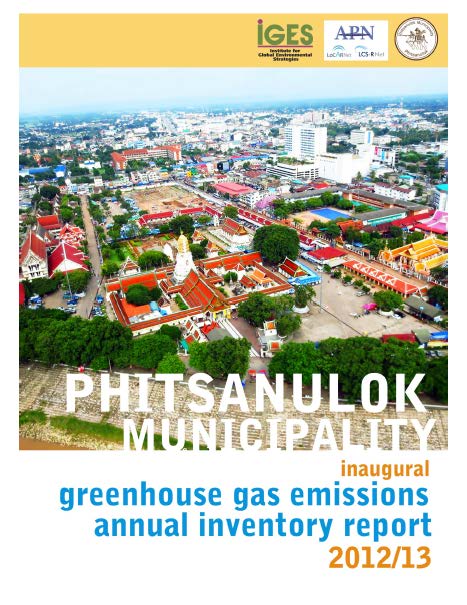
This publication is the first ever annual GHG emission inventory report of Phitsanulok Municipality, Thailand. It presents the GHG-related data for two types of inventories: (i) Municipal GHG inventory; referring to guidelines by ‘ICLEI (Local Governments for Sustainability) Local Government Thailand Greenhouse Gas Management Organization (TGO)...
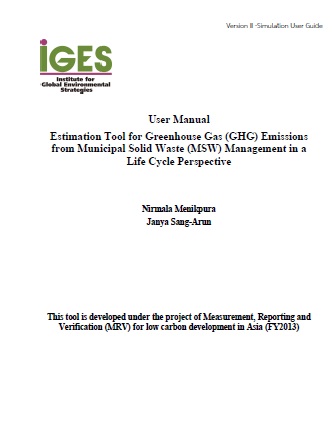
This GHG calculation tool is translated from the English version II to ease of use by local government in Thailand. The products include the GHG calculation tool based on Excel and a user manual that explains fundamental information of and how to use the IGES GHG calculation tool. Remarks: English and Khmer version are available.
This presentation briefly explains what is MRV and how to do MRV.
This presentation explains relation between municipal solid waste management and climate change including examples of climate friendly waste management practices.
The objective of this report is to facilitate local governments in decision making and implementation of urban organic waste utilization projects that can contribute to sustainable solid waste management and national agendas on food, energy, and climate change. This report provides an overview of national policy, regulations, and institutions...