This year, the Group of Seven (G7) Summit in June and the Group of Twenty (G20) Summit in November will be convened in Johannesburg, South Africa. Amid an increasingly complex international scenario, the G7 is expected to continue leading efforts to address global challenges and work in partnership with the Global South. The G20 Summit, which will be held for the first time on the African continent, will feature discussions that reflect the diverse positions and perspectives of its member countries on key issues.
■ Summit G7 Summit : 15 - 17 June 2025
G20 Summit: 22 - 23 November 2025
■ Environment-related Ministerial Meetings G7 Energy and Environment Ministers’ Meeting: 30 -31 October 2025 (Chairs’ Summary)
G20 Climate and Environmental Sustainability Working Group Ministerial Meeting: 16 - 17 October 2025
This special feature page highlights key trends and notable points related to sustainability discussions, explanations of the outcomes of the meetings, and introduces relevant IGES publications.
News
IGES Perspectives
“G20 Sustainable Finance Report and the Synergy Approach”
The G7, or Group of 7, consists of seven countries—France, the United States, the United Kingdom, Germany, Japan, Italy, and Canada—and the European Union (EU). In addition to summit meetings, ministerial meetings on specific topics are held annually. In 2025, Canada holds the G7 presidency, and the summit was held in Kananaskis, Alberta, on June 16 and 17.Under the leadership of the Canadian Prime Minister Carney, discussions were held on a wide range of topics, and concluded with the outcome documents on areas such as AI cooperation, the establishment of supply chains for critical minerals, and wildfire response strategies.
This special feature page provides expert perspectives on the outcomes of upcoming ministerial meetings related to the environment, energy, and sustainability, as well as trends in key themes and points of interest, along with explanatory articles and relevant IGES publications.
Engagement Groups
In addition to the Summit and ministerial meetings, the G7 has Engagement Groups, which are mechanisms independent of G7 governments that bring together stakeholders from various fields to make recommendations and other inputs.
There are seven official Engagement Groups: B7 (Business), C7 (Civil Society), L7 (Labor), S7 (Science), T7 (Think Tanks), W7 (Women), and Y7 (Youth). The recommendations (in the form of communiqués, statements, etc.) of each group are reflected in outcome documents of the Summit and ministerial meetings. The important role of engagement groups from various fields is growing in driving dynamic societal transformation, such as climate policy and achieving the Sustainable Development Goals (SDGs). Each year, multiple IGES researchers are involved in T7, and this year they contributed to drafting the T7 policy briefs.
G20, or Group of 20, consists of the G7 member countries (Canada, France, Germany, Italy, Japan, the United Kingdom, and the United States) plus Argentina, Australia, Brazil, China, India, Indonesia, South Korea, Mexico, Russia, Saudi Arabia, South Africa, Turkey, and the European Union (EU) and African Union (AU). The G20 is an important forum where ministers from various fields from each country gather to discuss various issues.
South Africa holds the presidency for 2025. Ahead of the G20 Summit to be held in Johannesburg on 22-23 November, the G20 Energy Transition Ministers' Meeting will take place on 26 September, and the G20 Climate and Environment Ministers' Meeting on 9 October. This page features articles on key trends and points of interest related to climate, energy, the environment, and sustainability, as well as relevant IGES publications.
Engagement Groups
Similar to the G7, the G20 has Engagement Groups composed of representatives from various stakeholders to provide policy recommendations for G20 deliberations. The engagement groups include B20 (business), C20 (civil society), SU20 (innovation, entrepreneurship, and collaboration), L20 (labor unions), O20 (ocean), P20 (parliament), S20 (science), SAI20 (supreme audit institutions), J20 (supreme courts), T20 (think tanks), U20 (cities), W20 (women), and Y20 (youth).
Here is the T20 South Africa 2025 Communiqué
Researcher's Perspectives

“G20 Sustainable Finance Report and the Synergy Approach”
The G20 Sustainable Finance Working Group (SFWG) was established to identify institutional and market barriers to mobilising greater public and private finance toward the objectives of the Paris Agreement and the 2030 Agenda, and to present policy options for addressing these barriers. The SFWG advances these objectives through several initiatives, including the publishing of an annual G20 Sustainable Finance Report. At the 2021 G20 Summit in Italy, the G20 Sustainable Finance Roadmap was endorsed in the Leaders’ Communiqué. The Roadmap outlines five priority areas and 19 corresponding actions related to climate change and broader sustainability issues, with progress reported and reviewed at each G20 Summit. The priority areas include developing sustainable finance markets; disclosure; risk assessment and management; the role of international development finance institutions and public finance; and transition finance.
The 2025 G20 Sustainable Finance Report1 reviews the progress made under the Roadmap and identifies three key priorities moving forward: strengthening the global sustainable finance ecosystem; scaling up finance for climate resilience and adaptation; and improving the integrity and functioning of carbon markets. Advancing these priorities is expected to help address systemic challenges in sustainable finance while generating multiple co-benefits across sustainable development priorities. Achieving multiple objectives simultaneously and generating integrated impacts is known as the synergy approach and has gained increasing international attention. For example, climate action contributes not only to reducing greenhouse gas emissions and enhancing climate resilience, but also to improving air quality, creating green jobs, enhancing public health, and conserving biodiversity.
Recognising the importance of this synergistic approach, the Sixth United Nations Environment Assembly (UNEA-6) held in February 2024 adopted the Resolution on Promoting Cooperation, Collaboration and Synergies in the National Implementation of International Environmental Agreements and Other Related Environmental Instruments2 proposed by the Government of Japan.
In response to these global developments, IGES is collaborating with the United Nations Economic and Social Commission for Asia and the Pacific (ESCAP), the United Nations Environment Programme (UNEP), and the Asian Development Bank (ADB) to prepare the Asia Synergy Report, which also examines financial mechanisms to support synergy-based approaches. Various financial mechanisms currently exist in the market, such as green bonds, impact investing, debt-for-nature swaps, and results-based financing, and the synergy approach is increasingly being incorporated into these mechanisms. To further scale up these efforts, it remains crucial to move beyond project-level initiatives and align investment priorities that integrate the synergy approach with the national-level strategies with relevant stakeholders. IGES will continue to contribute to international dialogue and advance research on the synergy approach and to developing methods and indicators for assessing synergistic impacts and ensuring data availability and accessibility.
1 https://g20sfwg.org/wp-content/uploads/2025/10/2025-G20-SFWG-Presidency-and-Co-chairs-SustainableFinance-report-1.pdf
2 https://www.env.go.jp/content/000204210.pdf (Japanese Only)

Critical Energy Transition Minerals (CETMs) are essential for clean energy transition and for achieving net-zero goals. However, the countries supplying these minerals in the Global South often do not receive much of their benefits. These countries face serious challenges from mining and processing activities, including environmental damage, social disruption and negative health impacts. Meanwhile, most of the economic benefits go to the countries that use these minerals to drive their energy transition. Without addressing this imbalance, energy transitions will be unequal.
The recommendations in this policy brief highlight some solutions to this serious issue. The brief argues that a G20-led global fund for just transition can play a key role in developing benefit sharing mechanisms to help the countries in the Global South as well as the local and indigenous communities.
Efforts for local value addition can help mineral-rich countries move beyond exporting raw materials toward processing and manufacturing, offering social and economic co-benefits alongside low-carbon growth. Community-focused benefit-sharing models can translate revenues into tangible improvements in health, education, infrastructure, and livelihoods.
Transparency and accountability in the global supply chains are equally critical. A credible global mining standard with traceability needs to be established to ensure that CETMs are ethically sourced, and that companies and governments are accountable to both communities and the environment. Establishing fair-trade mechanisms is also needed to strengthen producer countries’ negotiating power for benefit sharing.
What is most important is a people-first approach, ensuring indigenous and local communities have voice, rights and resources to engage meaningfully in the value chain and to contribute to their own economic development. Such a mechanism is not just ethical, but also essential for sustainable and socially just outcomes. Benefit sharing across CETM value chains is not optional; it is central to a truly just global energy transition.
Despite the interlinked and escalating climate and biodiversity crises, the actions proposed by governments across the world remain largely insufficient to meet the net-zero goals. There is greater demand for more ambitious and inclusive steps towards just transition, especially as the world is approaching the tenth anniversary of the Paris Climate Agreement.
In this context, the statement by the T20 Taskforce 05 on 'Accelerating climate action and the just energy transition' highlights the critical issues about climate change and just transition, and calls for enhanced action and cooperation among the international community. The statement outlines four priority areas:
- a) 'promoting sustainable and equitable critical mineral value chains',
- b) 'scaling adaptation finance',
- c) 'supporting inclusive just energy transition', and
- d) 'biodiversity-climate-development nexus'.
First, recognising that critical minerals play a key role in the energy transition, the statement argues that the G20 should adopt a shared rule for an equitable and responsible mineral value chain that not only enhances sustainability but also considers the need to fairly and equitably share benefits with producing countries.
The second recommendation suggests that the G20's approach should be in line with 'whole-of-government' and 'whole-of-society', especially in addressing poverty alleviation as well as pursuing social equity and resilience, gender equality, and economic empowerment. The recommendation also calls for stronger north-south collaboration for furthering just transition in areas including capacity development, technology transfer, etc.
The third recommendation focuses on accelerating climate adaptation and just transition finance, and demands that the G20 adopt stronger measures. The recommendation also highlights the importance of the G20 playing an active role in supporting the Baku to Belém roadmap - a joint initiative of CoP29 and CoP30 Presidencies to mobilise climate action.
The fourth recommendation argues that the G20 should take the lead in integrating climate and biodiversity nexus solutions within the G20 agenda.
By laying out the priority areas and proposing important recommendations, the 05th Taskforce of Think Tank 20 of G20 South Africa highlights that the G20 is well placed to promote ambitious, equitable, and just global transitions. Especially, considering the economic and political importance of the members.
In a context of escalating and interlinked climate and biodiversity crises, ambitious, integrated and inclusive action towards just transitions is central to ensuring a more sustainable, equitable and resilient world for current and future generations. The year 2025 marks the 10th anniversary of the Paris Agreement and the submission of the second...

“Our T7 Policy Brief Including Policy Recommendations to the G7”
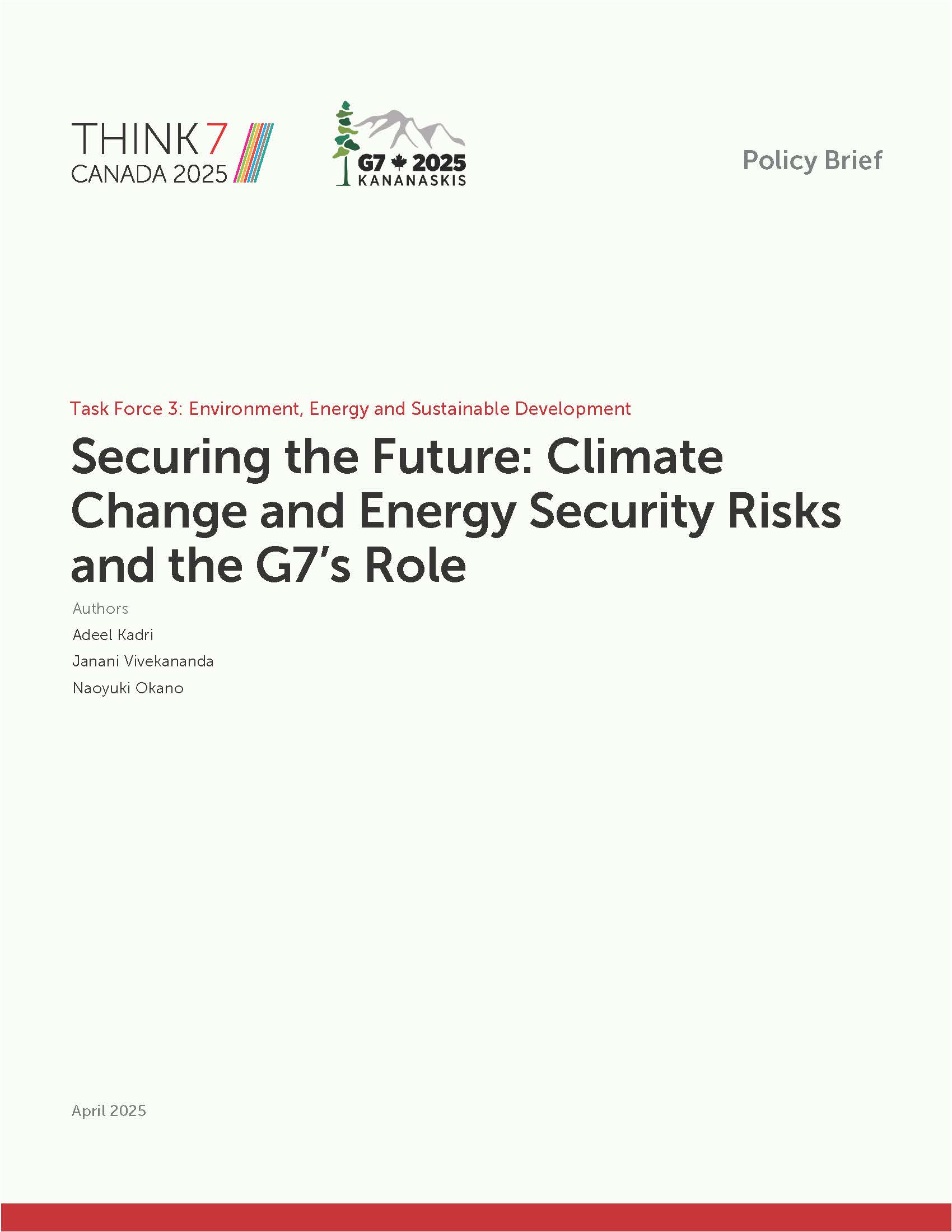
T7 (Think7) is an engagement group in which think tanks provide policy recommendations to the G7 based on their respective research findings. This time, as part of the outcomes of the IGES Asia-Pacific Climate Security Project (APCS), we jointly submitted recommendations with adelphi, a German think tank, and Manzil Pakistan, a Pakistani research institution. Each year, T7 sets several themes for recommendations that reflect the intentions of the country of presidency. This year, the themes are transformative technologies (AI and quantum technology); the digitalisation of the global economy; environment, energy, and sustainable development; and global peace and security.. Our proposal, “Ensuring Future Security: Climate Change and Energy Security Risks and the Role of the G7,” falls under the category of environment, energy, and sustainable development. The key points are as follows:
- ・ Climate change threatens national security and human security through indirect channels such as the collapse of livelihoods, migration, and instability of food and water resources, particularly in vulnerable regions around the world, including G7 countries.
- ・ G7 countries must harmonise the need for energy security with global climate goals. This includes accelerating the energy transition and decarbonisation while securing supply chains for critical mineral resources.
- ・ Critical minerals hold geopolitical significance due to their uneven distribution and concentration. G7 countries can mitigate geopolitical risks while promoting sustainable mining practices on a global scale by strengthening diplomatic and trade relations.
- ・ G7 countries must fulfill their commitments to climate justice for the Global South and strengthen multilateralism and international solidarity.
The Asia-Pacific Climate Security Project addresses a wide range of risks, including energy, food, and forced migration. In this recommendation, we emphasise the role of the G7 counties in addressing challenges in climate-vulnerable regions concentrated in the Global South, based on the findings of this study. We also focus on energy security and argue that the G7 countries should address geopolitical risks arising from the uneven distribution of critical minerals. These are perspectives that have not often been adequately addressed in traditional climate change mitigation and adaptation efforts, yet we think they are essential for strengthening climate action and achieving sustainable development. We hope that the messages we have put forward will catch the attention of many policymakers and lead to concrete actions.
※The contents presented in ‘Researcher’s Perspective’ are the views of the author(s) and do not necessarily reflect the views of IGES.
Relevant Publications
Relevant Projects

Relevant Events
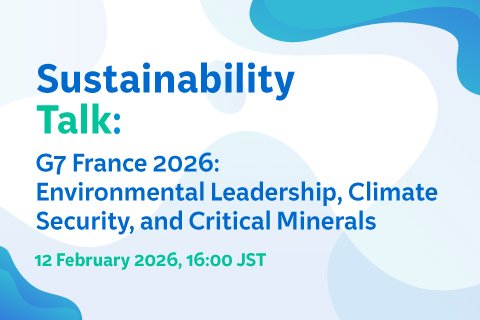
G7 France 2026: Environmental Leadership, Climate Security and Critical Minerals