

Results 31 to 40 of 83 (Sorted by date)
Book Chapter

In Implementing the Satoyama Initiative for the Benefit of Biodiversity and Human Well-being
The Satoyama Initiative is endorsed by the decision of the Tenth Conference of the Parties to the Convention on Biological Diversity (CBD COP 10) in 2010. It is a global effort with the vision to “realize societies in harmony with nature” through promotion and conservation of “socio-ecological production landscapes and seascapes” (SEPLS). The...
Conference Proceeding
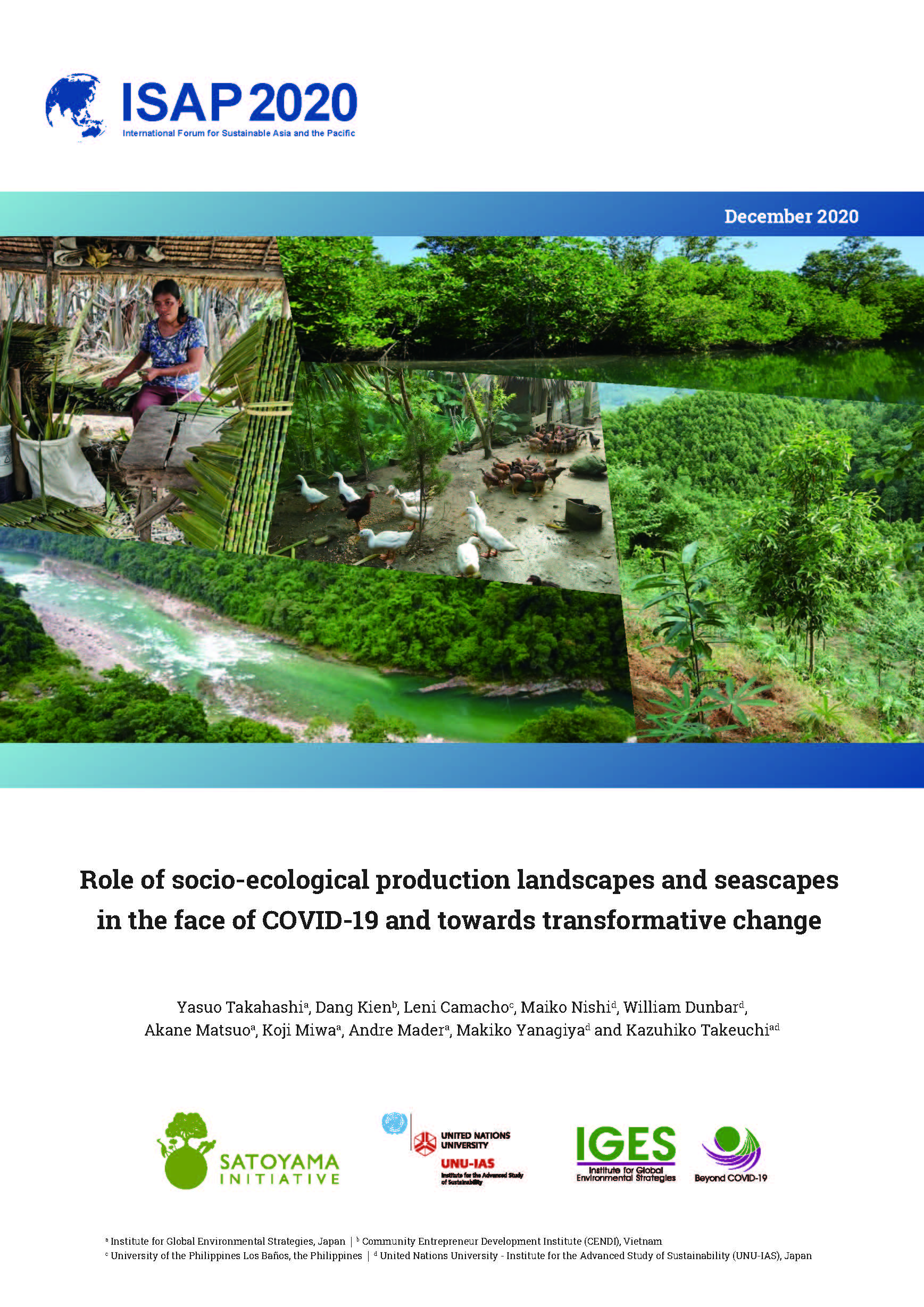
On Thursday 12 November 2020, United Nations University Institute for the Advanced Study of Sustainability (UNU-IAS) and Institute for Global Environmental Strategies (IGES) convened a session entitled “The Satoyama Initiative, transformative change, and societies in harmony with nature” at the 12th International Forum for Sustainable Asia and the...
Presentation
Earth League Annual Workshop
This presentation, delivered by Eric Zusman on behalf of IGES President Kazuhiko Takeuchi at the Earth League Annual Workshop on 20 October 2020, is entitled "Greening the COVID-19 Response, Recovery, and Redesign" and outlines the IGES Triple R Framework, the case for integrated approaches to respond to COVID-19, and potential applications of the...
Book
Editor:
Alexandros
Gasparatos
Merle
Naidoo
Abubakari
Ahmed
Alice
Karanja
Kensuke
Fukushi
The aim of this two-volume book series is to highlight some of the most pervasive sustainability challenges that Sub-Saharan Africa faces. The two volumes contain 20 chapters that illustrate very diverse sustainability challenges throughout the continent, adopting interdisciplinary and problem-oriented research approaches, and methods from the...
Book Chapter
In Sustainability Challenges in Sub-Sahara Africa II: Insights from Eastern and Southern Africa
The sustainability challenges that sub-Saharan Africa (SSA) faces tend to be multidimensional and span multiple Sustainable Development Goals (SDGs). Despite the inherent difficulty in solving them, such sustainability challenges also offer opportunities for achieving progress on multiple SDGs. This concluding chapter summarises the main...
Book Chapter
In Sustainability Challenges in Sub-Saharan Africa I: Continental Perspectives and Insights from Western and Central Africa
Despite significant progress over the past decades, Sub-Saharan Africa (SSA) remains the poorest and least developed region in the world. High levels of poverty, food insecurity and environmental degradation, as well as low access to infrastructure and low institutional capacity characterize many areas across the continent. There is a consensus...
Book
The aim of this 2-volume book is to highlight how Sustainability Science approaches can help solve some of the pervasive challenges that Africa faces. The volumes collect a number of local case studies throughout Africa that adopt transdisciplinary and problem-oriented research approaches using methodologies from the natural and the social sciences...
Presentation
Munhwa Future Report Session 2. Climate Crisis and Green New Deal
“Localisation of SDGs and Sustainable Growth in the Post-COVID Era”, a Presentation for the Munhwa Future Report on 3 September 2020 Munhwa Future Report 2020 is a forum for intellectual conversations with the purpose of looking ahead and highlighting the massive challenges facing human beings – such as poverty and starvation, economic polarization...
Peer-reviewed Article
In Sustainability Science
This study develops a projection model of future population distribution on the basis of Japan’s current depopulation trend and applies this model to scenario analyses that assume population compactification and dispersion. The model enables a description of population migration at two levels. First, municipal populations are projected using the...
Presentation

High Level Political Forum on Sustainable Development 2020 Side Event "Satoyama Initiative – Societies in Harmony with Nature: An inclusive approach for communities, landscapes and seascapes"
This presentation is about the critical role of socio-ecological production landscapes and seascapes (SEPLS) for the achievement of Sustainable Development Goals (SDGs) and the Post-2020 Global Biodiversity Framework. It overviews the Satoyama Initiative, including the Satoyama Development Mechanism, and discusses resilience in the face of COVID-19...
Results 1 to 9 of 9 (Sorted by date)
Project
Updated: October 2024
CBD COP16 Special Webpage
The Convention on Biological Diversity The Convention on Biological Diversity (CBD) is a multilateral environmental agreement on: (1) the conservation of biodiversity; (2) the sustainable use of the components of biodiversity; (3) the fair and...
Project
Updated: February 2023
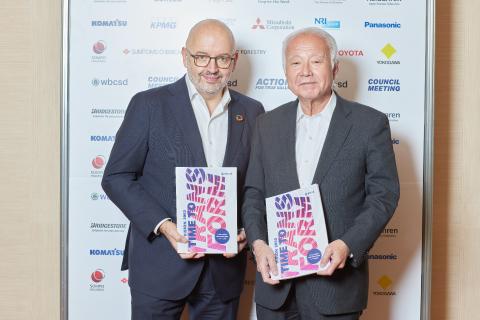
Vision 2050: Time to Transform -What actions are needed to bring about transformation?-
In October 2021, IGES published a Japanese translation of "Vision 2050 : Time to Transform" in cooperation with several Japanese companies and the World Business Council for Sustainable Development (WBCSD). Over one year later, the global situation...
Project
Updated: August 2022
Global Climate and SDG Synergy Conference
Calling for an integrative approach: Climate, SDGs and biodiversity Serious concerns were underlined at the 26th Conference of the Parties (COP26) to the United Nations Framework Convention on Climate Change (UNFCCC) regarding the current NDC targets
Project
Updated: July 2023
Sustainability Science journal
Sustainability Science probes interactions between global, social, and human systems, the complex mechanisms that lead to degradation of these systems, and concomitant risks to human well-being. The journal provides a platform for building...
Project
Updated: July 2020
IGES Activity on "High-level Political Forum on Sustainable Development (HLPF 2020)"
This special webpage presents reports and publications related to the High-level Political Forum on Sustainable Development (HLPF2020).
Project
Updated: July 2020
IGES Activity on "High-level Political Forum on Sustainable Development (HLPF 2019)"
This special webpage presents reports and publications related to the High-level Political Forum on Sustainable Development (HLPF), which as the main United Nations platform on sustainable development, is dedicated to the follow-up and review of the...
Project

Updated: October 2019
IPCC 48 - Special Report on Global Warming of 1.5°C
This is a special page containing information relevant to the 48th Session of the Intergovernmental Panel on Climate Change (IPCC), held in Incheon, Korea on 1-6 October 2018 and the its special report on Global Warming of 1.5°C.
Project
Updated: August 2023
IGES Inputs to Asia-Pacific Forum on Sustainable Development (APFSD)
APFSD is an annual meeting convened by the United Nations Economic and Social Commission for Asia and the Pacific (UNESCAP) aimed at strengthening the region’s readiness for the United Nations High-level Political Forum on Sustainable Development.
Project
Updated: August 2023
IGES Activity on "High-level Political Forum on Sustainable Development (HLPF)"
This special webpage presents publications related to the High-level Political Forum on Sustainable Development (HLPF), which as the main United Nations platform on sustainable development, is dedicated to the follow-up and review of the 2030 Agenda