Search

Results 2851 - 2860 of 6467 (Sorted by date)
Book Chapter
In SCOPING STUDY ON COMPOUND, CASCADING AND SYSTEMIC RISKS IN THE ASIA PACIFIC 2021
Author:
Vishnu Prasad
Pandey
Anil
Pohkrel
Rajendra
Sharma
Sanjaya
Giri
Nagendra
Kayastha
The ‘Scoping study on compound, cascading and systemic risks in the Asia-Pacific’, undertaken by the United Nations Office for Disaster Risk Reduction (UNDRR) and Asia Pacific Scientific and Technical Advisory Group (AP-STAG), presents an important opportunity to explore the challenges and potential associated with better understanding and managing...
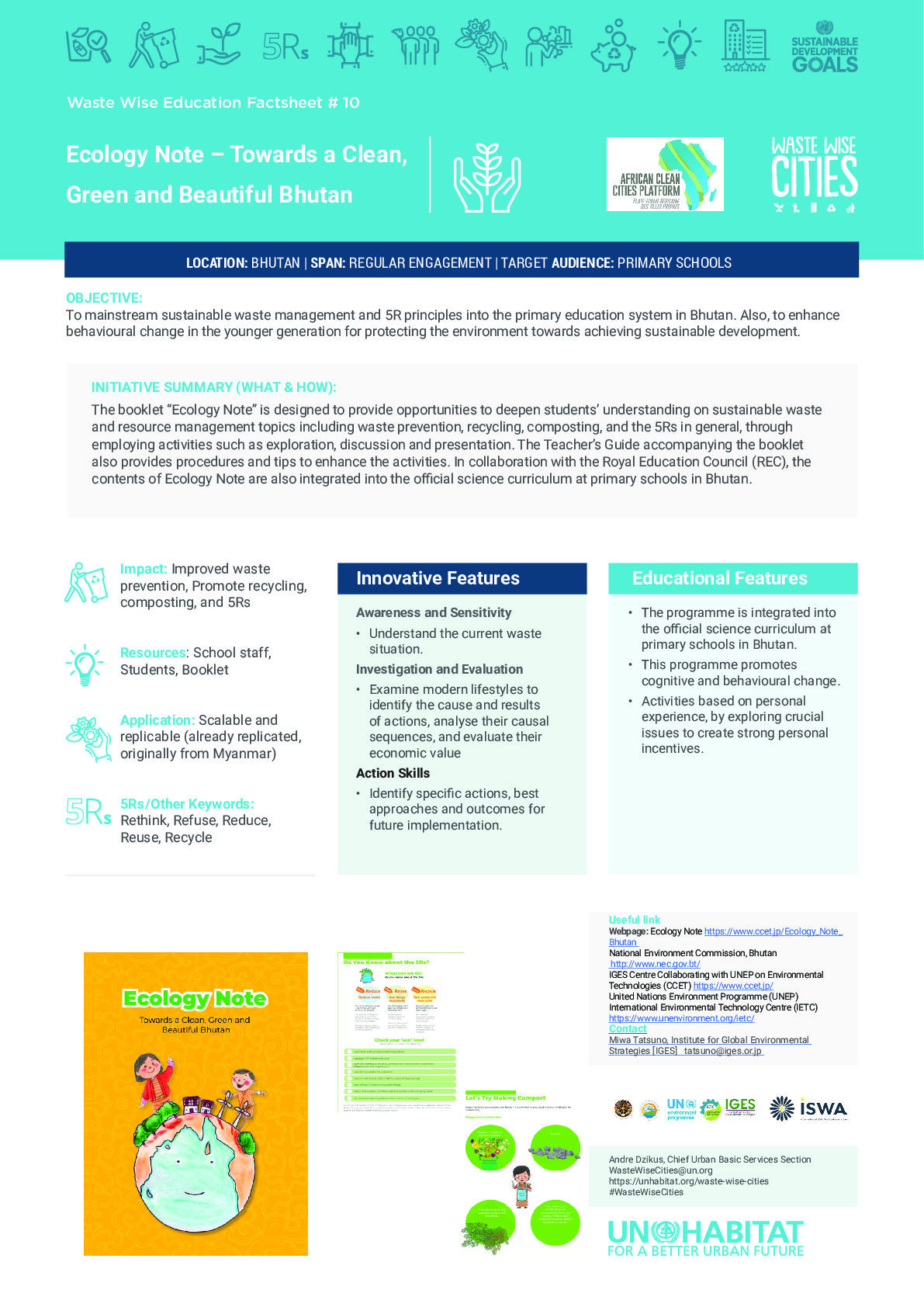
Fact Sheet
The booklet “Ecology Note” is designed to provide opportunities to deepen students’ understanding on sustainable waste and resource management topics including waste prevention, recycling, composting, and the 5Rs in general, through employing activities such as exploration, discussion and presentation. The Teacher’s Guide accompanying the booklet...
Keywords:
Working Paper
This paper provides an overview of progress on carbon taxes, emissions trading schemes (ETS) and voluntary carbon crediting mechanisms in Asia, identifying relevant policy gaps and giving suggestions based on the lessons and experiences with pertinent policy practices in this region. Overall, carbon pricing practices in Asia are still at an early...
Peer-reviewed Article
In Sustainability
Availability of water in the Ganges River basin has been recognized as a critical regional issue with a significant impact on drinking water supply, irrigation, as well as on industrial development, and ecosystem services in vast areas of South Asia. In addition, water availability is also strongly linked to energy security in the region. Hence...
Non Peer-reviewed Article
アジアの都市は,再エネのシェアの増加や多様な政 策措置の導入によるエネルギー効率の改善など,世界 的に合意されている気候変動の緩和策の目標に向けて すでにさまざまなレベルの取り組みを行ってきてい る。アジアの多くの都市も,ネットゼロへの取り組み を宣言してきている。いくつかの都市は,ネットゼロ に向けた計画と具体的な行動を公表した。しかし,ほ とんどの都市は利用できる資源や経験・能力が限られ ているために,2050 年までにネットゼロを達成する 長期計画を立てる課題に直面している。都市の境界内 で利用可能な再生資源が限られていることを考える と,都市単独でネットゼロを達成することは通常のア プローチでは極めて難しい。地域循環共生圏のアプロ ーチを採用すれば,農村地域との協力をネットゼロに...
Peer-reviewed Article
Author:
A city region is a unit comprising an urban core and surrounding peri-urban and, occasionally, rural areas. The Regional Circulating and Ecological Sphere (R-CES) proposed by the Japanese government is a guiding approach for policymaking that prioritises the harmonised flow of resources between urban and rural areas, low-carbon society, circular...
Peer-reviewed Article
In International Journal of Environmental Research and Public Health
Author:
Priyanaka
Mitra
Rajib
Shaw
Vibhas
Sukhwani
Md Abiar
Rahman
Sameer
Deshkar
Devesh
Sharma
Food, energy, and water (collectively referred to as ‘FEW’) security forms the key to human survival as well as socioeconomic development. However, the security of these basic resources is increasingly threatened due to growing demand. Beyond the widespread implications on public health, Coronavirus disease (COVID-19) has further raised additional...
Book Chapter
Author:
Vibhas
Sukhwani
Tomoko
Takeda
Rajib
Shaw
In addition to providing a range of social, economic, and environmental benefits to human societies, forest ecosystems also play a vital role in disaster prevention and mitigation. With the growing frequency and intensity of landslide hazards, the importance of forest management is increasingly being recognized to safeguard the sustainable delivery...
Book Chapter
In Groundwater for Sustainable Livelihoods and Equitable Growth
Author:
Paul
Pavelic
D.
Suhardiman
O.
Keovilignavong
C.
Clément
J.
Vinckevleugel
S.M.
Bohsung
K.
Xiong
L.
Valee
M.
Viossanges
S.
Douangsavanh
T.
Sotoukee
K.G.
Villholth
K.
Vongsathiane
Groundwater offers smallholder farmers in the lowlands of Lao PDR opportunities to diversify cropping beyond wet season paddy and thus enhance their livelihoods while reducing climate risks. This chapter focuses on evaluating existing and specifically developed groundwater irrigation options on the Vientiane Plain, and framing the findings around...
Policy Report
Carbon pricing instruments (CPIs) are being developed at different rates and in different forms in ASEAN Member States. The CPI survey focused on six AMS—Indonesia, Malaysia, the Philippines, Singapore, Thailand and Viet Nam (hereafter referred as AMS-6). Taking into account the availability of facility-level MRV guidelines as well as the sectoral...
Keywords: