
Results 1971 - 1980 of 5566 (Sorted by date)
Presentation

3rd Japanese- German Workshop on Renewable Energies
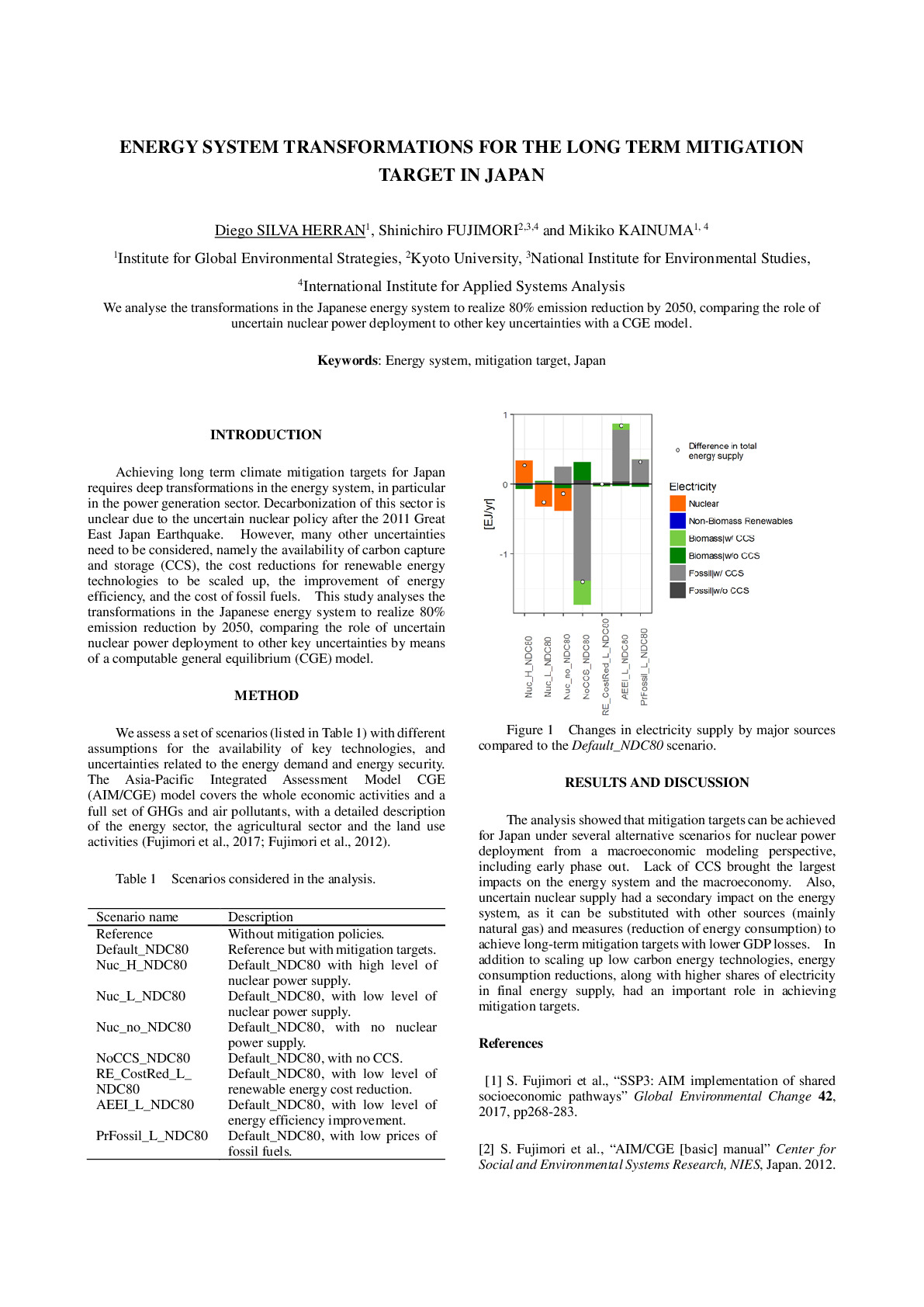
Achieving long term climate mitigation targets for Japan requires deep transformations in the energy system, in particular in the power generation sector. Decarbonization of this sector is unclear due to the uncertain nuclear policy after the 2011 Great East Japan Earthquake. However, many other uncertainties need to be considered, namely the...
Presentation
2018 Asia-Pacific Forum on Low Carbon Technology
Asian Development Bank (ADB) and Hunan Development and Reform Commission, China hosted the 2018 Asia-Pacific Forum on Low Carbon Technology and invited IGES as the discussant for the session on Perspectives from Global/Regional Alliances, Research and Advocacy Organizations on Coordinated Control and Management of Urban Carbon Emission Reduction...
Briefing Note
The 15th Annual Meeting of the Science and Technology in Society forum was held at the Kyoto International Conference Center from 7 to 9 October, 2018. The forum focused on lights and shadows of science and technology, and brought together global leaders in academia, industry and government from around 80 countries and regions, encouraging them to...
Presentation
Seminar on Renewable Energy Development in Mongolia
This presentation provides an update on renewable energy policies, technologies, and strategic focus in further renewable energy deployment towards a decarbonised future.
Report Chapter

In An IPCC special report on the impacts of global warming of 1.5 °C above pre-industrial levels and related global greenhouse gas emission pathways
This chapter frames the context, knowledge-base and assessment approaches used to understand the impacts of 1.5°C global warming above pre-industrial levels and related global greenhouse gas emission pathways, building on the IPCC Fifth Assessment Report (AR5), in the context of strengthening the global response to the threat of climate change...
Presentation
2018 Sustainable Development Transition Forum
The presentation addresses the question of how the HLPF can provide useful policy guidance.
Peer-reviewed Article
In Atmospheric environment
Black Carbon (BC) has been widely recognized as the second largest source of territorial and global climate change as well as a threat to human health. There has been serious concern of BC emission and its impact in Indo-Gangetic Plains (IGP) due to the use of biomass and fossil fuels for cooking, transportation and industrial activities. An...
Presentation
The World in 2050 (TWI2050) Seminar
This TWI2050 project seminar is being co-organised by UNU-IAS; the Japan Committee of the International Institute for Applied Systems Analysis (IIASA); the National Institute for Environmental Studies, Japan (NIES); and the Institute for Global Environmental Strategies (IGES); TWI2050 is a global research project developed to support the successful...
Conference Paper
3rd Japanese- German Workshop on Renewable Energies
Achieving long term climate mitigation targets for Japan requires deep transformations in the energy system, in particular in the power generation sector. Decarbonization of this sector is unclear due to the uncertain nuclear policy after the 2011 Great East Japan Earthquake. However, many other uncertainties need to be considered, namely the...
PR, Newsletter or Other
Southasiadisasters.net
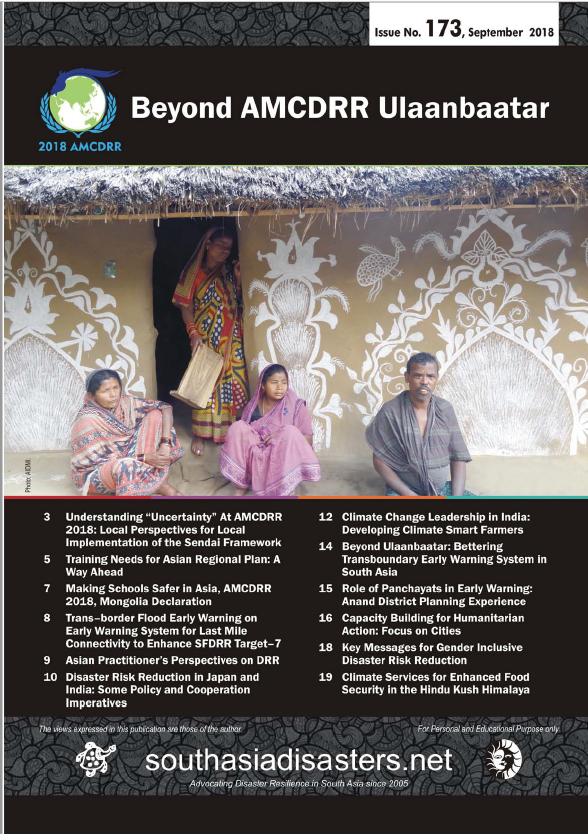
India and Japan are at different developmental progression pathways but they share a significant commonality in disaster risks. Both are among the most disaster-prone countries in the world. Yet, the approach they selected to disaster risk reduction (DRR) has significant differences. Realising the potential for cooperation in the field of DRR, both...
Keywords: